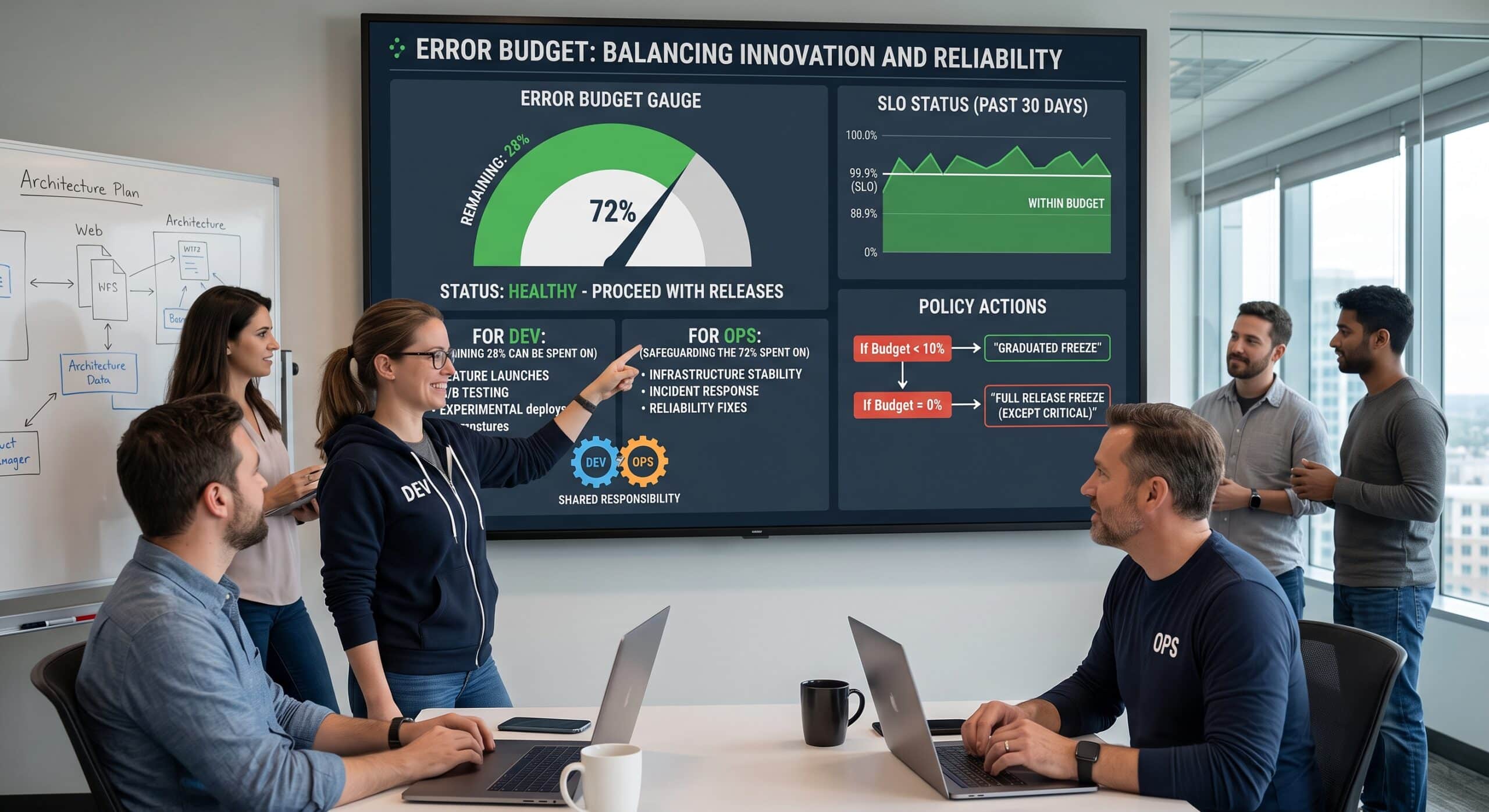
In Site Reliability Engineering, few operational friction points are as common as the battle between development velocity and system stability. I have spent enough time on production incidents to recognize the pattern. A release is ready, customers are waiting, and the development team wants to deploy. Operations sees a growing list of alerts, unresolved performance issues, and a service that has become harder to predict. The conversation quickly turns into a familiar argument:
- “Development does not understand production.”
- “Operations block every important launch.”
Both sides may be acting responsibly. Developers are trying to deliver value, while operations and reliability engineers are trying to protect customers from outages. The conflict exists because each group is often measured against a different definition of success.
Error budgets provide a practical way out.
An error budget turns reliability from a personal opinion into a shared operating agreement. Instead of asking whether a release “feels safe,” the team can ask a more useful question: how much unreliability can the service absorb before customer experience is harmed?
That question does not eliminate engineering judgment. It gives engineering judgment a common set of facts.
Why Dev and Ops Keep Colliding
Development teams are usually expected to deliver features, improve the product, respond to market pressure, and meet roadmap commitments. Their natural incentive is to increase the pace of change.
Operations teams have a different responsibility. They must keep services available, responsive, secure, and recoverable. Their natural incentive is to reduce unnecessary change and protect production.
Neither goal is wrong. The problem begins when one goal is treated as more legitimate than the other.
Without a shared reliability model, discussions become subjective:
- Developers say a release is important and low risk.
- Operations says the system has already experienced too many incidents.
- Product management asks both teams to compromise.
- Nobody can clearly define what compromise means.
This situation creates frustration on all sides. Developers may see reliability reviews as a final approval gate. Operations may feel forced to absorb every consequence of rushed delivery. Over time, both groups can become defensive.
The conflict is not really between people. It is a conflict between incentives, incomplete information, and unclear decision rights.
Site Reliability Engineering addresses this problem by treating reliability as an engineering feature with measurable objectives. The service has to be reliable enough to keep users satisfied, but it does not need to pursue an unrealistic goal of 100% availability. Core Site Reliability Engineering principles emphasize that extreme reliability can reduce innovation, increase cost, and limit the features a team can deliver.
What an Error Budget Means
The Simple Plain-Text Formula
Error Budget = 100% – Your Success Target (SLO)
Think of it as a simple math problem:
- 100% represents Total Perfection. This means your application never crashes, never slows down, and works flawlessly every second of the day.
- SLO (Service Level Objective) represents Realistic Success. This is the target reliability percentage you agree to give your users (for example, 99.9% uptime).
- Error Budget is Your Safety Margin. Whatever percentage is left over after subtracting your target from 100% is your budget for acceptable failure.
A Practical Example
If your team agrees that your application needs to be working 99.9% of the time to keep customers happy:
- You start with total perfection: 100%
- You subtract your realistic goal: 99.9%
- Your leftover Error Budget is: 0.1%
What This Means in Real Life
That remaining 0.1% is your safety allowance. It gives your team permission to take controlled risks—like releasing new code updates, installing security patches, or updating database hardware—knowing that even if something briefly breaks during those updates, you are still meeting your 99.9% reliability goal.
If your app stays within that 0.1% buffer, everyone is happy. If you break things so often that you exceed that 0.1% buffer, your error budget is gone, and developers must pause new features to focus purely on fixing stability.
SLOs Come Before Budgets
An error budget is only useful when it is based on a meaningful service-level objective. Choosing a random percentage and placing it on a dashboard will not resolve disagreements.
The SLO must describe something that matters to users. Common examples include:
- The percentage of successful requests.
- The percentage of requests completed below a latency threshold.
- The freshness of search, inventory, or reporting data.
- The percentage of records processed correctly.
- The durability of stored customer data.
- The percentage of jobs completed within an agreed time.
The underlying measurement is the service-level indicator (SLI). A useful SLI usually compares good events with total events. For instance, successful HTTP requests divided by total HTTP requests can represent availability, while requests completed within 400 milliseconds divided by total requests can represent a latency objective.
The best SLO is not necessarily the highest number the team can achieve. It is the level of service that customers need and the organization can defend without unsustainable toil.
A 100% SLO creates a serious operational problem. It leaves no room for ordinary failure, maintenance, or improvement. Every incident becomes a violation, and every change becomes unacceptable by definition. Standard Site Reliability Engineering frameworks describe 100% reliability as an unsuitable target because real systems and their surrounding dependencies cannot maintain perfection indefinitely.
As an SRE practitioner, I would rather work with a realistic 99.9% objective that everyone understands than an unofficial demand for perfection that nobody can consistently meet.
The Policy Makes the Difference
An error budget does not end conflict by itself. The organization must agree in advance about what happens when the budget is being consumed too quickly or has been exhausted.
A written policy should answer several practical questions:
- Who owns the SLO?
- Which events consume the budget?
- What happens when the budget reaches 50%, 75%, or 100%?
- Which types of releases are restricted?
- Who can authorize an exception?
- What reliability work receives priority?
- When can normal release activity resume?
- How are incidents and disputed measurements reviewed?
A simple policy might allow normal releases while the service is within its budget. If the service exhausts the budget during a rolling four-week period, the team might pause nonessential feature releases and prioritize reliability improvements, defect correction, rollback automation, dependency remediation, or capacity work.
That pause should not be framed as punishment. Modern Site Reliability Engineering methodologies explicitly describe change halts as a way to give teams permission to focus on reliability rather than as a disciplinary response.
This distinction matters. If a budget freeze is treated as blame, developers will hide risk and operations will become an enforcement department. If it is treated as a pre-agreed engineering response, the team can act quickly without reopening the same argument during every incident.
The policy should also include exceptions. A security fix, urgent data-protection change, or emergency mitigation may need to proceed even when the budget is exhausted. Those exceptions should be documented and reviewed, not used as a loophole for routine feature work.
How Budgets Align Incentives
The most powerful feature of an error budget is that it gives development and operations the same incentive.
When the service has budget remaining, developers have room to move quickly. They can release features, run experiments, and improve the product without asking operations to approve every individual decision.
When the budget is nearly gone, developers have a reason to slow down. They do not need to be persuaded that testing, safer rollout practices, or reliability work matter. A failed deployment may consume the remaining budget and delay their own roadmap.
This is a much healthier relationship than one in which operations or SRE teams act as permanent gatekeepers.
Consider a team preparing a major checkout change. The developers have completed functional testing, but the service has already used 80% of its monthly error budget because of elevated latency and two deployment-related incidents.
Under an informal process, operations might reject the release while developers argue that the change is unrelated to the previous incidents.
Under an error-budget policy, the discussion becomes more concrete. The team might choose a smaller canary, increase rollback readiness, delay the launch until latency improves, or proceed only with a limited percentage of traffic. The decision is based on current reliability risk rather than on which group argues more forcefully.
The budget also exposes the cost of excessive reliability demands. If a team continually exceeds its SLO while delivering little product value, the target may be too strict, the measurement may be wrong, or the service may need additional investment. If the team never comes close to using its budget and releases are unnecessarily slow, the organization may be overengineering the service.
Reliability should be high enough to protect users, not so high that it prevents useful progress
The Misuse of Error Budgets
An error budget can be misused. The most common mistake is treating it as a quota that teams are expected to consume.
That mindset encourages careless releases near the end of a measurement window. It also treats failures as acceptable merely because a mathematical allowance remains. A better approach is to use the budget as a risk signal.
Tracking Consumption with Burn-Rate Alerts
Track both the amount of budget remaining and the rate at which it is being consumed. A service that has used 30% of its budget over three weeks may be healthy, whereas a service that uses 30% in ten minutes is in immediate danger.
This is where burn-rate monitoring becomes useful. The team can define alerts for rapid budget consumption over multiple time windows. A fast burn rate triggers investigation and rollback before the entire budget disappears.
Categorizing the Drivers of Budget Loss
The dashboard should explicitly show the root causes of budget consumption. Useful categories include:
- Failed deployments or incorrect configurations
- Dependency outages and network failures
- Capacity exhaustion and database performance bottlenecks
- Application defects and unhandled traffic patterns
- Monitoring or classification errors
The objective is not to create a sophisticated blame report, but to identify which engineering investments will effectively reduce future customer impact.
Post-Incident Reviews and Systemic Questions
A single outage that consumes a significant portion of the budget (e.g., 20%) should trigger a post-incident review and high-priority corrective action.
The review must focus strictly on systems and decisions rather than individual mistakes:
- Why was the failure possible, and why did testing miss it?
- Why did monitoring not identify it sooner, and why was rollback difficult?
- Which dependency amplified the incident?
- What structural changes will reduce the probability or impact of recurrence?
Error Budgets and Performance Engineering
Reliability is not limited to uptime. A service can be technically available while being too slow to use.
For that reason, performance objectives should often be part of the error-budget conversation. A web service may have a 99.9% availability objective and a separate latency objective requiring 99% of requests to complete within a defined threshold.
This approach prevents teams from hiding performance degradation behind successful status codes. If customers abandon a workflow because it takes ten seconds, a system that returns HTTP 200 responses is not delivering a reliable experience.
Performance-related budget consumption can come from:
- Increased tail latency
- Queue growth
- Resource saturation
- Slow database queries
- Garbage-collection pauses
- Dependency contention
- Inefficient caching
- Traffic spikes
- Excessive retries
The correct response is not always “add more machines.” The team may need to improve request prioritization, introduce load shedding, optimize a query, reduce payload size, revise a timeout, or isolate workloads with different reliability requirements.
Error budgets help rank these improvements. A performance project that prevents repeated customer-visible failures may be more valuable than a project that improves an internal benchmark with no measurable user benefit.
A Practical Adoption Plan
Organizations do not need to implement a complete Site Reliability Engineering program in one large project. A small team can begin with one service and one meaningful objective.
Start by identifying the service’s most important user journey. Define the good outcome in terms that can be measured. Select a simple SLI, such as successful requests divided by total requests, and establish an initial SLO below 100%.
Then agree on a four-week rolling window or another period appropriate for the service. Standard Site Reliability Engineering guides identify a four-week rolling window as a useful general-purpose interval because it supports timely decisions while smoothing short-term variation.
Next, publish the policy. Do not keep it in an internal conversation where only a few engineers know the rules. Product managers, developers, SREs, support teams, and stakeholders should be able to see the objective, measurement, and response.
After that, connect the budget to ordinary engineering processes:
- Review budget health during sprint planning.
- Discuss major changes alongside their expected reliability risk.
- Include reliability work in the product roadmap.
- Use incidents to refine SLOs and measurement.
- Review the policy at least quarterly.
- Record exceptions and the reasoning behind them.
The first version will not be perfect. That is normal. An SLO that fails to reflect customer experience should be refined. A budget that triggers too many false alarms needs better measurement. A policy that nobody follows needs stakeholder agreement or clearer ownership.
The goal is not to create a perfect reliability system. The goal is to create a feedback loop that improves decisions over time.
What Error Budgets Cannot Fix
Error budgets cannot repair a culture that refuses to honor agreements. If leaders override every freeze for commercial reasons, the budget becomes a decorative metric. If team members use the policy to reject all change, the organization will lose the balance that makes Site Reliability Engineering so valuable.
The measurements can also be misleading. A server-side success rate may look healthy while customers experience browser failures, slow pages, or broken workflows. The team must periodically compare its SLIs with support cases, customer feedback, incident records, and business outcomes.
Error budgets are also not a replacement for good engineering. They do not eliminate the need for testing, observability, capacity planning, incident response, disaster recovery, security controls, or thoughtful architecture.
What they do is connect those practices to an explicit decision framework.
Frequently Asked Questions
What is an error budget in Site Reliability Engineering?
An error budget is the amount of failure or unreliability a service can experience while still meeting its SLO. For a 99.9% objective, the error budget is 0.1% of the measured events or time in the selected window.
Does an error budget mean failures are acceptable?
No. It means the organization has acknowledged that some failure is unavoidable in a changing, distributed system. The budget provides room for responsible risk-taking while preserving a clear response when reliability falls below the agreed level.
Who owns the error budget?
The product owner, development team, and SRE or operations team should share responsibility. Product defines the customer need, developers control much of the change risk, and engineers help measure and defend the service objective.
Should releases stop when the budget is exhausted?
Often, nonessential feature releases should pause while the team restores reliability. The exact response should be defined in advance and should allow exceptions for urgent security fixes, emergency mitigation, and changes that directly address the reliability problem.
What is a good starting SLO for teams adopting Site Reliability Engineering?
Start with one critical user journey and a simple, measurable objective. Availability and latency are common starting points, but freshness, correctness, durability, and processing completion may be more meaningful for other systems.
How often should error budgets be reviewed?
Teams should monitor them continuously, discuss them during regular planning, and review the SLO and policy periodically. A four-week rolling window can support operational decisions, while quarterly reviews can support larger investment choices.
Can error budgets measure performance as well as availability?
Yes. A service can define a budget for slow requests, excessive queue time, stale data, failed jobs, or another customer-relevant performance condition. Reliability is broader than uptime.
What happens if the SLO is unrealistic?
The team should revisit the SLI, the measurement method, the target, and the available engineering capacity. An SLO that cannot be defended without excessive toil is not a useful operating objective.
Key Web References & Links
- Google SRE Book (Chapter 3: Embracing Risk)
- URL: https://sre.google/sre-book/embracing-risk/
- Context: The foundational origin of Error Budgets. Outlines how Google SREs use mathematical reliability targets to balance velocity against risk, removing emotion from feature release decisions.
- Atlassian Incident Management Guide
- URL: https://www.atlassian.com/incident-management/kpis/error-budget
- Context: Explains how error budgets serve as a bridge between development agility and operational stability, defining how teams can safely consume allowable downtime.
- OpenObserve Engineering Blog
- URL: https://openobserve.ai/blog/error-budgets-explained/
- Context: Practical breakdown of error budget policies, burn rates, graduated tiers (Healthy, Watch, Critical, Frozen), and defining what actually freezes when a budget is depleted.
- Sumo Logic SRE Glossary
- URL: https://www.sumologic.com/glossary/error-budget
- Context: Details how SLIs, SLOs, and SLAs interact, including how product owners and engineering leads use error budgets as objective data points to govern release freezes.
- Motadata SRE Guide
- URL: https://www.motadata.com/blog/sre-error-budget
- Context: Focuses on tracking burn rates, balancing innovation against reliability, and avoiding common pitfalls like using SLAs instead of operational SLOs.
- Nobl9 SLO & Error Budget Guide
- URL: https://www.nobl9.com/service-level-objectives/error-budget
- Context: Deep dive into SLO calculations, burn-rate alerting thresholds, and structuring composite error budgets around user journeys.
Error budgets do not make developers and operations agree on every technical decision. They do something more valuable: they give both groups a shared definition of acceptable risk, a shared view of customer impact, and a pre-agreed response when reliability begins to suffer.
That is how the argument changes. Devs can move quickly when the service is healthy. Ops can demand focused stabilization when the evidence shows that customers are paying the price. The decision belongs neither to the loudest developer nor to the most cautious operator. It belongs to the reliability data and the policy the team agreed to follow under a unified Site Reliability Engineering strategy.