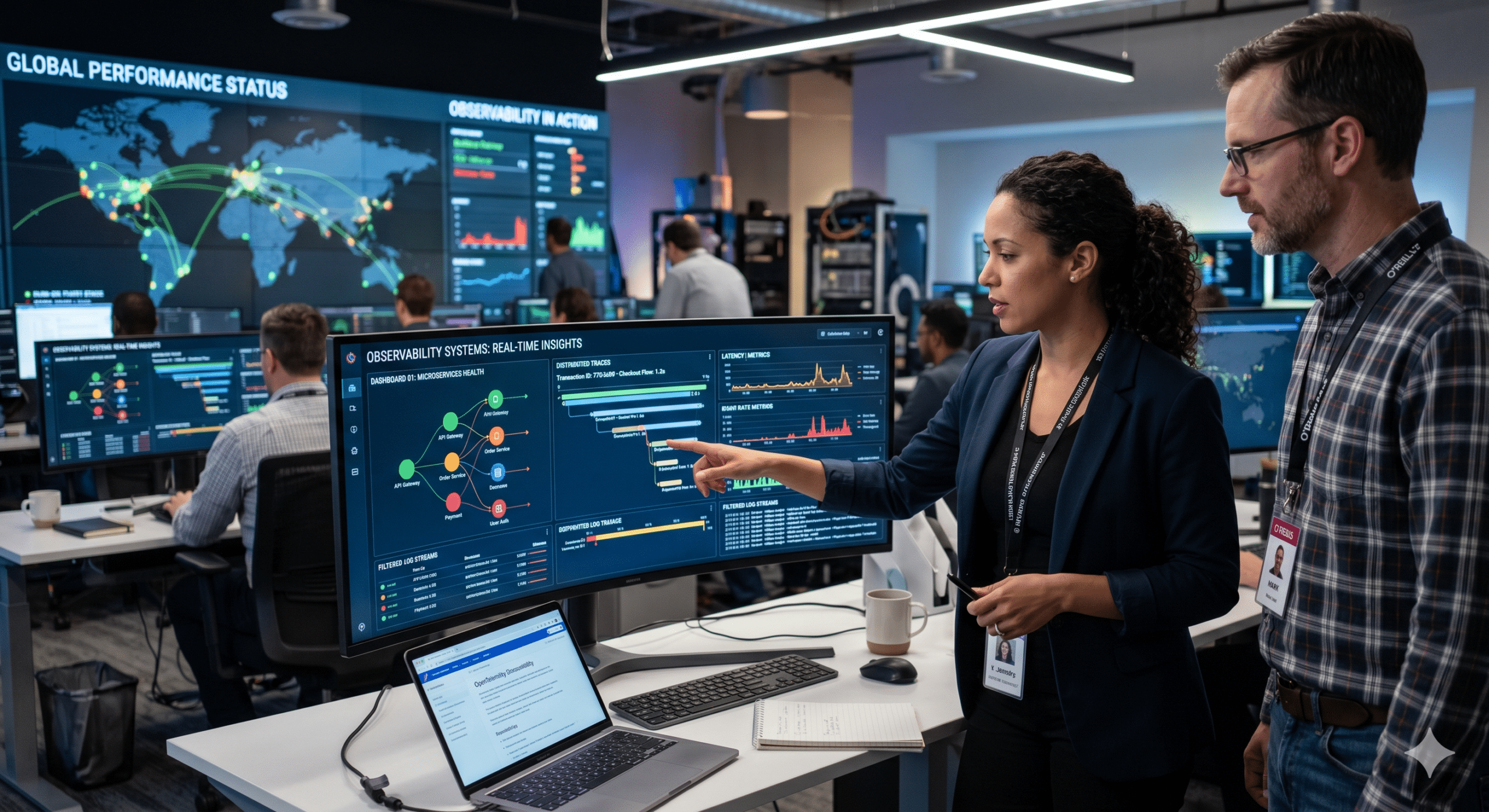
Modern enterprises have become incredibly dependent on technology. Every customer interaction, online purchase, employee workflow, financial transaction, support request, and business decision is connected to a growing ecosystem of applications, databases, cloud platforms, APIs, networks, and third-party services. As organizations continue investing in digital transformation, artificial intelligence, cloud migration, automation, and data-driven decision-making, their technology environments become more powerful, but also significantly more complex. From my perspective as a Systems Architect and Systems Designer, one of the biggest challenges organizations face today is no longer building technology. The real challenge is understanding what that technology is doing at any given moment and quickly identifying why something is not working when problems occur. This is where Observability Systems have become one of the most important disciplines in Enterprise Architecture and Systems Design.
Many executives still think of observability as another IT monitoring tool or a dashboard that infrastructure teams use to watch servers. In reality, observability is much more than that. It is a strategic capability that allows organizations to gain deep visibility into how systems behave, interact, perform, and respond under real-world conditions. As enterprise environments continue to evolve toward distributed architectures, microservices, hybrid cloud deployments, and AI-powered applications, observability is becoming the foundation that enables organizations to maintain reliability, improve customer experiences, reduce operational risks, and make informed business decisions.
The organizations that succeed in the digital economy are not necessarily the ones with the most advanced technology stacks. They are often the organizations that can see, understand, and respond to what is happening inside their technology ecosystems faster than their competitors. Observability Systems provide that visibility, and that visibility creates a significant competitive advantage.
Why Observability Systems Matter More Than Ever
There was a time when enterprise applications were relatively simple. A company might operate a single business application running on a dedicated server inside its own data center. Monitoring was straightforward because administrators only needed to watch a handful of systems. If a server became unavailable, an alert was triggered, and the problem could usually be isolated quickly.
Today’s enterprise environments look entirely different.
A customer opening a mobile banking application might unknowingly interact with dozens of services before seeing their account balance. The request could pass through authentication services, API gateways, fraud detection systems, cloud databases, security platforms, analytics engines, payment processors, and external integrations. Each of these components may be hosted in different locations, managed by different teams, and operating on different technology platforms.
As systems become increasingly interconnected, troubleshooting becomes significantly more difficult. When a customer reports that a transaction failed, the problem could originate from almost anywhere within the ecosystem. Traditional monitoring may indicate that all servers are operational, yet customers are still experiencing issues. This is because modern technology environments require visibility beyond infrastructure health.
Observability Systems solve this challenge by helping organizations understand not only whether something is working, but also why it is working, why it is failing, and how different components influence one another. This deeper understanding allows technical teams to identify root causes faster, reduce downtime, and maintain higher levels of service reliability.
From an architectural perspective, observability transforms technology management from reactive firefighting into proactive operational intelligence.
The Evolution from Monitoring to Observability
One of the most common misconceptions I encounter is the belief that monitoring and observability are the same thing. While they are related, they serve different purposes.
Monitoring focuses on predefined conditions. Organizations establish thresholds, configure alerts, and track specific metrics. For example, teams might monitor CPU utilization, memory consumption, network traffic, database response times, or application availability. When a metric exceeds an established threshold, an alert is generated.
This approach works well when teams already know what they are looking for.
However, modern enterprise environments frequently experience unexpected behaviors that do not fit predefined patterns. New software deployments, changing customer behavior, cloud infrastructure modifications, and third-party service dependencies can create issues that traditional monitoring was never configured to detect.
Observability addresses this limitation by providing the ability to investigate unknown problems. Rather than simply generating alerts, observability enables teams to explore system behavior, identify hidden relationships, and understand complex interactions occurring across distributed environments.
The distinction may appear subtle, but it fundamentally changes how organizations manage technology. Monitoring tells you that something is wrong. Observability helps you understand why it is wrong and how to fix it.
This capability becomes increasingly valuable as organizations continue adopting cloud-native architectures and large-scale digital platforms.
Understanding the Core Components of Observability Systems
At the heart of every observability strategy are three critical sources of telemetry data: metrics, logs, and traces. Together, they provide a comprehensive view of system behavior and operational performance.
Metrics serve as quantitative measurements that help organizations understand trends and performance over time. These measurements may include transaction volumes, response times, error rates, throughput, resource utilization, customer activity, and infrastructure performance indicators. Metrics provide valuable insight into overall system health and help teams quickly identify abnormal behavior before it develops into a major incident.
Logs provide detailed records of events occurring throughout applications and infrastructure components. Every user action, application process, security event, database operation, and system transaction can generate log data. When properly collected and analyzed, logs offer detailed context that helps teams understand precisely what occurred during a specific event or failure.
Distributed tracing adds another layer of visibility by following requests as they travel across interconnected systems. In modern architectures where a single transaction may involve dozens of services, traces reveal how requests move through the environment and where delays, bottlenecks, or failures occur.
From a systems architecture perspective, these three elements work together to create a complete operational picture. Metrics reveal symptoms, logs provide evidence, and traces expose relationships. Organizations that successfully integrate all three pillars achieve a level of visibility that dramatically improves operational effectiveness.
Why Enterprise Architects Must Prioritize Observability
Observability is often viewed as a responsibility of DevOps teams, Site Reliability Engineers, or infrastructure specialists. While these groups certainly play important roles, observability should begin at the architectural level.
The most successful enterprise systems are designed with observability embedded from the beginning rather than added later as an afterthought.
When architects incorporate observability principles into system design, every component generates meaningful telemetry data. Every transaction becomes traceable. Every service exposes relevant performance metrics. Every application produces actionable operational insights.
This architectural approach creates substantial long-term benefits.
Organizations gain the ability to understand customer journeys across multiple systems. They can identify performance bottlenecks before users complain. They can evaluate the impact of new deployments with greater confidence. They can measure service reliability using real-world operational data rather than assumptions.
Perhaps most importantly, they can align technology performance directly with business outcomes.
As a Systems Architect, I often emphasize that technology should never exist in isolation. Every technical decision ultimately influences customer experience, operational efficiency, revenue generation, compliance requirements, or strategic objectives. Observability bridges the gap between technical operations and business performance.
The Relationship Between Observability and Customer Experience
Many organizations underestimate how closely observability is connected to customer satisfaction.
Customers rarely care about servers, databases, APIs, or cloud infrastructure. What they care about is whether a service works when they need it.
When applications load slowly, transactions fail, websites become unavailable, or mobile experiences degrade, customers become frustrated. In highly competitive industries, even minor disruptions can result in lost revenue and damaged brand reputation.
Observability provides organizations with the ability to detect customer-impacting issues before they become widespread problems.
Instead of waiting for support tickets to arrive, teams can identify abnormal patterns, investigate root causes, and implement corrective actions proactively. This creates a more stable and reliable experience for customers while reducing operational stress for technical teams.
In many ways, observability has become one of the most effective tools for protecting customer trust.
Observability in Cloud-Native Enterprise Environments
The rise of cloud computing has dramatically increased the importance of observability.
Traditional infrastructure environments were relatively predictable. Servers remained in fixed locations, workloads changed gradually, and dependencies were easier to understand.
Cloud-native architectures operate very differently.
Applications may scale automatically in response to demand. Containers can be created and destroyed within seconds. Workloads may move across regions dynamically. Services often communicate through APIs that span multiple cloud providers and external platforms.
This dynamic nature creates tremendous flexibility but also introduces significant operational complexity.
Without observability, organizations struggle to understand what is happening inside these rapidly changing environments.
Cloud-native observability enables architects and operations teams to maintain visibility despite constant change. By collecting telemetry data continuously and analyzing system behavior in real time, organizations can maintain operational control while taking full advantage of cloud scalability and agility.
The Financial Value of Observability Systems
One of the most overlooked benefits of observability is its impact on cost optimization.
Many organizations initially invest in observability to improve reliability and reduce downtime. However, they often discover substantial financial benefits that extend far beyond incident management.
Cloud spending continues to increase across nearly every industry. Unfortunately, many organizations lack visibility into how resources are actually being utilized. As a result, they frequently overprovision infrastructure, maintain unused services, and allocate resources inefficiently.
Observability provides the operational data necessary to identify these inefficiencies.
Architects can analyze workload behavior, understand resource consumption patterns, and make informed decisions regarding capacity planning. Infrastructure investments become more strategic because decisions are based on measurable data rather than assumptions.
Over time, these optimizations can generate significant savings while simultaneously improving performance.
The Future of Observability in the Age of Artificial Intelligence
Artificial Intelligence is introducing a new generation of enterprise complexity.
Organizations are rapidly deploying AI-powered chatbots, recommendation engines, predictive analytics systems, intelligent automation platforms, and autonomous decision-making tools. These technologies create new opportunities but also introduce new operational risks.
Traditional monitoring approaches were designed primarily for infrastructure and application performance. AI systems require additional visibility.
Organizations must understand model behavior, prediction accuracy, data quality, inference latency, and decision outcomes. They need visibility into how AI systems interact with enterprise applications and influence business processes.
Observability is evolving to meet these requirements.
Future observability platforms will likely combine operational telemetry with AI governance capabilities, enabling organizations to monitor not only system performance but also the behavior and effectiveness of intelligent systems.
This evolution represents one of the most important trends shaping the future of Enterprise Architecture.
Building an Effective Observability Strategy
Successful observability initiatives do not begin with technology selection. They begin with business objectives.
Organizations should first identify the services, processes, and customer journeys that are most critical to operational success. Once these priorities are understood, architects can design telemetry strategies that support meaningful visibility.
The focus should always remain on generating actionable insights rather than collecting excessive amounts of data.
Many organizations make the mistake of gathering enormous volumes of telemetry information without establishing clear objectives for how that data will be used. This approach often creates complexity without delivering meaningful value.
A successful observability strategy aligns technical visibility with business priorities. It provides stakeholders with relevant information, supports rapid decision-making, and enables continuous improvement across the enterprise.
When implemented effectively, observability becomes far more than an operational capability. It becomes a strategic asset that supports innovation, resilience, and long-term growth.
Conclusion
Observability Systems have emerged as one of the most important disciplines in modern Enterprise Architecture and Systems Design. As organizations continue embracing cloud computing, distributed systems, artificial intelligence, digital transformation, and increasingly complex technology ecosystems, the ability to understand system behavior in real time has become a business necessity.
The most successful enterprises recognize that reliability, performance, customer satisfaction, and operational efficiency all depend on visibility. They understand that building technology is only part of the challenge. Equally important is understanding how that technology behaves under real-world conditions and responding quickly when issues arise.
From a Systems Architect’s perspective, observability represents a fundamental shift in how organizations manage complexity. It transforms reactive troubleshooting into proactive intelligence. It enables faster decision-making, stronger reliability, lower operational costs, and better customer experiences.
As enterprise environments continue evolving, observability will become even more critical. Organizations that invest in observability today will be better equipped to manage tomorrow’s challenges, support future innovations, and maintain the operational excellence required to succeed in an increasingly digital world.
Frequently Asked Questions
What are Observability Systems?
Observability Systems are technologies and practices that provide visibility into application performance, infrastructure behavior, and system interactions through metrics, logs, traces, and telemetry data.
Why are Observability Systems important?
They help organizations detect issues faster, identify root causes, improve reliability, optimize performance, reduce downtime, and support better business decision-making.
How is observability different from monitoring?
Monitoring focuses on predefined alerts and known conditions. Observability enables teams to investigate unknown issues and understand complex system behavior.
What industries benefit from observability?
Virtually every industry benefits from observability, including banking, healthcare, manufacturing, retail, telecommunications, logistics, government, and technology services.
Is observability only for cloud environments?
No. While observability is especially valuable in cloud-native architectures, it also provides significant benefits for on-premises systems, hybrid environments, and traditional enterprise applications.