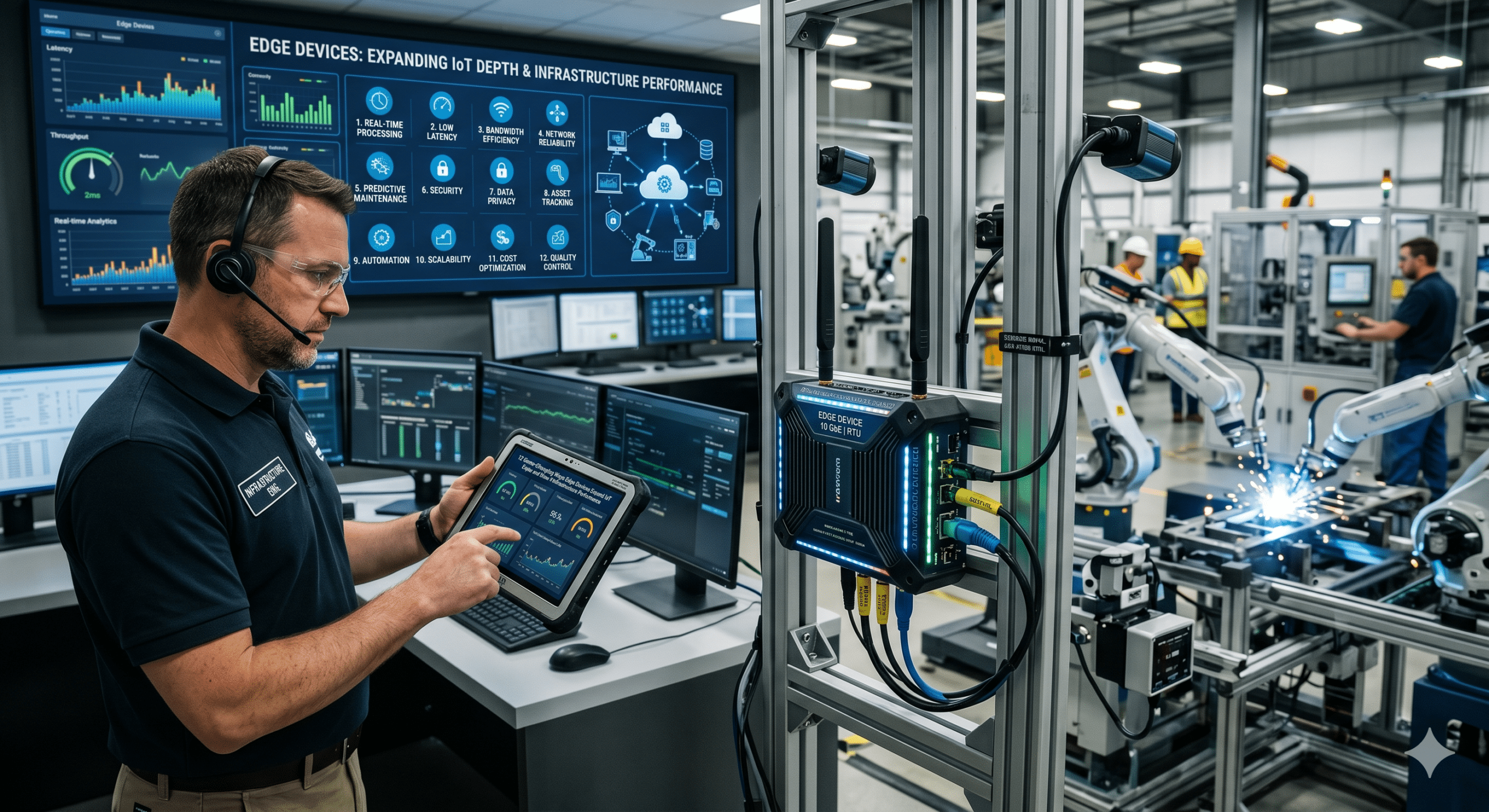
As a Data Center Architect and Network Engineer, I have witnessed the Internet of Things evolve from a promising concept into a critical component of modern infrastructure. Years ago, organizations focused primarily on connecting devices and collecting data. However, as IoT deployments expanded, businesses quickly discovered that simply gathering information was not enough. Instead, the real challenge became turning that information into actionable insights fast enough to improve operations.
Today, organizations are under constant pressure to increase throughput, shorten cycle times, and reduce waste. Consequently, traditional centralized computing models are beginning to show their limitations. While cloud platforms remain valuable, they often introduce delays that can affect operational efficiency. Therefore, many enterprises are moving intelligence closer to where data is generated.
This is where Edge Devices are making a significant difference.
Rather than sending every piece of information to a distant data center for analysis, Edge Devices process data near the source. As a result, systems can react faster, make better decisions, and operate more efficiently. Moreover, this approach reduces network congestion while improving reliability.
From a Hardware & Infrastructure Systems perspective, Edge Devices are no longer optional enhancements. Instead, they are becoming foundational technologies that help organizations maximize throughput, reduce cycle times, and minimize scrap rates across complex environments.
Understanding What IoT Depth Really Means
Many discussions about IoT focus on the number of connected devices. However, the true value of IoT lies in something much deeper.
IoT depth refers to the ability of an organization to collect, process, analyze, and act on information throughout multiple layers of operations. In other words, it measures how effectively data is transformed into decisions that improve business performance.
For example, a factory may have thousands of sensors monitoring equipment, temperatures, and production output. Nevertheless, if the collected data takes several seconds to process and respond to, operational opportunities may be lost. Consequently, equipment issues may worsen, production delays may increase, and quality problems may go unnoticed.
By contrast, organizations with strong IoT depth can identify issues almost immediately. As a result, they can respond faster, prevent disruptions, and maintain higher levels of efficiency.
This is precisely why Edge Devices have become so important. Rather than relying solely on centralized systems, they bring intelligence closer to the operational environment. Therefore, businesses can make faster decisions while improving overall performance.
Why Traditional Architectures Create Performance Bottlenecks
Historically, most IoT architectures were designed around centralized processing. Data collected from sensors would travel across networks to centralized servers or cloud platforms before being analyzed.
At first, this approach worked well. However, as IoT deployments grew, new challenges began to emerge.
For instance, thousands of connected devices generate enormous amounts of information every second. Consequently, networks become busier, storage requirements increase, and processing workloads expand significantly.
Furthermore, every step in the data journey introduces additional latency. Data must be transmitted, received, processed, analyzed, and returned before action can occur. As a result, response times increase.
From a throughput perspective, these delays can become expensive. Production lines may continue operating with incorrect settings. Likewise, quality issues may spread throughout multiple production batches before they are detected.
Therefore, organizations seeking higher performance are increasingly adopting Edge Devices to reduce dependency on centralized processing and accelerate decision-making.
1. Local Data Processing Significantly Improves Throughput
One of the most important advantages of Edge Devices is their ability to process information locally.
Traditionally, raw sensor data would travel to a central platform for analysis. However, Edge Devices perform processing much closer to the source. As a result, organizations eliminate unnecessary delays associated with network transmission and centralized computation.
For example, a machine vision system inspecting products on an assembly line can identify defects instantly. Instead of waiting for cloud analysis, the system can make immediate decisions regarding product acceptance or rejection.
Consequently, production lines continue operating smoothly without interruptions. Furthermore, operators receive immediate feedback when issues arise.
From a network engineering standpoint, local processing also reduces bandwidth consumption. Because only relevant information is transmitted across the network, communication channels remain available for critical business applications.
Therefore, throughput improves while infrastructure resources are utilized more efficiently.
2. Faster Decisions Lead to Shorter Cycle Times
Cycle time is one of the most important measurements in any operational environment. Simply put, it represents the amount of time required to complete a process from start to finish.
The shorter the cycle time, the more productive an organization becomes.
Unfortunately, traditional architectures often introduce delays because every decision depends on centralized processing systems. As data volumes increase, these delays become more noticeable.
Edge Devices address this challenge by enabling real-time decision-making.
For example, robotic manufacturing systems frequently rely on sensor feedback to adjust positioning and movement. With edge processing, those adjustments occur immediately. Consequently, machines spend less time waiting for instructions.
Moreover, faster responses allow organizations to complete more production cycles within the same operational period. As a result, overall capacity increases without requiring major facility expansions.
Meanwhile, employees spend less time addressing avoidable delays and more time focusing on value-added activities.
Therefore, Edge Devices play a direct role in reducing cycle times across modern industrial environments.
3. Real-Time Quality Monitoring Reduces Scrap Rates
Every defective product represents wasted materials, labor, energy, and machine capacity. Therefore, minimizing scrap rates remains a priority for manufacturers worldwide.
Traditionally, quality inspections occurred periodically throughout the production process. However, this approach often allowed defects to accumulate before they were detected.
Edge Devices change this dynamic by supporting continuous quality monitoring.
For instance, sensors can monitor dimensions, temperatures, pressures, and other critical parameters in real time. If a process begins drifting outside acceptable limits, corrective actions can occur immediately.
As a result, fewer defective products move through the production line. Moreover, operators can identify root causes before problems escalate.
Consequently, organizations experience lower scrap rates and improved resource utilization.
Furthermore, real-time quality monitoring helps maintain consistent production standards. Therefore, customer satisfaction improves alongside operational efficiency.
4. Predictive Maintenance Prevents Throughput Losses
Unexpected equipment failures can have a devastating impact on productivity. Not only do breakdowns interrupt production, but they also create costly downtime and repair expenses.
Historically, maintenance strategies relied heavily on fixed schedules or reactive responses. However, these approaches often failed to identify problems early enough.
Edge Devices support predictive maintenance by continuously analyzing operational data.
For example, sensors can monitor vibration patterns, temperatures, motor performance, and energy consumption. As data is processed locally, unusual trends can be detected before equipment failure occurs.
Consequently, maintenance teams gain valuable time to schedule repairs.
Moreover, organizations can replace components during planned maintenance windows rather than during emergency shutdowns.
As a result, throughput remains stable and production disruptions are minimized.
Additionally, predictive maintenance extends equipment life while reducing long-term operational costs.
5. Reduced Network Dependency Increases Operational Reliability
Reliable operations depend heavily on reliable communications. However, network interruptions are sometimes unavoidable.
In traditional architectures, connectivity issues can severely affect system performance because centralized platforms become inaccessible. Consequently, operations may slow down or stop altogether.
Edge Devices provide an important layer of resilience.
Because critical processing occurs locally, operational systems can continue functioning even when connectivity is degraded. Furthermore, local decision-making remains available until communications are restored.
As a result, production activities experience fewer interruptions.
Meanwhile, organizations gain greater confidence in their ability to maintain operations under challenging conditions.
Therefore, Edge Devices help improve reliability while supporting throughput objectives.
6. Intelligent Data Filtering Eliminates Information Overload
One challenge that many organizations underestimate is the sheer volume of data generated by IoT environments.
Every connected sensor produces information continuously. Consequently, organizations may find themselves overwhelmed by enormous amounts of data.
However, not every data point provides meaningful business value.
This is where Edge Devices create a significant advantage.
Rather than transmitting every sensor reading, Edge Devices can analyze information locally and filter out unnecessary data. As a result, only meaningful events are forwarded to centralized systems.
Furthermore, infrastructure teams gain clearer visibility into operational priorities.
At the same time, storage requirements decrease and network congestion is reduced.
Consequently, organizations spend less time managing excessive data volumes and more time focusing on actionable insights.
Therefore, intelligent filtering improves both operational efficiency and infrastructure performance.
7. Enhanced Automation Accelerates Operational Performance
Automation has become a cornerstone of modern industrial operations. However, automation systems are only as effective as the speed of the decisions that support them.
In many traditional environments, automated systems still depend on centralized processing platforms. Consequently, even small delays can affect production efficiency. Furthermore, as data volumes increase, those delays often become more noticeable.
Edge Devices help eliminate these bottlenecks by enabling intelligent automation directly at the source of operations.
For example, sensors monitoring conveyor systems can detect changes in speed, load, or product flow in real time. Subsequently, automated controls can adjust operational settings immediately without waiting for instructions from a centralized server.
As a result, production processes remain balanced and efficient.
Moreover, local automation reduces the risk of production interruptions caused by communication delays. At the same time, operators gain greater confidence that systems will respond quickly when conditions change.
Consequently, organizations can achieve higher throughput while maintaining operational consistency.
Furthermore, automated responses help reduce human error, which is often a hidden contributor to production delays and quality issues.
Therefore, Edge Devices strengthen automation strategies while supporting faster and more reliable operations.
8. Improved Visibility Across Distributed Infrastructure
Modern organizations rarely operate from a single location. Instead, they manage factories, warehouses, distribution centers, retail facilities, and remote sites spread across multiple regions.
As infrastructure becomes more distributed, maintaining visibility becomes increasingly challenging.
Traditionally, centralized monitoring systems attempted to collect information from every location. However, this approach often created delays and generated overwhelming amounts of data.
Edge Devices provide a more efficient alternative.
By processing information locally, each site gains immediate operational intelligence. Meanwhile, critical insights can still be shared with centralized management platforms when necessary.
As a result, organizations achieve a balance between local responsiveness and enterprise-wide visibility.
For example, a manufacturing company with facilities across several countries can monitor production performance at each location while simultaneously maintaining a consolidated operational view.
Furthermore, localized processing reduces network traffic and improves responsiveness.
Consequently, infrastructure teams can identify bottlenecks, equipment issues, and performance trends much faster than before.
Therefore, distributed environments become easier to manage while maintaining high levels of operational efficiency.
9. Artificial Intelligence at the Edge Speeds Up Decision-Making
Artificial intelligence is rapidly transforming industrial operations. However, AI systems deliver the greatest value when they can make decisions without delay.
Historically, AI workloads were primarily executed within centralized data centers or cloud platforms. While this approach remains valuable, it can introduce latency that limits responsiveness.
Edge Devices are changing that model.
Today, organizations increasingly deploy AI capabilities directly at the edge. As a result, machine learning algorithms can process data immediately after it is generated.
For instance, computer vision systems can inspect products on an assembly line and identify defects within milliseconds. Likewise, predictive analytics engines can detect abnormal equipment behavior before failures occur.
Consequently, organizations can react much faster to changing conditions.
Moreover, local AI processing reduces the need to transmit large volumes of raw data across the network. Therefore, bandwidth consumption decreases while performance improves.
At the same time, AI-powered Edge Devices provide greater operational intelligence at the point where decisions matter most.
Ultimately, faster AI-driven responses contribute directly to higher throughput, shorter cycle times, and lower scrap rates.
10. Better Resource Utilization Improves Infrastructure Efficiency
As IoT environments continue expanding, organizations must carefully manage infrastructure resources.
Unfortunately, centralized architectures often struggle to scale efficiently. As more devices generate data, servers require additional processing power, storage capacity, and network bandwidth.
Consequently, infrastructure costs can rise quickly.
Edge Devices help address this challenge by distributing workloads throughout the environment.
Rather than sending every task to centralized systems, processing occurs where it delivers the greatest value. As a result, organizations make better use of available resources.
Furthermore, distributed processing reduces pressure on data centers and core network infrastructure.
Meanwhile, centralized platforms can focus on higher-level analytics, reporting, and long-term data management.
Consequently, overall system performance improves while operational costs remain more predictable.
In addition, organizations gain greater flexibility when expanding IoT deployments because infrastructure resources can scale incrementally.
Therefore, Edge Devices support sustainable growth without creating unnecessary complexity.
11. Stronger Security Supports Continuous Operations
Security has become a critical concern for every connected environment. As the number of IoT devices increases, the potential attack surface also expands.
Consequently, organizations must protect operational systems without sacrificing performance.
Edge Devices contribute to stronger security in several important ways.
First, they reduce the amount of sensitive information that must travel across networks. As a result, organizations can limit exposure to potential threats.
Second, local processing enables organizations to implement security controls closer to operational assets. Therefore, suspicious activity can be detected and addressed more quickly.
Furthermore, segmentation strategies become easier to implement when intelligence is distributed across the infrastructure.
As a result, security incidents are less likely to spread throughout the environment.
Meanwhile, production systems continue operating with minimal disruption.
Consequently, organizations can protect both operational continuity and business performance.
Most importantly, stronger security reduces the risk of downtime, which directly supports throughput and productivity objectives.
12. Future-Proofing Infrastructure for Long-Term IoT Growth
The future of IoT will involve significantly more connected devices, larger data volumes, and increasingly sophisticated applications.
Therefore, organizations must prepare their infrastructure for long-term expansion.
Traditional centralized architectures often struggle to keep pace with growing demands. As more devices connect to the network, performance challenges become increasingly difficult to manage.
Edge Devices provide a scalable foundation for future growth.
Because intelligence is distributed throughout the environment, organizations can expand operations without overwhelming centralized systems.
Furthermore, new applications such as autonomous systems, advanced robotics, machine learning, and real-time analytics can operate more effectively when supported by edge processing.
As a result, infrastructure remains agile and responsive even as complexity increases.
Meanwhile, organizations can continue introducing innovative technologies without compromising performance.
Ultimately, Edge Devices provide the flexibility needed to support the next generation of IoT-driven operations.
Therefore, they have become a critical component of modern Hardware & Infrastructure Systems.
The Data Center Architect’s Perspective
From my perspective as a Data Center Architect and Network Engineer, every infrastructure decision should support measurable business outcomes.
While technology continues evolving, the goals remain remarkably consistent. Organizations want to increase throughput, reduce cycle times, and minimize waste.
Edge Devices directly contribute to all three objectives.
First, they reduce latency by processing information closer to where it is generated. As a result, decisions occur faster and operations become more responsive.
Second, they improve throughput by eliminating unnecessary delays associated with centralized processing. Consequently, systems can complete more work within the same timeframe.
Third, they help reduce scrap rates by enabling real-time quality monitoring and predictive decision-making. Therefore, organizations waste fewer resources and achieve better production consistency.
Furthermore, Edge Devices improve resilience, strengthen security, and support long-term scalability.
Taken together, these benefits create a compelling business case for edge-enabled infrastructure.
Conclusion
Ultimately, the future of IoT is not defined by the number of connected devices. Instead, it is defined by how effectively organizations use the information those devices generate.
This is precisely why Edge Devices have become such an important part of modern infrastructure strategies.
By processing data closer to its source, organizations can make faster decisions, improve operational visibility, and respond to changing conditions in real time. As a result, throughput increases, cycle times decrease, and scrap rates decline.
Furthermore, Edge Devices reduce network congestion, support predictive maintenance, strengthen automation, and improve infrastructure resilience.
At the same time, they create a scalable foundation capable of supporting future innovation.
Therefore, organizations that invest in Edge Devices today are positioning themselves for greater efficiency, stronger competitiveness, and long-term operational success.
As IoT deployments continue expanding, Edge Devices will play an increasingly important role in helping businesses achieve measurable performance improvements across every layer of their Hardware & Infrastructure Systems.
Frequently Asked Questions
What are Edge Devices?
Edge Devices are computing systems that process data close to where it is generated. Rather than sending all information to a centralized server or cloud platform, they analyze data locally and support faster decision-making.
How do Edge Devices improve throughput?
Because processing occurs near the source, data travels shorter distances and decisions happen faster. As a result, operational delays are reduced and systems can complete more work within the same period.
Can Edge Devices reduce manufacturing scrap?
Yes. By enabling real-time monitoring and immediate corrective actions, Edge Devices help detect quality issues before they affect large production batches. Consequently, scrap rates can be significantly reduced.
Why are Edge Devices important for IoT?
IoT environments generate enormous amounts of data. Therefore, processing information locally helps reduce latency, improve responsiveness, and increase overall system efficiency.
Do Edge Devices replace cloud computing?
No. Instead, Edge Devices complement cloud platforms. While edge systems handle time-sensitive processing, cloud environments continue supporting centralized analytics, reporting, and long-term data storage.
Are Edge Devices suitable for large enterprises?
Absolutely. In fact, large enterprises often benefit the most because Edge Devices improve scalability, reduce network congestion, and support distributed operations across multiple locations.
References for Further Reading
- SUSE – The Foundations of Edge Computing Infrastructure
Excellent overview of edge infrastructure, deployment models, scalability, and real-world industrial applications. It is particularly useful for understanding how Edge Devices support modern IoT environments and distributed computing architectures. - Mirantis – The Complete Guide to Edge Computing Architecture
A comprehensive technical guide explaining edge architecture, low-latency computing, infrastructure design, and enterprise deployment strategies. It is especially relevant for organizations seeking to improve throughput and reduce operational delays. - IBM Think – What Is Edge Computing?
IBM provides an enterprise-focused explanation of edge computing, IoT integration, data processing strategies, and business benefits. This resource is valuable for executives and infrastructure architects alike. - STL Partners – 10 Edge Computing Use Case Examples
This article explores practical edge computing applications across manufacturing, smart grids, logistics, healthcare, and transportation. It provides strong examples that support real-world deployment scenarios. - Penguin Solutions – Designing an Edge Computing Infrastructure: Best Practices
An excellent resource focused on infrastructure planning, deployment considerations, governance, scalability, and operational management of Edge Devices and edge platforms. - TierPoint – The Strategic Guide to Edge Computing
Covers the relationship between edge computing, cloud computing, IoT, latency reduction, and modern manufacturing operations. Particularly useful for infrastructure and network architects. - Splunk – Edge Computing Types You Need to Know
A practical guide that explains different edge computing models and how organizations can choose the right architecture based on operational requirements and business objectives.