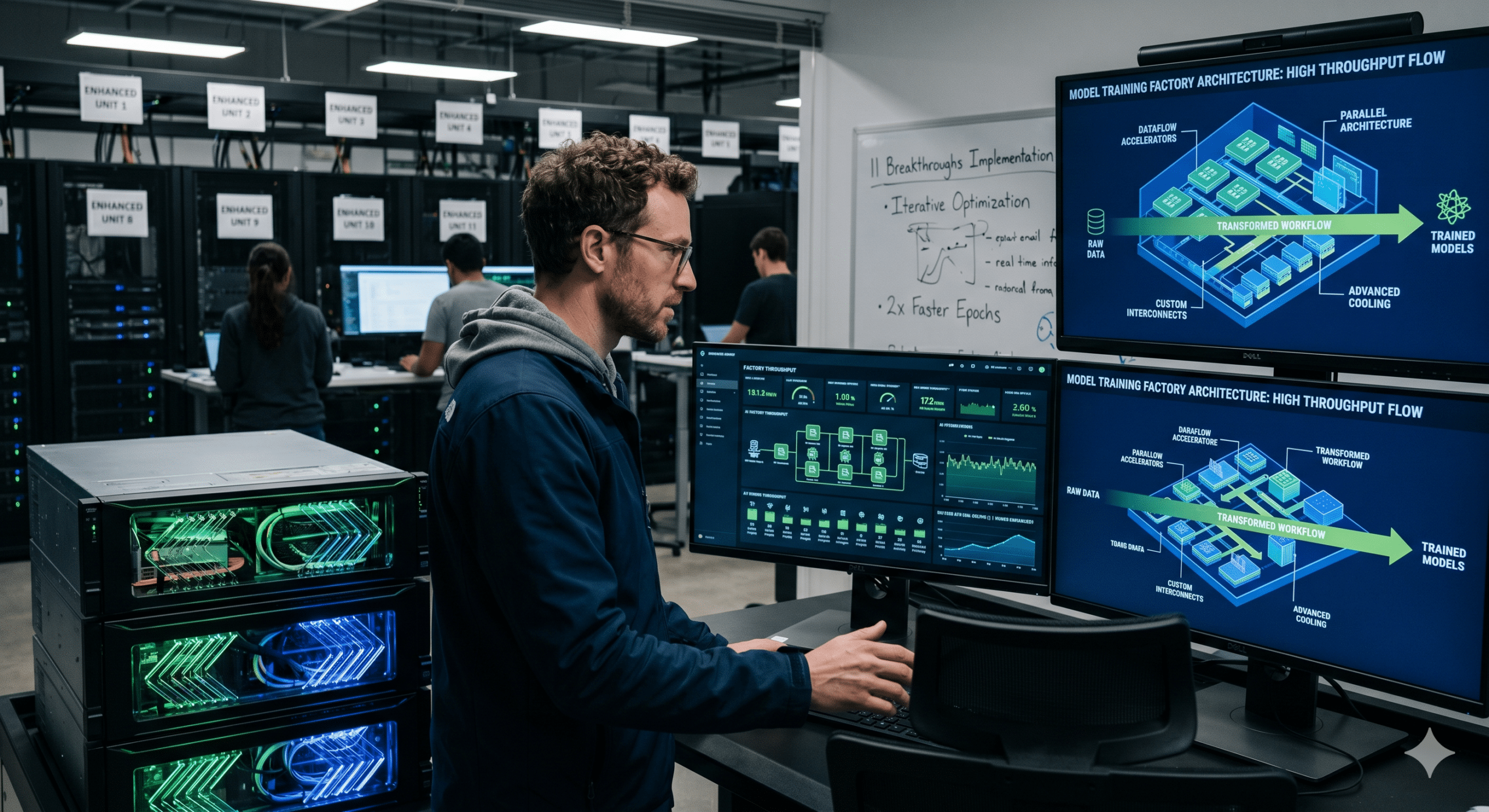
Artificial intelligence is often discussed in terms of model accuracy, benchmark scores, and impressive demonstrations. However, after spending years designing large-scale AI infrastructure and optimizing training environments, I have learned that the real challenge is rarely the model itself. The real challenge is building Model Training Systems that can consistently deliver more output, reduce training delays, and minimize wasted resources.
Many organizations focus heavily on algorithm improvements while overlooking the engineering systems that support those algorithms. Yet in production environments, training efficiency often determines whether an AI initiative succeeds or struggles under rising infrastructure costs.
When viewed through the lens of throughput, cycle time, and scrap reduction, AI engineering starts to resemble advanced manufacturing. Data becomes raw material. GPUs become production equipment. Training pipelines become assembly lines. The finished product is a deployable model ready for real-world workloads.
The teams that achieve the best results are not necessarily training the most sophisticated models. Instead, they are operating the most efficient Model Training Systems.
In this article, I will explore the engineering principles that allow organizations to dramatically increase training throughput, shorten development cycles, and reduce costly model failures while maintaining quality and scalability.
Why Model Training Systems Matter More Than Ever
The AI industry has entered an era where infrastructure efficiency directly impacts competitiveness.
Training modern models requires enormous computational resources, vast datasets, complex orchestration platforms, and highly coordinated engineering workflows. As model sizes continue to grow, infrastructure bottlenecks become more expensive and more visible.
Recent advances in AI hardware demonstrate how critical infrastructure optimization has become. New generations of AI accelerators are specifically designed to shorten training timelines while improving utilization rates across massive distributed environments. (IT Pro)
What many executives fail to realize is that purchasing more hardware rarely solves the underlying problem.
A poorly designed training environment can waste thousands of GPU hours every week.
In contrast, a well-designed training environment allows organizations to train more models using the same infrastructure budget.
That difference can represent millions of dollars annually.
The Manufacturing Mindset Applied to AI
One of the most useful ways to understand AI engineering is through manufacturing principles.
Factories focus on three primary objectives:
- Increase throughput
- Reduce cycle time
- Minimize scrap
The same principles apply directly to Model Training Systems.
Throughput measures how many successful training jobs can be completed within a given period.
Cycle time measures how quickly an idea moves from experimentation to production deployment.
Scrap represents wasted effort, failed training runs, unusable datasets, poor experiments, and infrastructure inefficiencies.
Once AI teams begin measuring these three metrics, performance improvements become much easier to identify.
Instead of asking:
“How can we train a larger model?”
The better question becomes:
“How can we train more useful models faster while wasting fewer resources?”
Breakthrough 1: Eliminate Data Pipeline Bottlenecks
In many AI environments, GPUs spend more time waiting for data than actually performing computations.
This issue quietly destroys throughput.
Engineers often assume the training cluster is the limiting factor. In reality, storage systems, network throughput, and data loading pipelines frequently become the true bottlenecks.
Modern training infrastructure requires continuous high-speed delivery of data to compute resources. When datasets arrive slowly, expensive hardware remains idle.
Research into machine learning infrastructure consistently highlights data movement and storage performance as critical factors influencing overall training efficiency. (SEI)
Improving data access often delivers larger performance gains than adding additional GPUs.
Breakthrough 2: Design for Parallelism from Day One
Many training environments are built around individual experiments.
That approach works during early development.
However, once organizations scale, training jobs begin competing for the same infrastructure resources.
The highest-performing Model Training Systems are designed for parallel execution.
Instead of processing one experiment at a time, multiple workloads execute simultaneously across distributed resources.
Parallelism increases throughput without necessarily increasing hardware investments.
Organizations that embrace distributed training architectures often complete weeks of experimentation in days.
The result is faster innovation and shorter development cycles.
Breakthrough 3: Reduce Experimentation Waste
One of the largest hidden costs in AI engineering is failed experimentation.
Teams frequently launch hundreds of training runs that provide little actionable insight.
This is the equivalent of manufacturing defective products.
Every unsuccessful experiment consumes compute resources, engineering time, and infrastructure capacity.
The most mature AI organizations establish rigorous experiment management systems that track configurations, datasets, hyperparameters, and outcomes.
This creates institutional memory.
Instead of repeating mistakes, teams build upon prior knowledge.
Research on production machine learning consistently identifies reproducibility and experiment tracking as key factors in operational efficiency. (ML Ops)
Breakthrough 4: Treat Data Quality as Scrap Reduction
Manufacturing leaders obsess over raw material quality because defects introduced at the beginning become more expensive later.
AI engineering follows the same pattern.
Poor-quality data creates inaccurate models, unstable performance, and repeated retraining efforts.
Every mislabeled record, duplicate entry, or corrupted dataset introduces hidden costs.
The most efficient Model Training Systems invest heavily in data validation before training begins.
Data quality issues identified early cost far less to resolve than issues discovered after deployment.
Many organizations focus on model optimization while ignoring data quality.
In practice, improving datasets often produces larger gains than changing architectures. (Label Your Data)
Breakthrough 5: Build Continuous Training Pipelines
Traditional software can remain stable for years.
AI systems cannot.
Data changes.
User behavior evolves.
Market conditions shift.
As a result, models gradually lose effectiveness.
Modern AI engineering addresses this challenge through continuous training pipelines that regularly refresh models using updated datasets.
This approach dramatically reduces cycle time between identifying performance degradation and deploying improvements.
Industry frameworks increasingly emphasize continuous integration, continuous delivery, and continuous training as essential components of scalable AI systems. (Google Cloud Documentation)
Organizations that automate retraining cycles maintain higher model quality while reducing operational overhead.
Breakthrough 6: Maximize Hardware Utilization
Buying additional GPUs is easy.
Using them efficiently is difficult.
Across the industry, hardware utilization rates remain surprisingly low.
Idle GPUs represent pure waste.
The most successful AI organizations continuously monitor resource allocation, scheduling efficiency, memory utilization, and job execution patterns.
Small improvements in utilization compound significantly at scale.
A training cluster operating at 85% efficiency can produce substantially more output than one operating at 60%, even when both contain identical hardware.
Infrastructure optimization therefore becomes one of the highest-return engineering investments available.
Breakthrough 7: Standardize Training Environments
Many organizations struggle with environment inconsistencies.
A model trains successfully on one machine but fails elsewhere.
Dependencies differ.
Libraries change.
Configurations drift.
These issues create unnecessary delays and increase scrap rates.
Standardized environments solve this problem by ensuring reproducibility across development, testing, and production.
When every engineer works from a consistent foundation, troubleshooting becomes faster and deployment risks decline.
Mature MLOps environments consistently emphasize standardization and reproducibility as core operational principles. (ML Ops)
Breakthrough 8: Shorten Feedback Loops
Cycle time is heavily influenced by feedback speed.
Engineers need rapid visibility into training performance.
If discovering a problem takes three days, improvement cycles become painfully slow.
If the same issue is identified within thirty minutes, progress accelerates dramatically.
Effective monitoring systems provide real-time insights into training metrics, resource utilization, convergence behavior, and system health.
Fast feedback enables faster decision-making.
Faster decision-making enables faster innovation.
This principle remains one of the most powerful drivers of AI engineering productivity.
Breakthrough 9: Scale Infrastructure Intelligently
Many organizations assume scaling means acquiring more hardware.
However, scaling without optimization often magnifies inefficiencies.
The better approach is scalable architecture.
Infrastructure should expand smoothly while maintaining consistent performance.
Large-scale AI environments increasingly rely on sophisticated orchestration systems, distributed computing frameworks, and intelligent scheduling mechanisms to manage growing workloads. (Databricks)
When architecture scales effectively, throughput grows without proportional increases in operational complexity.
Breakthrough 10: Automate Repetitive Engineering Work
Every manual process introduces delays.
Engineers should focus on solving problems rather than repeatedly executing routine tasks.
Automated validation, deployment, testing, monitoring, and resource provisioning significantly reduce cycle times.
Organizations embracing automation consistently achieve faster model delivery and lower operational costs. (Google Cloud Documentation)
Automation also reduces human error, which directly lowers scrap rates.
The fewer mistakes introduced into the system, the more efficiently resources are utilized.
Breakthrough 11: Engineer for Reliability Before Scale
One of the most common mistakes in AI development is scaling unstable systems.
A flawed process simply produces more problems when expanded.
Reliability should always precede growth.
Training pipelines must be resilient, reproducible, observable, and recoverable.
Recent research continues to emphasize the importance of architectural guidelines for model integration, deployment, and operational consistency across AI systems. (arXiv)
Organizations that prioritize reliability create a foundation capable of supporting future growth without sacrificing performance.
The Future of Model Training Systems
The next generation of AI engineering will focus less on building bigger models and more on building smarter systems.
Future Model Training Systems will automatically allocate resources, detect bottlenecks, optimize workloads, and continuously improve efficiency without requiring constant human intervention.
Infrastructure intelligence will become just as important as model intelligence.
The organizations that master this transition will enjoy faster development cycles, lower operating costs, and significantly greater AI productivity.
The competitive advantage will not come from owning the most hardware.
It will come from operating the most efficient training ecosystem.
Conclusion
The conversation around artificial intelligence often centers on algorithms, architectures, and benchmark scores. While those elements matter, they are only part of the equation.
From an engineering perspective, success depends on throughput, cycle time, and scrap reduction.
The strongest AI organizations treat Model Training Systems as production environments rather than experimental playgrounds. They optimize data flow, reduce waste, improve hardware utilization, automate repetitive work, and shorten feedback loops.
As AI adoption continues to accelerate, infrastructure efficiency will increasingly determine who can innovate faster and who gets left behind.
The future belongs to organizations that build training systems capable of producing more value with fewer resources.
That is the true art of AI engineering.
Frequently Asked Questions
What are Model Training Systems?
Model Training Systems are the infrastructure, software, workflows, and engineering processes used to train, evaluate, and improve machine learning models efficiently at scale.
Why are Model Training Systems important?
They help organizations increase training throughput, reduce development cycle times, lower infrastructure costs, and improve model quality.
How do Model Training Systems reduce waste?
They reduce waste by improving data quality, automating repetitive tasks, maximizing hardware utilization, and preventing failed training runs through better monitoring and validation.
What is the biggest bottleneck in model training?
In many environments, data pipelines and storage systems create larger bottlenecks than compute hardware. Slow data delivery often leaves expensive GPUs underutilized.
How can organizations improve training throughput?
Organizations can improve throughput by optimizing data pipelines, increasing parallel processing, automating workflows, improving hardware utilization, and reducing unnecessary experimentation.
What role does infrastructure play in AI success?
Infrastructure provides the foundation for efficient model development. Strong infrastructure enables faster experimentation, reliable deployment, and continuous model improvement.
References and Further Reading
- Chip Huyen – MLOps Guide – One of the most respected resources for production machine learning, infrastructure design, model deployment, and AI system engineering. Chip Huyen is widely recognized for her work on ML systems and real-world AI deployment.
- Google Cloud – MLOps: Continuous Delivery and Automation Pipelines – A highly authoritative guide explaining how machine learning systems move from experimentation into production environments.
- MLOps Community – One of the largest practitioner communities focused on machine learning engineering and AI infrastructure.
- Hopsworks AI Blog – Excellent technical content covering feature stores, training pipelines, model serving, and AI infrastructure.
- Evidently AI – Machine Learning Engineering Blogs – A curated collection of engineering blogs from organizations building machine learning systems at scale.
- Full Stack Deep Learning – One of the best resources for engineers building and operating AI systems in production.
- Google Research – Rules of Machine Learning – A classic guide covering engineering principles for building successful machine learning systems.
- Netflix Technology Blog – One of the highest-authority engineering blogs available today.
- Uber Engineering Blog – Strong focus on infrastructure scaling, machine learning platforms, experimentation systems, and AI operations.
- OpenAI Research and Engineering Blog – An excellent source for understanding modern LLM architectures, training methods, evaluation, and AI infrastructure.