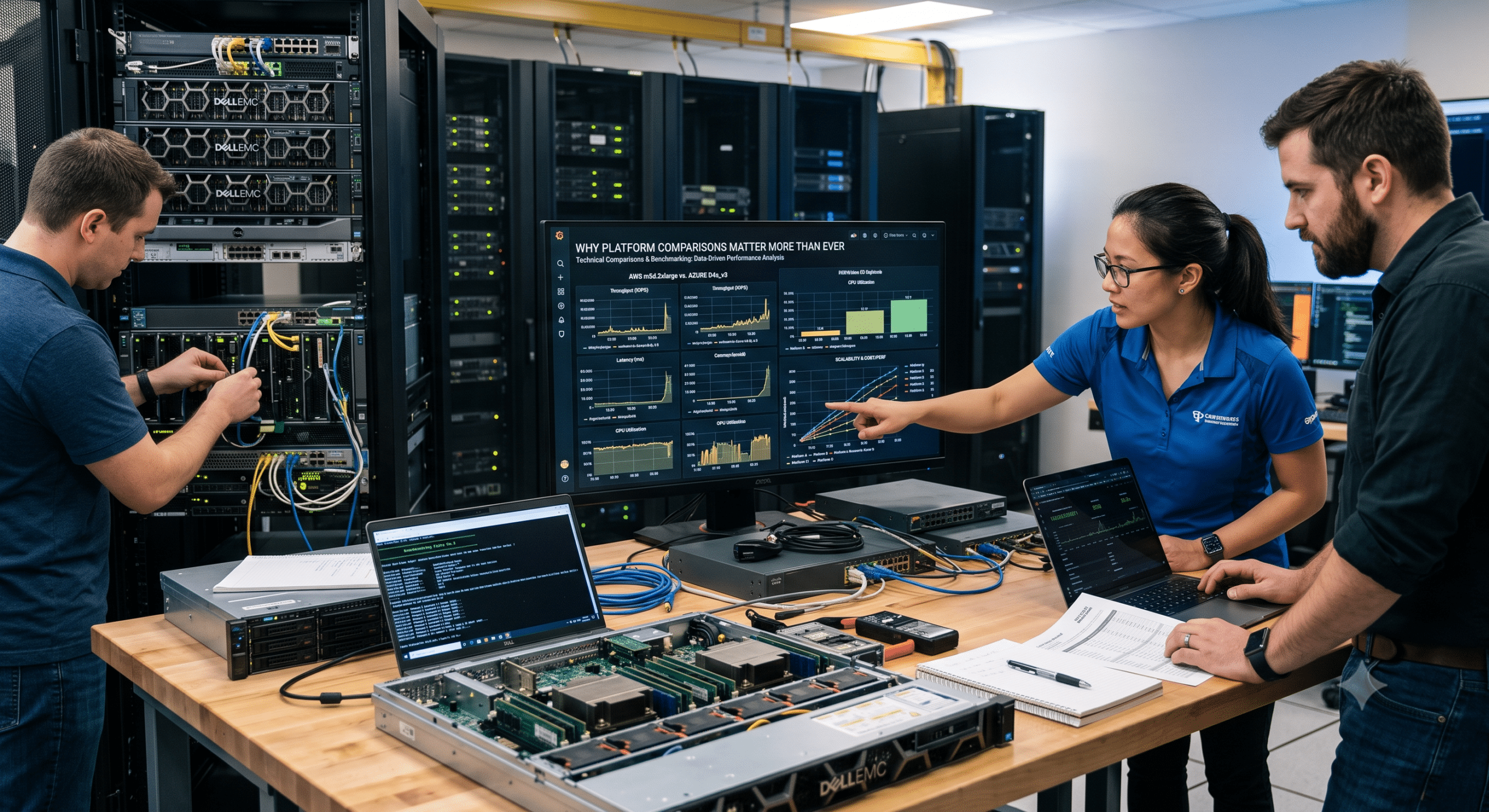
As a Benchmarking Engineer, I’ve learned one lesson that never changes: platform comparisons prove time and again that the platform looking best on paper isn’t always the platform that performs best in real life. To begin with, technology vendors publish impressive specifications. At the same time, marketing teams promise faster performance, lower costs, stronger security, and better scalability. However, while those claims may be accurate in certain situations, the reality is that every business has different workloads, users, budgets, and technical requirements. For this reason, platform comparisons are an essential part of every technology decision.
What Are Platform Comparisons?
Fundamentally, platform comparisons are the structured process of evaluating two or more technology solutions using measurable criteria rather than relying on opinions.
For instance, rather than asking, “Which platform is better?” a benchmarking engineer asks, “Which platform performs better for this specific workload under these conditions?” Indeed, that difference changes everything because good comparisons rely on measurable evidence rather than assumptions.
Typical platforms being compared include:
-
Cloud providers
-
Database systems
-
Operating systems
-
Industrial automation platforms
-
Manufacturing software
-
ERP solutions
-
CRM platforms
-
AI development environments
-
Data analytics platforms
-
Container orchestration systems
In short, each platform has distinct strengths and weaknesses depending on the specific business objectives.
Why Benchmarking Is More Important Than Marketing
One mistake organizations frequently make is choosing technology based on feature lists alone. However, features don’t automatically create value. In fact, a platform offering hundreds of capabilities may perform poorly if those capabilities increase complexity or require expensive infrastructure.
For this reason, benchmarking helps separate marketing claims from measurable performance.
Consider this scenario: A cloud platform might advertise unlimited scalability. During testing, however, engineers may discover:
-
higher latency
-
slower database response
-
increased storage costs
-
API rate limitations
-
unexpected network bottlenecks
Without benchmarking, these issues often appear only after deployment, at which point fixing them becomes far more expensive. Consequently, real-world testing helps organizations avoid costly surprises.
The Role of a Benchmarking Engineer
Many people assume benchmarking engineers simply run performance tests. In reality, though, the role is much broader. Specifically, a benchmarking engineer designs fair comparisons between competing technologies while ensuring every platform operates under equivalent conditions.
Responsibilities often include:
-
Creating repeatable testing environments
-
Selecting meaningful workloads
-
Measuring response times
-
Monitoring CPU utilization
-
Tracking memory consumption
-
Evaluating storage performance
-
Measuring network throughput
-
Testing scalability
-
Recording reliability statistics
-
Producing comparison reports
Above all, the engineer’s responsibility is not to prove one vendor is superior. On the contrary, the goal is to provide objective evidence that decision-makers can trust.
Common Situations That Require Platform Comparisons
Organizations perform platform comparisons throughout the technology lifecycle. To illustrate, here are a few common examples:
Cloud Migration Projects
Before moving applications to the cloud, companies compare providers based on:
-
Compute performance
-
Storage speed
-
Geographic availability
-
Disaster recovery options
-
Pricing models
-
Security capabilities
Enterprise Software Selection
Similarly, businesses compare enterprise platforms to evaluate:
-
Ease of deployment
-
Integration options
-
Licensing costs
-
User experience
-
Reporting capabilities
-
Long-term maintenance
Manufacturing and Industrial Systems
In addition, industrial organizations compare automation platforms by measuring:
-
Controller response times
-
Device compatibility
-
Network stability
-
Cybersecurity features
-
Maintenance requirements
-
Lifecycle support
As a direct result, reliable benchmarking reduces operational risks before large-scale deployments.
Artificial Intelligence Platforms
Furthermore, AI platforms continue evolving rapidly. Therefore, performance engineers compare:
-
Model training speed
-
GPU efficiency
-
Inference latency
-
Memory usage
-
Framework compatibility
-
Cost per training hour
Since AI workloads consume significant computing resources, even small performance improvements can reduce operating expenses substantially.
The Difference Between Benchmarking and Simple Testing
These two terms are often confused; however, they serve fundamentally different purposes.
Testing answers one basic question: “Does it work?”
In contrast, benchmarking answers several deeper questions:
-
How fast is it?
-
How stable is it?
-
How efficient is it?
-
How much does it cost to operate?
-
How does it compare against competitors?
-
How does performance change under heavy workloads?
Briefly put, testing verifies functionality, whereas benchmarking measures performance. Both are important, but benchmarking provides the strategic information executives need before making major technology investments.
The 6 Core Areas Every Platform Comparison Should Measure
Professional platform comparisons should evaluate multiple dimensions rather than relying on a single performance score. In fact, focusing on only one metric—such as raw speed—can produce misleading conclusions because every platform makes trade-offs.
1. Performance
Performance is usually the first metric organizations consider. Typically, measurements include:
-
Response time
-
Throughput
-
Transactions per second
-
Query execution time
-
Batch processing speed
-
Startup time
Ultimately, the best-performing platform consistently delivers predictable results under both light and heavy workloads.
2. Scalability
A platform may perform well with 100 users but struggle when usage grows to 10,000. Thus, benchmarking scalability involves gradually increasing demand while monitoring:
-
CPU utilization
-
Memory consumption
-
Network activity
-
Storage performance
-
System stability
Ideally, a scalable platform maintains acceptable performance as workloads increase without requiring disproportionate hardware upgrades.
3. Reliability
Of course, performance means little if a platform frequently fails. Engineers therefore measure reliability using indicators such as:
-
Uptime
-
Error rates
-
Recovery time
-
Mean Time Between Failures (MTBF)
-
Mean Time to Recovery (MTTR)
Consequently, reliable platforms deliver consistent service even under stress, maintenance events, or unexpected spikes in demand.
4. Cost Efficiency
It is also worth noting that the fastest platform is not always the best investment. Therefore, a complete benchmark considers:
-
Licensing costs
-
Infrastructure expenses
-
Cloud consumption
-
Storage charges
-
Support fees
-
Operational overhead
Evaluating cost alongside technical performance provides a far more accurate picture of long-term value.
5. Security and Compliance
Security is often overlooked during early platform comparisons, yet it should never be treated as an afterthought. After all, a platform that delivers excellent speed but lacks strong security controls can expose an organization to unnecessary risks.
As a benchmarking engineer, I always recommend evaluating security alongside performance. The primary goal is to understand whether a platform can protect sensitive data while maintaining acceptable performance levels.
Important security factors include:
-
Identity and access management (IAM)
-
Encryption for data at rest and in transit
-
Multi-factor authentication (MFA)
-
Audit logging
-
Compliance certifications
-
Vulnerability management
-
Patch deployment process
-
Backup and disaster recovery options
In summary, a secure platform should make it easy to manage permissions, monitor activity, and recover from unexpected incidents.
6. Ease of Management
Finally, the last benchmarking category focuses on daily operations. A platform might have outstanding technical performance yet require a large IT team to manage it. Over time, operational complexity can cost more than the software itself.
For this reason, benchmarking management capabilities includes reviewing:
-
Installation process
-
Configuration simplicity
-
Monitoring tools
-
Automation support
-
Documentation quality
-
Technical support
-
Software updates
-
Learning curve
As a rule, the easier a platform is to manage, the lower its operational costs and the fewer mistakes administrators are likely to make.
Building a Fair Benchmark
One of the biggest mistakes organizations make is comparing platforms under different conditions. Specifically, if one platform receives more hardware resources or lighter workloads than another, the results become unreliable. Therefore, professional benchmarking follows a structured process designed to keep every test fair and repeatable.
Step 1: Define the Objective
To begin, start by identifying what you want to measure. For example:
-
Database performance
-
Web application speed
-
Cloud infrastructure efficiency
-
AI model training time
-
Manufacturing system response
-
API throughput
Without a clear objective, benchmarking produces data that may not support business decisions.
Step 2: Create Equal Test Environments
Next, every platform should operate under nearly identical conditions, including:
-
Same CPU allocation
-
Same memory
-
Same storage capacity
-
Same operating system version
-
Same network bandwidth
-
Same workload
Keeping the environments consistent helps ensure that any differences are caused by the platforms—rather than by the test setup.
Step 3: Use Realistic Workloads
Synthetic tests are useful, but they rarely reflect how systems behave in production. Instead, engineers should use workloads that mirror actual business activity, such as:
-
Customer transactions
-
File uploads
-
Manufacturing data collection
-
ERP reporting
-
AI inference requests
-
Database queries
Indeed, realistic workloads reveal strengths and weaknesses that simple benchmark utilities may overlook.
Step 4: Run Multiple Tests
Furthermore, one benchmark run is never enough because performance naturally varies due to background processes, caching, network conditions, and system activity. Consequently, professional engineers repeat each test several times and calculate averages.
In doing so, they also monitor:
-
Peak performance
-
Average performance
-
Minimum performance
-
Performance consistency
Importantly, consistency is often more valuable than occasional high scores.
Step 5: Document Everything
Above all, good benchmarking is impossible without detailed documentation. Thus, every report should include:
-
Hardware specifications
-
Software versions
-
Configuration settings
-
Test procedures
-
Environmental conditions
-
Raw performance data
-
Graphs and charts
-
Observations
As a result, comprehensive documentation allows future engineers to reproduce the same tests and validate the results with confidence.
Performance Metrics That Matter Most
Not every benchmark metric deserves equal attention. However, some measurements provide a much clearer picture of real-world performance than others.
-
Latency: Latency measures how long it takes for a platform to respond to a request. Lower latency usually creates a better user experience, especially for real-time applications, financial systems, and industrial automation.
-
Throughput: In contrast, throughput measures how much work a platform completes within a given time frame (e.g., requests per second). Hence, high throughput indicates that a system can handle large workloads efficiently.
-
Resource Utilization: Additionally, engineers monitor how effectively a platform uses available resources like CPU, memory, storage, and network bandwidth. Ideally, efficient platforms deliver better performance without consuming unnecessary resources.
-
Availability: Availability measures how often a platform remains operational. Since critical systems demand maximum uptime, even small improvements in availability can significantly reduce downtime costs.
-
Error Rate: Ultimately, performance without accuracy has little value. Therefore, benchmarking should also measure failed requests, crashes, timeouts, and integrity issues, as low error rates indicate a stable platform.
Common Mistakes During Platform Comparisons
Even experienced teams can introduce errors that affect benchmark results. Fortunately, avoiding these pitfalls leads to more reliable decisions.
-
Comparing Different Hardware: Running Platform A on newer hardware than Platform B creates an unfair comparison. Thus, hardware consistency is essential.
-
Ignoring Long-Term Costs: Many organizations focus only on purchase price. However, ongoing expenses (maintenance, licensing, cloud usage, support) often exceed the initial investment. As a result, a platform with a higher upfront cost may prove less expensive over five years.
-
Testing Only Peak Performance: Peak performance numbers look impressive, but most systems spend their time under normal workloads. Therefore, benchmark reports should include idle, average, and sustained performance over time.
-
Overlooking Scalability: Current performance is only part of the picture. Since businesses grow and applications evolve, benchmarking should estimate how well a platform performs as demand rises.
-
Ignoring User Experience: Finally, a technically fast platform may still frustrate users if it is difficult to navigate. Hence, operational efficiency should be considered alongside technical statistics.
Real-World Example: Comparing Two Cloud Platforms
Imagine a manufacturing company evaluating two cloud platforms for its production analytics system. Both vendors advertise high availability, advanced security, and scalable infrastructure. However, instead of relying on marketing materials, the engineering team conducts structured platform comparisons.
Specifically, the benchmark evaluates data ingestion speed, dashboard response times, monthly operating costs, storage performance, and API latency. After several weeks of testing, the findings reveal that one platform offers slightly faster processing, while the other delivers lower operating costs and simpler management.
Although the faster option wins in raw performance, the second platform ultimately provides better long-term value because it aligns more closely with the company’s budget, staffing, and operational goals. Thus, this example highlights an important lesson: the “best” platform depends on the business context, not just benchmark scores.
Benchmarking Is a Continuous Process
Technology changes quickly. For example, software receives updates, cloud providers introduce new hardware, and security requirements become stricter. As a consequence, a benchmark completed last year may no longer reflect current performance.
Therefore, leading organizations schedule regular benchmarking exercises to:
-
Validate software updates
-
Measure infrastructure improvements
-
Identify performance regressions
-
Compare new technologies
-
Support future purchasing decisions
In short, continuous benchmarking helps organizations stay informed and make decisions based on current data rather than outdated assumptions.
Best Practices for Meaningful Platform Comparisons
After participating in many benchmarking projects, I’ve found that successful organizations follow the same habits regardless of industry: they don’t chase impressive benchmark scores—they focus on business outcomes.
Here are the best practices I recommend:
-
Start With Business Goals: Before comparing any technology, define what success looks like. In other words, technical performance should always support business objectives rather than become the objective itself.
-
Benchmark Your Own Workloads: Vendor benchmarks often use carefully controlled environments. Instead, benchmark using your own production-like data, expected traffic, security settings, and integration requirements. Industry guidance consistently recommends benchmarking workloads that closely resemble your own environment. (AWS Documentation)
-
Measure More Than Speed: A complete evaluation should balance performance with stability, security, availability, cost, and ease of maintenance.
-
Repeat Benchmarks Regularly: Because technology evolves constantly, performance engineering is most effective when it begins early and continues throughout the software lifecycle. (AWS Documentation)
-
Keep Detailed Records: Ultimately, thorough documentation ensures your team will be able to reproduce the same tests and verify improvements with confidence months later.
The Future of Platform Comparisons
Technology is becoming increasingly dynamic. As artificial intelligence changes software development, cloud-native architectures evolve, and edge computing expands, benchmarking is evolving as well.
Consequently, modern platform comparisons increasingly include:
-
AI-assisted performance analysis
-
Continuous performance monitoring
-
Automated benchmarking pipelines
-
Real-time observability
-
Predictive capacity planning
-
Sustainability metrics, including energy efficiency
Rather than performing benchmarks once before deployment, organizations now measure performance continuously. This approach allows engineering teams to detect regressions, validate updates, and make architectural decisions based on current data instead of assumptions.
Final Thoughts
As a Benchmarking Engineer, I’ve learned that no platform is universally the best, because every technology involves trade-offs. One solution may deliver exceptional speed but require higher operating costs. Another may offer excellent scalability while demanding more administrative effort.
That’s why platform comparisons should never focus on a single benchmark score. Instead, evaluate each platform across performance, reliability, scalability, security, operational complexity, and total cost of ownership.
In conclusion, benchmarking is more than a technical exercise—it is a business decision tool. When performed correctly, it reduces risk, improves return on investment, and helps organizations build technology environments that continue to perform well as demands grow. Ultimately, companies that consistently benchmark their platforms gain a significant competitive advantage.
Frequently Asked Questions (FAQ)
What are platform comparisons?
Platform comparisons are the process of evaluating two or more technology platforms using measurable criteria such as performance, scalability, security, cost, reliability, and ease of management. Overall, the goal is to identify which platform best fits a specific business need.
Why are platform comparisons important?
They reduce risk by replacing assumptions with measurable data. Instead of selecting technology based on marketing materials, organizations use benchmarking results to make informed decisions that align with technical and business goals.
What is the difference between benchmarking and performance testing?
Performance testing determines whether a system meets expected performance requirements under specific conditions. In contrast, benchmarking compares the performance of multiple platforms or configurations using consistent testing methods. (AWS Documentation)
Which metrics should be included in platform comparisons?
Generally speaking, a comprehensive comparison typically measures response time (latency), throughput, resource utilization, storage performance, availability, error rates, scalability, security capabilities, and operational costs.
How often should organizations perform benchmarking?
Benchmarking should be conducted before major technology purchases, cloud migrations, infrastructure upgrades, or significant software releases. Additionally, many organizations perform annual or continuous benchmarking. (Gartner)
Can vendor benchmark results be trusted?
Vendor benchmarks can provide a useful starting point, but they should not be the only source of information. Rather, running your own benchmarks using production-like conditions provides far more reliable results. (AWS Documentation)
What industries benefit most from platform comparisons?
Virtually every industry benefits—including manufacturing, healthcare, financial services, retail, government, telecommunications, cloud computing, software development, industrial automation, and logistics.
References
The following high-authority resources provide additional guidance on performance engineering, benchmarking, and platform evaluation:
-
AWS Prescriptive Guidance. A Phased Approach for Performance Engineering in the AWS Cloud. AWS Documentation
-
AWS Prescriptive Guidance. The Pillars of Performance Engineering. AWS Documentation
-
AWS Well-Architected Framework. Use Benchmarking to Drive Architectural Decisions. AWS Documentation
-
Gartner. IT Benchmarking. Gartner
-
Gartner. Benchmarking That Powers Smarter IT Decisions. Gartner
-
Gartner. Software Engineering Score. Gartner