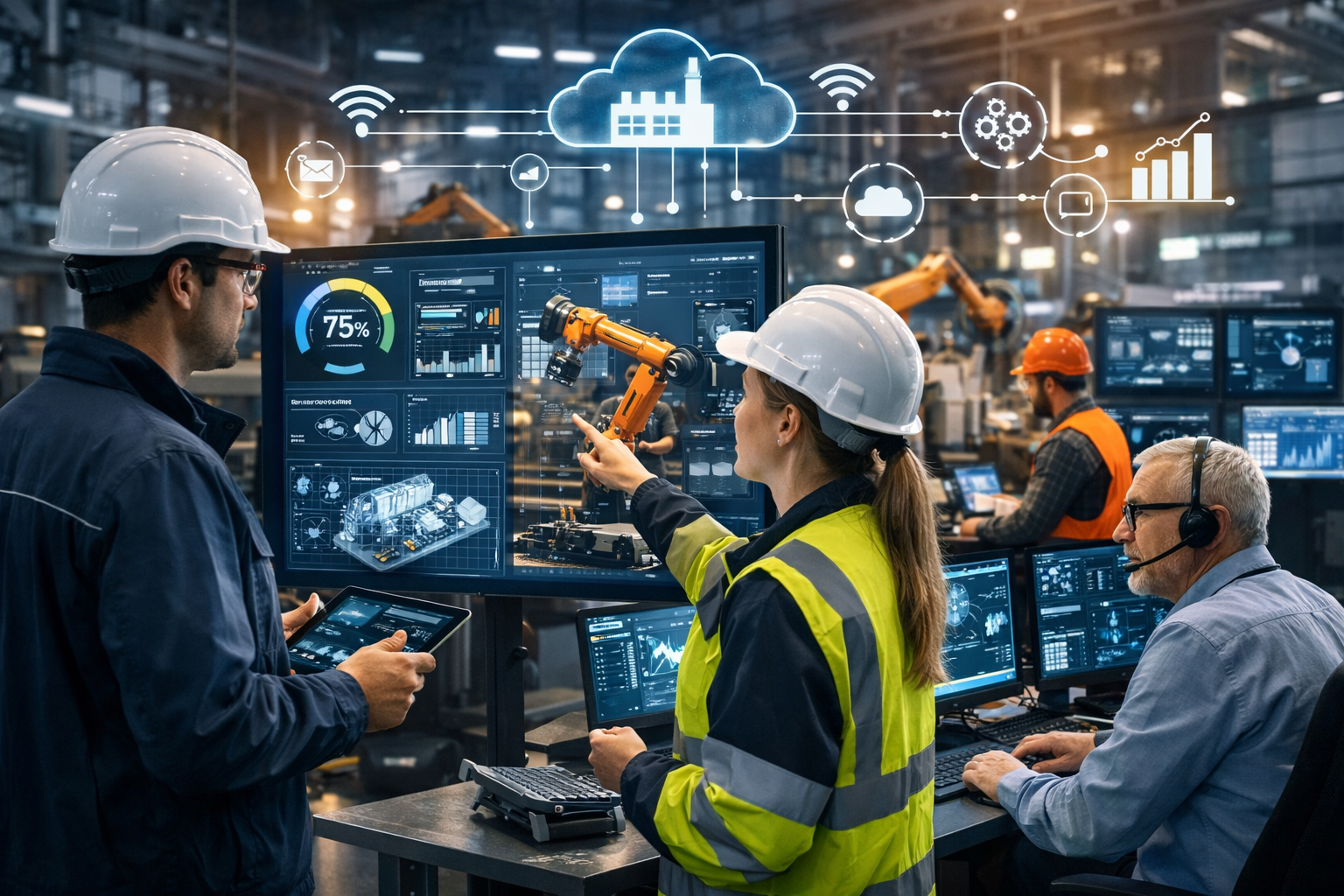
Industrial IoT, often called IIoT, represents one of the most powerful applications of IoT and connected technology. While consumer IoT focuses on smart homes and personal devices, IIoT applies connectivity, data, and automation to industrial environments such as manufacturing, energy, transportation, and logistics.
By connecting machines, sensors, and systems, IIoT enables industries to operate more efficiently, safely, and intelligently. This article explains what Industrial IoT is, how it works, and why it plays a critical role in modern connected technology.
What Is Industrial IoT (IIoT)?
Industrial IoT refers to the use of connected sensors, devices, software, and analytics within industrial settings. These systems collect data from machines and processes, analyze it in real time, and use the results to improve operations.
Unlike traditional automation, IIoT systems do not operate in isolation. Instead, they connect machines, control systems, and enterprise platforms into a unified digital ecosystem.
As a result, organizations gain visibility into operations that were previously difficult or impossible to monitor continuously.
How IIoT Differs from Consumer IoT?
Although IIoT and consumer IoT share similar technologies, their goals and requirements differ significantly.
Consumer IoT focuses on convenience, comfort, and user experience. In contrast, IIoT prioritizes reliability, accuracy, safety, and long-term performance.
Industrial environments often involve harsh conditions, such as extreme temperatures, vibration, and electrical noise. Therefore, IIoT devices must meet stricter standards and operate continuously for years.
Because of these demands, IIoT systems emphasize durability, redundancy, and precise data handling.
Core Components of an IIoT System
Every IIoT system consists of several interconnected components that work together to collect, process, and act on data. In real deployments, what is Industrial IoT and how it works becomes clear through connected sensors, controllers, and analytics platforms operating together.
Sensors play the first role by measuring physical conditions such as temperature, pressure, vibration, and flow rate. These measurements provide real-time insight into machine and process behavior.
Industrial controllers and gateways then collect sensor data and perform local processing. In many cases, these devices run edge computing workloads to reduce latency.
Finally, connected platforms analyze data at scale, store historical records, and provide dashboards for operators and engineers.
Together, these components create a closed-loop system for monitoring and control.
Connectivity in Industrial IoT
Reliable connectivity is essential for IIoT systems. Industrial networks must transmit data accurately and consistently, even in challenging environments.
Wired connections remain common in industrial settings because they offer stability and low latency. However, wireless connectivity has become increasingly important due to flexibility and scalability.
IIoT systems often use a combination of local networks and wide-area connections. This hybrid approach allows critical operations to continue locally while sharing selected data with centralized systems.
As connectivity improves, IIoT deployments become easier to scale and manage.
Edge Computing in IIoT Environments
Edge computing plays a central role in Industrial IoT. Instead of sending all data to the cloud, IIoT systems process information close to where it is generated.
This approach reduces latency and enables faster responses. For example, if a machine shows signs of failure, edge systems can trigger alarms or shutdowns immediately.
In addition, edge computing reduces bandwidth usage by filtering and summarizing data before transmission.
Because industrial processes often require real-time control, edge computing has become a standard architectural choice in IIoT.
Data Analytics and Intelligence
Data is the true value driver in IIoT systems. Sensors generate large volumes of information, but analytics turn that data into insight.
Basic analytics identify trends, thresholds, and anomalies. More advanced techniques use machine learning to predict failures or optimize performance.
For instance, predictive maintenance systems analyze vibration and temperature data to detect early signs of equipment wear. As a result, organizations reduce downtime and maintenance costs.
Over time, analytics enable continuous improvement across industrial operations.
Predictive Maintenance and Asset Monitoring
One of the most widely adopted IIoT use cases is predictive maintenance. Traditional maintenance relies on fixed schedules or reactive repairs. IIoT changes this approach entirely.
By monitoring equipment in real time, IIoT systems identify issues before failures occur. Maintenance teams receive alerts based on actual machine condition rather than assumptions.
Asset monitoring also improves visibility across facilities. Operators track performance, usage, and health of machines from a central location.
Consequently, organizations extend asset lifespan and improve operational reliability.
IIoT in Manufacturing and Production
Manufacturing represents a major area of IIoT adoption. Connected machines provide insight into production rates, quality metrics, and energy consumption.
IIoT systems support real-time quality control by detecting defects early in the process. When issues occur, systems adjust parameters automatically or alert operators.
In addition, connected technology enables flexible production lines that adapt to changing demand.
Through IIoT, manufacturers increase efficiency while maintaining consistent quality.
Energy Management and Industrial Efficiency
Energy usage represents a significant cost in industrial operations. IIoT systems help organizations monitor and optimize energy consumption.
Connected meters and sensors track usage across machines, buildings, and processes. Analytics then identify inefficiencies or abnormal patterns.
By acting on these insights, organizations reduce waste and improve sustainability.
As energy costs rise, IIoT-driven optimization becomes increasingly valuable.
Security Challenges in Industrial IoT
Security remains one of the most critical concerns in IIoT. Industrial systems often control physical processes, making security breaches potentially dangerous.
IIoT environments must protect devices, networks, and data from unauthorized access. Authentication ensures only trusted systems communicate with machines.
Encryption protects data in transit, while secure firmware prevents malicious code execution.
Because industrial systems often operate continuously, security strategies must balance protection with availability.
Interoperability and Integration
Industrial environments often include equipment from multiple vendors and generations. As a result, interoperability becomes a major challenge.
IIoT systems must integrate legacy equipment with modern connected platforms. Gateways and standardized interfaces help bridge this gap.
In addition, data integration across systems enables enterprise-wide visibility. When production, maintenance, and business systems share information, decision-making improves.
Successful IIoT deployments prioritize interoperability from the start.
Scalability and Lifecycle Management
IIoT systems often start small and grow over time. Therefore, scalability plays a key role in system design.
Connected platforms must support thousands or even millions of devices. At the same time, organizations must manage updates, configurations, and monitoring efficiently.
Lifecycle management ensures devices remain secure and functional throughout their operational life.
By planning for scalability early, organizations avoid costly redesigns later.
Benefits of Industrial IoT Adoption
Industrial IoT delivers measurable benefits across operations.
Organizations improve efficiency by reducing downtime and optimizing processes. Safety improves through real-time monitoring and automated responses.
Data-driven decision-making replaces guesswork, leading to better outcomes.
Furthermore, IIoT supports innovation by enabling new business models and services.
Because of these advantages, IIoT adoption continues to grow across industries.
Challenges and Barriers to IIoT Implementation
Despite its benefits, IIoT adoption presents challenges. Initial investment costs can be significant, especially for large-scale deployments.
Skill gaps also exist, as IIoT requires expertise in networking, data analytics, and cybersecurity.
Change management represents another hurdle. Organizations must adapt workflows and train staff to use new systems effectively.
Addressing these challenges requires clear strategy, strong leadership, and long-term commitment.
The Future of Industrial IoT
The future of IIoT looks increasingly intelligent and autonomous. Advances in artificial intelligence enable systems to learn and adapt over time.
Improved connectivity supports faster data exchange and real-time collaboration between systems.
As standards mature, interoperability improves, making IIoT more accessible.
Ultimately, IIoT will continue to reshape how industries operate, compete, and innovate.
Conclusion
Industrial IoT represents a powerful application of IoT and connected technology. By connecting machines, data, and analytics, IIoT transforms industrial operations.
For beginners, IIoT demonstrates how connected technology extends beyond consumer devices into critical infrastructure. For professionals, it offers advanced tools for efficiency, safety, and optimization.
As industries face increasing complexity and competition, Industrial IoT will remain a key driver of digital transformation and long-term success.