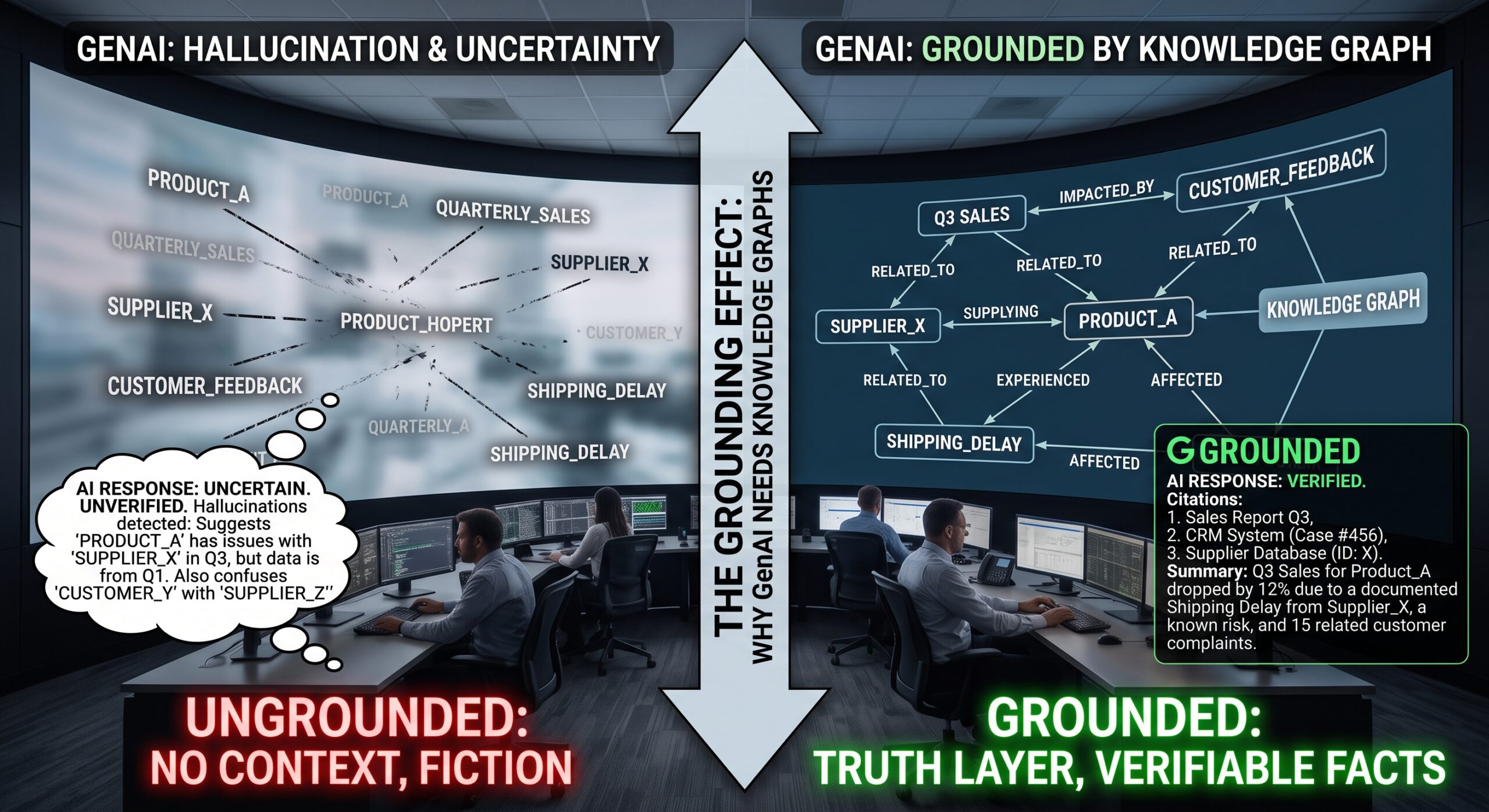
I spent most of last year in the same meeting, just with different logos on the slide, trying to fix conversational AI that couldn’t trust its own data—a problem that ultimately requires Enterprise Knowledge Graphs. A team had shipped a chatbot on top of their internal documents. The demo looked great. Then it went to production. A claims adjuster asked it a policy question, and it answered with total confidence using a clause that didn’t exist.
I’ve now watched that exact failure play out in nine separate deployments, across finance, healthcare, and manufacturing, and the pattern never changes. The model isn’t the problem. The retrieval is.
That’s the uncomfortable truth nobody puts on the roadmap slide. Swap GPT for Claude for Gemini and the hallucination rate barely moves. The model guesses correctly most of the time and guesses confidently wrong the rest of it. What actually moves the needle is what you hand the model before it answers. That’s where Enterprise Knowledge Graphs stop being an academic curiosity. They become the thing that decides whether your AI program survives contact with real users.
Vector search gets you close, not correct
Similarity is not the same as truth
Most Retrieval Augmented Generation stacks I’ve inherited from other teams work the same way. You chunk the documents, embed the chunks, drop them in a vector database, and retrieve the top handful by cosine similarity. It works fine for a proof of concept, because similarity search genuinely excels at finding text that sounds related to a question. The trouble is that “sounds related” and “is true” are not the same property. Nothing in that pipeline checks for the second one.
Independent benchmarking on hallucination rates makes this concrete rather than anecdotal. Published rates run anywhere from about fifty to eighty two percent on open ended generation tasks, depending on the model and the prompting method. Real world conversational deployments still show hallucination prevalence around thirty one percent globally. Even grounded summarization, about as easy a case as retrieval gets, isn’t immune once source documents contain outdated or contradictory versions of the same fact. Legal research queries fare worse still, with reported error rates between fifty eight and eighty eight percent when the tool can’t verify which clause supersedes which.
The reason is structural, not a training defect. A vector index has no concept of an entity. It doesn’t know that “Acme Corp,” “Acme Corporation,” and the ticker “ACM” name the same legal entity, or that someone amended a contract clause eleven months ago and chunk 4,502 still holds the stale version. Instead, it retrieves text that resembles the query and hands that text to a language model that sounds certain about whatever it gets. Similarity is a heuristic for relevance. It was never a substitute for a fact.
A grounding failure, not a hallucination
Go back to that claims adjuster example. The chatbot didn’t fail because the underlying model was weak. It failed because two versions of the same policy document sat in the vector index at once, one current and one superseded. Nothing in the retrieval pipeline knew to prefer one over the other. The pipeline handed the model both fragments with equal weight, and the model stitched together a plausible sounding answer from whichever fragment scored marginally higher on similarity.
That’s not a hallucination in the sense of the model inventing facts from nothing. It’s a grounding failure, and grounding failures are a data architecture problem before they’re ever a model problem.
What an Enterprise Knowledge Graph actually is
Nodes, edges, and provenance
Strip away the marketing language. An enterprise knowledge graph is a structured, connected model of the entities, relationships, and rules that define how a business actually operates. Customers, contracts, products, policies, regulations, and the people who own them all become nodes. The relationships between them (this policy supersedes that one, this customer belongs to this account, this part depends on that supplier) become edges. Each edge carries its own properties: effective dates, confidence scores, who approved the change, and when someone last verified it.
That last part is the piece most vector only architectures skip entirely. It’s the piece information architecture people have fought for since long before anyone said “generative AI” out loud: provenance. A well built graph doesn’t just store the fact that a customer is flagged for review. It stores who flagged them, under which policy, on what date, and whether a newer policy has since replaced it. When a retrieval system can trace a fact back to its source and its validity window, the language model stops guessing and starts citing.
Why the ontology matters
This is also where the ontology comes in, and it’s worth being precise about that word, because people throw it around loosely. An ontology is the schema that says what kinds of things exist in your business and how they can relate to each other. Without one, a graph is just a pile of connected records.
With one, “status equals two” in a legacy system stops being an opaque integer that only a fifteen year veteran analyst can decode. It becomes an explicit, machine readable statement: the account sits suspended pending review. Applications and long tenured employees have always understood that mapping implicitly. AI agents can’t, unless somebody writes it down in a form the agent can query.
Ground truth, not just more context
People use the phrase “ground truth” loosely in AI circles. In the context of retrieval it has a specific, useful meaning: a fact that’s verified, sourced, and current, as opposed to text that merely looks plausible. Enterprise Knowledge Graphs supply that in three concrete ways a flat document index can’t.
Entity resolution
Real enterprise data is messy. The same customer shows up under six spellings across five systems. A knowledge graph reconciles those into one canonical node. A query about that customer then pulls every relevant fact, instead of a fraction of it scattered across duplicate records the retrieval system never linked together.
Temporal and hierarchical validity
Policies change. Org charts change. Product catalogs change. A graph can encode that clause fourteen was valid until March, when clause nineteen replaced it. Retrieval then respects effective dates instead of surfacing whichever version happened to embed closest to the query. This single feature has cut more downstream hallucinations in my deployments than any prompt engineering trick I’ve tried.
Multi hop reasoning
Some genuinely useful business questions connect several facts that never appear in the same document. Which suppliers feed a product line currently under a compliance hold, and which of our contracts with those suppliers expire next quarter? A vector search over chunked text has no path from A to B to C. A graph traversal does, because the relationships are explicit edges you can walk rather than an inference you’re hoping the model gets right.
None of this replaces the language model’s reasoning ability. It replaces the model’s guesswork about facts it was never actually given. That distinction is the whole ballgame.
GraphRAG: combining the graph with the generation
How the indexing works
Enterprise Knowledge Graphs pair with generation through a technical pattern that’s matured fast over the last two years. It usually goes by the name GraphRAG. Microsoft’s open research on the approach is a useful reference point for how it works under the hood. You may still end up building your own version instead of adopting their exact toolchain.
The indexing phase extracts entities and relationships from raw text, then clusters them hierarchically (Microsoft’s implementation uses the Leiden community detection technique) into groups of related concepts. It generates summaries at each level of that hierarchy. The result is a graph holding both fine grained facts and higher level thematic summaries sitting on top of them.
How the querying works
The query phase is where it earns its keep. A well designed GraphRAG system doesn’t run one retrieval strategy for every question. It answers broad, corpus spanning questions by summarizing across communities. It answers narrow questions about a specific entity by traversing that entity’s local neighborhood in the graph. Questions needing both get a blended strategy that mixes community context with entity level detail. And when a question is genuinely just “find me the paragraph that says X,” the system still runs a straightforward similarity search. Graph traversal isn’t free, and you shouldn’t pay for it when you don’t need it.
The measured impact of doing this well isn’t subtle. Researchers across the graph database community have measured GraphRAG’s truthfulness improvement over baseline retrieval at around eighty percent. That lines up with what I’ve watched happen internally: the failure mode shifts from confidently wrong to correctly saying it doesn’t know. That shift alone changes whether a business will put the system in front of customers.
Where data governance actually lives in this stack
It’s a governance artifact, not just a retrieval accelerant
Most AI conference talks skip this part, and they shouldn’t, because it’s the part that determines whether any of this survives an audit. An enterprise knowledge graph isn’t just a retrieval accelerant. Whether a team plans for it or not, it’s a governance artifact.
The moment you build an ontology, you’ve made a set of decisions about what “customer,” “policy,” and “approval” mean across the organization. Somebody has to own those decisions, review them on a cadence, and version them when the business changes. I’ve sat on ontology review boards that meet every nine weeks. Letting definitions drift silently is how you end up with a graph that’s technically running but quietly wrong. That’s arguably worse than not having one, because now people trust it.
Access control and lineage belong in the graph
This is also where Enterprise Knowledge Graphs intersect directly with master data management and access control, rather than sitting beside them as separate initiatives. If your graph encodes that a contract clause is only visible to people in a certain legal jurisdiction, the graph query layer should enforce that constraint. It shouldn’t rely on a prompt instruction bolted on afterward, one a clever user can talk their way around. Lineage tracking, which most data governance teams already maintain for regulatory reasons, becomes directly reusable as the provenance layer your retrieval system needs to cite sources. You’re not building two systems. You’re finally connecting two systems that belonged together from the start.
Analysts covering the data and analytics governance space keep pointing at exactly this convergence. They describe the shift toward context aware governance platforms as one of the defining changes in how organizations will need to manage information heading into next year. That’s not a coincidence. Once an organization commits to grounding its AI in verified structure, the governance function stops being a compliance checkbox. It becomes the thing that makes the AI trustworthy in the first place.
What it actually takes to build one
Start narrow
I won’t pretend this is a weekend project, and I’d be doing you a disservice if I made it sound like one. The pattern that’s worked across the Enterprise Knowledge Graph deployments I’ve led starts narrow. Pick one domain, usually the one with the highest cost of being wrong (claims, contracts, clinical protocols) rather than the one with the most data. Build the ontology for that domain first, with actual subject matter experts in the room, not just engineers guessing at what “policy” means to the business.
Staff it correctly
Entity resolution across your source systems is usually the single largest chunk of effort, and it’s the one teams most consistently underestimate. Expect it to take longer than the graph database implementation itself. Once you resolve entities and model relationships, the retrieval layer is genuinely the easier half of the build. It’s hybrid search: vector similarity for fuzzy matching, paired with graph traversal for structural facts.
Staffing matters more than tooling choice at this stage. The strongest builds I’ve been part of had a subject matter expert in the ontology sessions from day one. Nobody waited to bring one in only for a review at the end. Engineers can model relationships all day. Only someone who has actually adjudicated a claim or read a hundred contracts knows which distinctions the business cares about and which ones are noise. Skip that involvement and you end up with a technically elegant graph that models the wrong things precisely.
Sequence it correctly
The mistake I see most often isn’t technical. It’s sequencing. Teams stand up the language model integration first, because it’s the exciting, demoable part, and treat the graph as a phase two enhancement. Flip that order. The graph is what makes the demo trustworthy rather than merely impressive. Retrofitting governance and structure onto a system already in front of users is a much harder conversation to have with a compliance team than building it in from the start.
Plan for maintenance
It’s also worth setting expectations early: this is not a one time build. Ontologies drift as the business changes, teams replace source systems, and new regulations redefine what counts as a valid relationship. Budget for maintenance the same way you would for any other piece of core infrastructure. A knowledge graph nobody reviews anymore is, slowly and quietly, a knowledge graph that has stopped being ground truth.
The bottom line
Generative AI doesn’t have a creativity problem. It has a grounding problem, and no amount of prompt tuning fixes an architecture that never gave the model verified facts to work with in the first place. Enterprise Knowledge Graphs supply that structure. You resolve entities instead of duplicating them. Relationships become explicit instead of staying inferred. And provenance lets a system say where a fact came from and when it stopped being true.
Pair an Enterprise Knowledge Graph with a retrieval strategy that actually uses it, instead of treating the graph as a diagram for a slide deck, and the hallucination conversation changes. It stops being about detecting when the system is wrong. It becomes about building something that’s wrong so rarely you can put it in front of a customer. That’s a materially different, more defensible place for an enterprise AI program to stand.
Frequently Asked Questions
What is an Enterprise Knowledge Graph, and how is it different from a data catalog?
A data catalog tells you where data lives and who owns it. An enterprise knowledge graph goes further and models the entities, relationships, and business rules connecting that data, so a system can reason across records instead of just locating them. Neo4j’s overview of building an enterprise knowledge graph walks through this distinction in practical terms. Neo4j: Building the enterprise knowledge graph
Does adding a knowledge graph actually reduce hallucinations, or is that overstated?
The measured effect is real, though it depends heavily on implementation quality. Research on GraphRAG style architectures has shown truthfulness improvements of roughly eighty percent over baseline retrieval. Entity resolution and explicit relationships remove much of the ambiguity that causes models to guess. Neo4j: The knowledge layer for enterprise AI
What exactly is GraphRAG, and do I need Microsoft’s specific implementation?
GraphRAG is a pattern, not a single product. It combines entity and relationship extraction, hierarchical community clustering, and multiple retrieval modes for different question types. Microsoft’s open research implementation offers a well documented reference architecture, but plenty of teams build a lighter, custom version on their own graph database. Microsoft GraphRAG documentation
How bad are hallucination rates in production language models right now?
Published benchmarks vary widely by task and model. Rates range from roughly fifteen percent on the strongest models under easy conditions to over eighty percent on open ended or legal research tasks without grounding. Real world conversational deployments average around thirty one percent. SQ Magazine: LLM Hallucination Statistics 2026
Where does data governance fit into an enterprise knowledge graph project?
It’s not a separate workstream, it’s the foundation. Teams need to build ontology ownership, lineage tracking, and access control into the graph itself, rather than layer them on afterward. That’s why people increasingly describe governance platforms in terms of context and semantic structure rather than just cataloging. Atlan: Gartner Magic Quadrant for D&A Governance Platforms 2026
Is this only viable for large enterprises with big data teams?
No, though the scope should match the organization. Smaller teams generally see better results starting with one narrow, high stakes domain and a focused ontology, rather than attempting a company wide graph on day one. The core techniques (entity resolution, hybrid retrieval, explicit relationships) scale down as well as they scale up. Elastic Search Labs: Graph RAG and Elasticsearch
What is the difference between a knowledge graph and a vector database for RAG?
A vector database retrieves text based on semantic similarity, useful for fuzzy, language driven matching, but it has no concept of verified facts or relationships. A knowledge graph stores explicit entities and relationships with provenance, enabling multi hop reasoning and fact verification that similarity search can’t provide on its own. Most production systems now use both together. DigitalOcean: An overview of AI hallucinations with RAG and knowledge graphs
References
- Neo4j. Building the enterprise knowledge graph. https://neo4j.com/blog/knowledge-graph/building-enterprise-knowledge-graph/
- Neo4j. The knowledge layer for enterprise AI. https://neo4j.com/blog/agentic-ai/enterprise-knowledge-layer/
- Microsoft Research. GraphRAG documentation. https://microsoft.github.io/graphrag/
- DigitalOcean. An overview of AI hallucinations with RAG and knowledge graphs. https://www.digitalocean.com/community/conceptual-articles/ai-hallucinations-with-rag-and-knowledge-graphs
- SQ Magazine. LLM hallucination statistics 2026. https://sqmagazine.co.uk/llm-hallucination-statistics/
- Atlan. What is a knowledge graph? How they reduce LLM hallucinations. https://atlan.com/know/what-is-a-knowledge-graph/
- Elastic Search Labs. Graph RAG and Elasticsearch: implementing RAG on a knowledge graph. https://www.elastic.co/search-labs/blog/rag-graph-traversal
- Atlan. Gartner Magic Quadrant for D&A Governance Platforms 2026. https://atlan.com/know/gartner/magic-quadrant-for-data-governance-2026/
- Tredence. GraphRAG explained: how knowledge graphs enable hallucination free GenAI. https://www.tredence.com/blog/graphrag-knowledge-graphs-hallucination-free-genai