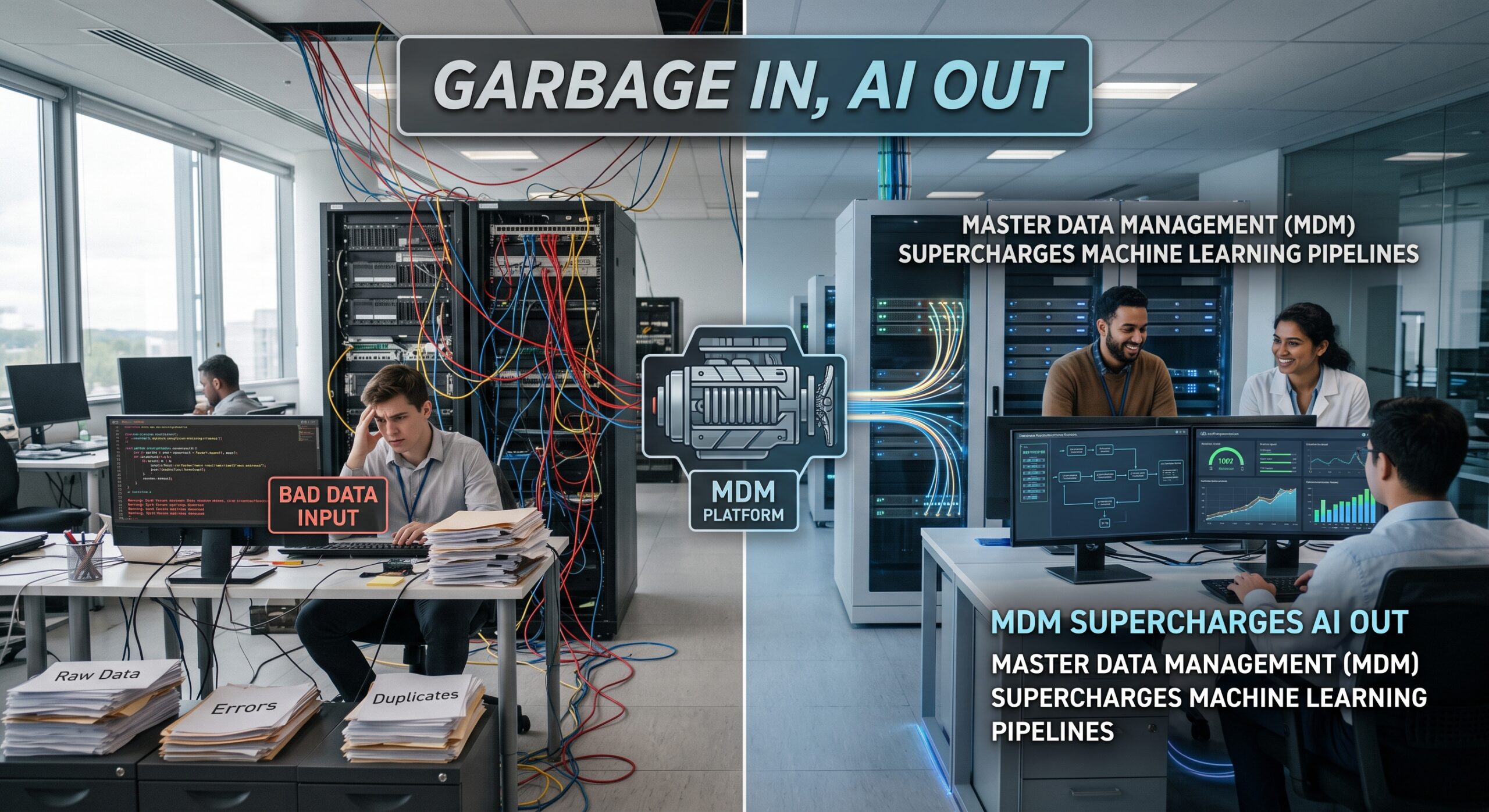
Every enterprise we’ve worked with asks some version of the same question: why isn’t our AI model performing the way the vendor demo promised? The honest answer rarely involves the algorithm—it usually comes down to what’s feeding it. Without robust Master Data Management, your machine learning pipeline is built on fragmented records, conflicting product hierarchies, and departmental silos. Master Data Management isn’t a back-office compliance exercise anymore; it is the core architectural foundation your AI strategy either stands on or collapses without.
We’ve spent our careers building and repairing data architectures for organizations that scaled faster than their governance could keep up with. Data quality always mattered. What changed is that AI made the consequences visible, expensive, and fast. A flawed report used to sit quietly in a spreadsheet until someone caught the error. A flawed model trained on the same bad data makes thousands of automated decisions before anyone notices something is wrong.
The AI Boom Outran the Data Foundation
Most companies never built their data infrastructure with machine learning in mind. They built transactional systems for billing, inventory, HR, and CRM. Each one served its own department, with its own definition of “correct.” Then those same systems became the raw material for predictive models, recommendation engines, and generative AI copilots. Nobody went back to reconcile the underlying records first.
The result is a mismatch that’s easy to describe and hard to fix. A machine learning model doesn’t just need data. It needs data that means the same thing everywhere it appears. Say a customer named Robert Chen exists as three separate entities across your CRM, your billing platform, and your support desk. A churn-prediction model isn’t looking at one customer’s behavior anymore. It’s looking at three fragments of behavior, and none of them tells the full story. The model isn’t wrong here. The data carried that damage long before the first line of training code ever ran.
Master Data Management addresses exactly this problem. It establishes one trusted, continuously maintained version of the entities that matter most to a business. Customers, products, suppliers, locations, employees, and the relationships between them all live in that single version. A solid foundation means everything you build on top of it, including AI, inherits that reliability. A shaky one means everything you build inherits the mess, usually at a larger scale and a faster pace than anyone expected.
Why “Garbage In, AI Out” Is More Than a Catchy Phrase
People toss around the old programming adage “garbage in, garbage out” so often that it’s lost some of its bite. AI needs an updated version, because the failure mode isn’t linear anymore. It compounds. A traditional application processes bad data and produces a bad output, one record at a time, and a human usually catches it downstream. A machine learning model trained on bad data doesn’t just repeat the error once. It learns the error as a pattern. It generalizes from that pattern. Then it applies the flawed logic to every new case it encounters afterward.
Consider a fairly common scenario. A regional bank trains a credit risk model on customer income and employment data pulled from three legacy systems. Nobody ever fully reconciled those systems after a merger. Roughly 12 percent of customer records contain duplicate or conflicting employment histories. The model has no way to know that duplication exists. It simply treats each duplicate as additional evidence, and it subtly overweights certain customer segments while underweighting others. Nobody designed that bias on purpose. It emerged from unresolved master data, and it will keep emerging at scale every time the model scores a new applicant, until someone fixes the source.
This is the mechanism that keeps enterprise data architects up at night: AI doesn’t always fail loudly when the data is bad. It often fails quietly. It produces plausible-looking outputs that are subtly, systematically wrong in ways nobody can easily trace back to their origin. By the time the business spots the pattern in customer complaints or regulatory findings, the flawed logic has already shaped months of decisions.
What Clean, Unified Master Data Actually Looks Like
It helps to get concrete about what “clean” master data really means, because people use the term loosely. In practice, it comes down to five properties working together, not any single fix.
Accuracy means the record reflects reality right now. The address is current. The product specification matches what actually shipped. The account status is correct as of today, not as of whenever someone last touched it.
Consistency means every system describes the same entity the same way, so a “customer” in marketing is recognizably the same customer in billing and support. Completeness means the fields a model actually needs hold real values, not empty cells or placeholder values that quietly corrupt calculations downstream.
Uniqueness means each real-world entity has exactly one authoritative record, not three or four near-duplicates competing for attention. Timeliness means the data reflects the current state of the business, not a snapshot from last quarter or last year.
None of this happens by accident, and none of it stays fixed on its own. Source systems keep generating new records. Mergers keep introducing new duplicates. Business rules keep evolving. Master Data Management is the discipline, the governance structure, and the technical infrastructure behind all five. It keeps these properties true over time, not just at the moment a project goes live.
Five Ways Unified Master Data Strengthens Machine Learning Pipelines
We tell every client the same thing when they ask where to start an AI initiative: start with the data foundation, not the model. Here are five concrete ways a properly governed master data layer changes what your machine learning pipeline actually delivers.
1. It Removes Duplicate Signal Before Training Begins
Deduplicated, “golden record” master data keeps a model from accidentally treating one customer as five different people, or one product as four different SKUs. This single change alone tends to move model accuracy more than any tuning exercise, because duplication doesn’t just add noise. It distorts the underlying distribution the model learns from.
2. It Standardizes Categories and Reference Data
When product categories, geographic hierarchies, and customer segments follow one consistent taxonomy instead of five inconsistent ones, feature engineering gets dramatically simpler and far less error-prone. Data scientists spend less time writing brittle mapping logic and more time actually improving the model.
3. It Establishes Clear Lineage and Stewardship
A model’s output sometimes needs explaining or auditing, and this matters enormously when that moment comes. Someone might challenge a lending decision or a hiring recommendation. When that happens, the enterprise needs to trace exactly which record, from which source, informed that outcome. Without master data governance, that trail usually doesn’t exist in any coherent form.
4. It Enables Relationship Mapping
Raw, siloed data simply can’t tell you that a subsidiary belongs to a parent company. It can’t tell you that a household contains related individual customers, or that a component belongs to a larger product family. A well-built master data model can. Machine learning models that draw on these relationships, for fraud detection, recommendation systems, and supply chain forecasting, consistently outperform models working from flat, disconnected tables.
5. It Cuts the Long-Term Cost of Keeping a Model Alive
This is the one executives underestimate most. A model trained on well-governed master data degrades more slowly and predictably as the business changes. The underlying entities it depends on receive ongoing upkeep instead of silently decaying. Retraining becomes a scheduled improvement instead of an emergency response to a data quality collapse someone finally noticed.
The Real, Measurable Cost of Skipping This Step
Executive sponsors sometimes treat data governance as a nice-to-have that can wait until after the AI pilot proves value. We understand the instinct. Governance work is less exciting than a working demo. But the sequencing is backwards, and the cost of getting it backwards isn’t abstract.
The Direct Financial Hit
Gartner estimates that poor data quality costs organizations an average of millions of dollars annually through wasted labor, missed opportunities, and flawed decisions. That estimate predates the current wave of AI adoption, which multiplies the blast radius of every bad record. When a human analyst works around bad data, the damage usually stays contained to one report or one decision. When an AI system operationalizes bad data at scale, the damage compounds across every automated decision the system makes, until someone finally intervenes.
We’ve watched organizations spend seven figures on a machine learning platform, only to discover six months into deployment that the model’s recommendations were quietly unreliable. The cause traced back to product master data nobody had reconciled after an acquisition. The fix wasn’t a better algorithm. It was the unglamorous work of entity resolution, standardization, and stewardship that should have happened before the first training run. Rebuilding trust in a model that already burned the business once costs far more than building that trust from the start.
The Compliance Exposure
There’s also a compliance dimension that’s getting harder to ignore. Regulations around AI explainability and data provenance keep tightening across industries and jurisdictions. Regulators increasingly ask a very specific question: can you show us where this data came from and how you governed it. An organization without a master data management practice usually can’t answer that question with any confidence. That gap becomes a real business risk once AI systems start making decisions that touch customers directly.
Building an MDM Foundation That AI Can Actually Trust
None of this requires ripping out existing systems or freezing AI initiatives for a year while governance catches up. The organizations that get this right tend to follow a similar path, adapted to their own scale and industry.
Start With the Domains That Matter Most
Prioritize the master data domains that actually matter to your AI use cases, rather than trying to govern everything at once. A retailer building a recommendation engine needs rock-solid product and customer master data long before it needs perfectly governed employee records. Prioritizing by business impact, not theoretical completeness, keeps the effort focused and shows value early.
Invest in Matching and Entity Resolution
Good matching technology can identify when “Robert Chen,” “Bob Chen,” and “R. Chen, Jr.” at the same address are probably the same person, or at least flag the ambiguity for a steward to review. Modern matching engines increasingly use machine learning themselves. That creates a useful feedback loop: better master data improves AI, and well-designed AI improves master data in return.
Assign Real Ownership
Master data without a steward tends to drift back into chaos within a year, no matter how good the initial cleanup was. Organizations that sustain clean data treat stewardship as an ongoing job function, not a one-time project with an end date. They also build validation directly into the pipelines feeding AI systems. That validation flags a record that fails a basic quality check and routes it for review instead of letting it slip silently into the training set.
Measure Drift, Don’t Assume It Away
Track duplication rates, completeness, and standardization drift on an ongoing dashboard rather than assuming a one-time cleanup will hold. That dashboard gives both the governance team and the AI team an early warning system. It surfaces trouble long before a model’s output starts drifting in ways nobody can easily explain.
How This Plays Out Across Industries
The specifics change from sector to sector, but the underlying pattern repeats almost everywhere we look.
Retail and Consumer Goods
Product master data is usually the first casualty of rapid catalog growth. A single SKU can carry three different descriptions across the e-commerce platform, the point-of-sale system, and the supply chain tool. A demand-forecasting model trained across those inconsistent descriptions ends up forecasting fragments of demand instead of the true picture. That shows up later as stockouts on popular items and overstock on items the model never recognized as the same product.
Financial Services
Customer master data carries the heaviest weight here, because it feeds credit decisioning, fraud detection, and regulatory reporting all at once. A household with four accounts spread across three unreconciled customer IDs doesn’t just confuse a marketing model. It can cause a fraud-detection system to miss a pattern that only becomes visible once you correctly link the accounts to the same person.
Healthcare and Life Sciences
Provider and patient master data errors carry consequences that go well beyond inefficiency. A predictive model built to flag high-risk patients is only as good as the identity resolution connecting a patient’s records across visits, departments, and affiliated facilities. Get that resolution wrong, and the model quietly works from an incomplete clinical history.
Manufacturing
Supplier and materials master data shapes everything downstream, from procurement forecasting to the quality-control models that catch defects before they reach a customer. Duplicate or inconsistently classified supplier records can hide a risky supplier relationship from a model built to flag it. The risk signal splits across records the system never recognized as connected.
The industries differ, but the failure mode doesn’t. Wherever core business entities go unmanaged, AI systems built on top of them inherit blind spots. Those blind spots stay hard to catch until the damage has already spread.
Governance Is a Discipline, Not a Deployment
Every executive sponsoring an AI initiative should internalize one point: Master Data Management is not a project you finish and move past. It’s a discipline you maintain, the same way you maintain security posture or financial controls. New source systems arrive constantly. Acquisitions bring new companies into the fold. Business definitions evolve. Without continuous stewardship, even a perfectly clean data foundation degrades. The AI systems depending on it degrade right along with it, often without anyone noticing until the outputs start looking strange.
The enterprises seeing genuine, durable value from AI right now almost always treated data governance as a prerequisite, not an afterthought. They didn’t wait for a perfect data environment before starting AI work, but they didn’t ignore the data foundation either. They built master data management and machine learning as parallel efforts that reinforce each other over time.
Here’s the uncomfortable conclusion for any data leader. If your organization invests heavily in AI without investing in master data management, you’re not derisking your AI program. You’re quietly building the conditions for its failure. Clean, unified, well-governed master data isn’t the unglamorous prerequisite standing between your business and AI value. It is the AI value, expressed in a form every downstream system, model, and decision can actually trust.
Frequently Asked Questions
What is Master Data Management, in plain terms?
Master Data Management is the set of processes, governance rules, and technology that create and maintain one accurate, consistent version of an organization’s core business entities. That covers customers, products, suppliers, locations, and similar records across every system that uses them. Gartner’s overview of data quality explains why this consistency matters at an enterprise level.
Why does poor master data hurt AI models more than it hurts traditional software?
Traditional applications process bad data one transaction at a time, and people usually catch and correct errors individually. AI models generalize from patterns in their training data. An unresolved duplicate doesn’t just cause one bad output. It becomes part of the model’s learned logic and repeats at scale. Harvard Business Review covers this exact dynamic in detail.
Do we need a full MDM platform before we can start any AI project?
No. Successful organizations prioritize the master data domains most relevant to their first AI use cases. They expand governance as more use cases come online. IBM’s overview of common data quality issues offers a helpful starting point for scoping that first phase.
How does entity resolution fit into this picture?
Entity resolution is the matching process that identifies when records from different systems refer to the same real-world customer, product, or supplier. It works even when spelling or formatting differs. It’s a core MDM capability. It increasingly uses machine learning itself, which creates a feedback loop between better master data and better AI. Profisee explains this relationship well.
What’s the biggest mistake enterprises make when combining MDM and AI initiatives?
They treat the two as sequential instead of parallel efforts. Some delay AI until the data looks “perfect.” Others launch AI with no governance investment at all. Both approaches tend to fail. Deloitte’s perspective on master data management for enterprise AI addresses this sequencing problem directly.
How do we know if our master data is actually ready for AI?
Check your duplication rates, the completeness of the fields your models actually use, and how consistently your systems define entities. If those numbers stay unknown or clearly poor, that’s your signal to invest in governance before scaling AI further. Informatica’s rundown of how AI and MDM reinforce each other includes practical indicators worth reviewing.
References
- Gartner. “Data Quality: Why It Matters and How to Achieve It.” https://www.gartner.com/en/data-analytics/topics/data-quality
- Harvard Business Review. “If Your Data Is Bad, Your Machine Learning Tools Are Useless.” https://hbr.org/2018/04/if-your-data-is-bad-your-machine-learning-tools-are-useless
- IBM. “Data Quality Issues and Challenges.” https://www.ibm.com/think/insights/data-quality-issues
- Deloitte. “Master Data Management for Enterprise AI.” https://www.deloitte.com/ch/en/Industries/life-sciences-health-care/perspectives/master-data-management-for-enterprise-ai.html
- Informatica. “How AI Improves Master Data Management (MDM).” https://www.informatica.com/blogs/10-ways-ai-improves-master-data-management.html
- Profisee. “Machine Learning Master Data Management Explained.” https://profisee.com/blog/profisee-mdm-and-machine-learning/
- Profisee. “What Is ‘Garbage In, Garbage Out,’ and Why Is It Still a Problem?” https://profisee.com/blog/garbage-in-garbage-out/
- Dun & Bradstreet. “Companies Using Generative AI Need Clean, Trusted, and Actionable Data.” https://www.dnb.com/en-ch/knowledge/blog/generative-ai-benefits-rely-on-data.html