If you’ve ever streamed a movie, joined a Zoom meeting, uploaded photos to the cloud, checked your bank account online, or used AI tools, you’ve relied on Data Centers without even thinking about it. Most people imagine “the cloud” as something floating in cyberspace, but from years of working in systems engineering and network infrastructure, I can tell you the cloud is very real. It lives inside massive facilities packed with servers, switches, cooling systems, fiber optics, batteries, and enough electrical engineering to power a small town.
What makes modern Data Centers fascinating is that they are no longer just server rooms hidden in office buildings. They’ve evolved into highly engineered ecosystems built for performance, reliability, security, and nonstop connectivity. Behind every website, enterprise application, banking transaction, AI model, and social media platform is an infrastructure layer working 24/7 without rest.
The funny thing is that most users only notice Data Centers when something breaks. If a service goes down for even a few minutes, people immediately realize how dependent daily life has become on digital infrastructure. From healthcare systems to transportation networks, nearly everything today depends on resilient backend systems.
As someone who has spent years dealing with switches, routing tables, virtualization, rack deployments, structured cabling, power redundancy, and troubleshooting infrastructure failures at 2 AM, I’ve learned that building reliable systems is not about flashy technology alone. It’s about planning for failure before failure happens. That mindset is exactly what defines world-class Data Centers.
What Data Centers Really Are
At the most basic level, Data Centers are facilities designed to store, process, and distribute digital information. They house physical hardware such as servers, storage arrays, networking equipment, firewalls, and backup systems. However, modern infrastructure goes far beyond hardware alone. It also includes virtualization platforms, cloud orchestration, monitoring systems, security layers, automation tools, and environmental controls. (Built In)
A well-designed data center operates like a living organism. Every component depends on another component. Servers need stable power. Power systems generate heat. Cooling systems remove that heat. Network devices move data across regions and countries. Monitoring tools watch everything in real time. Security systems protect both physical access and digital assets.
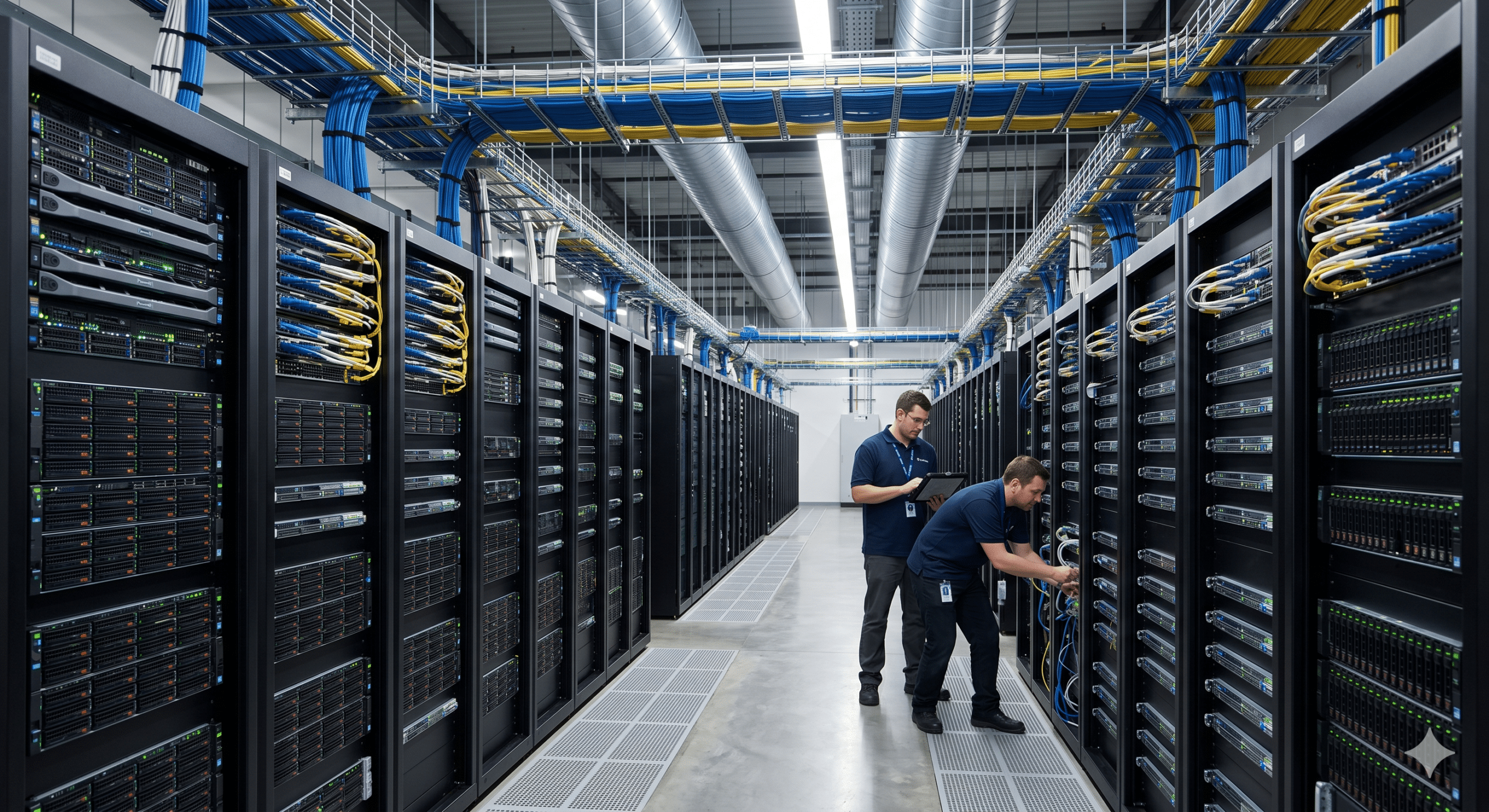
When I first walked into a large enterprise data center years ago, what surprised me most wasn’t the servers. It was the infrastructure surrounding them. The raised floors, cable trays, precision cooling units, redundant UPS systems, biometric access controls, environmental sensors, and endless rows of networking gear were far more impressive than the blinking server lights. Interestingly, many professionals in the industry say the same thing. The “invisible” infrastructure is often more critical than the compute hardware itself. (Reddit)
Why Data Centers Matter More Than Ever
The demand for Data Centers has exploded because the world now generates an unbelievable amount of digital traffic every second. Businesses rely on cloud computing. Remote work requires stable collaboration platforms. Streaming services consume massive bandwidth. Artificial intelligence needs enormous processing power. Edge computing is expanding. IoT devices constantly send telemetry data. Everything connects back to infrastructure.
The rise of AI has dramatically accelerated this demand. Modern AI workloads require high-density GPU clusters, advanced cooling technologies, and extremely fast networking fabrics. Traditional infrastructure designs are struggling to keep up with these power and performance requirements. Industry experts have even warned that power availability is becoming one of the biggest limitations facing future Data Centers. (IT Pro)
What many people don’t realize is that reliable infrastructure directly impacts business survival. A few minutes of downtime can cost companies millions of dollars in lost revenue, damaged reputation, and operational disruption. That’s why uptime, redundancy, and resilience are treated almost like religion inside enterprise environments.
The Core Components of Modern Data Centers
Servers and Compute Infrastructure
Servers are the brains of the operation. These machines handle applications, databases, virtualization workloads, AI processing, and cloud services. Years ago, organizations commonly deployed standalone physical servers for every application. Today, virtualization and containerization have completely transformed infrastructure efficiency.
Instead of running one application per server, organizations now use hypervisors and orchestration platforms to maximize hardware utilization. Technologies like VMware, Kubernetes, and hyper-converged infrastructure allow companies to scale resources dynamically while reducing hardware waste.
AI-focused environments are pushing this even further. GPU clusters, accelerated compute nodes, and ultra-fast storage systems are becoming standard in modern enterprise deployments.
Networking Systems
As a network engineer, I can confidently say the network is the nervous system of every data center. Without stable networking, even the most powerful servers become useless.
Modern Data Centers rely on high-speed switching, redundant routing, load balancing, and fiber interconnects to move massive amounts of traffic with minimal latency. Spine-leaf architectures have largely replaced traditional hierarchical designs because they provide better scalability and east-west traffic performance.
One major trend today is the growing importance of distributed infrastructure. AI workloads, cloud services, and edge computing require Data Centers to communicate seamlessly across long distances while maintaining low latency. (Cisco Blogs)
Interestingly, companies are also experimenting with entirely new network topologies to improve efficiency. Amazon recently introduced a quasi-random networking design aimed at reducing hardware requirements while improving throughput and lowering power consumption. (WIRED)
Storage Systems
Storage has evolved dramatically over the years. Traditional spinning hard drives are increasingly replaced by SSD and NVMe technologies that provide significantly faster performance.
Organizations now manage petabytes of data across hybrid environments that combine on-premises infrastructure, cloud storage, and backup repositories. Storage systems must balance speed, redundancy, scalability, and disaster recovery capabilities.
From experience, storage planning is often underestimated. Businesses focus heavily on compute power but forget that poor storage performance can bottleneck entire applications.
Power Infrastructure
Power systems are among the most important elements inside Data Centers. Servers cannot tolerate unstable electricity. Even short interruptions can damage hardware, corrupt data, or trigger outages.
That’s why enterprise facilities invest heavily in redundant power architecture. This typically includes UPS systems, backup generators, redundant electrical feeds, and intelligent power distribution units.
In high-tier facilities, power redundancy is designed so aggressively that infrastructure can survive multiple simultaneous failures without downtime.
The challenge today is that AI-driven infrastructure is consuming enormous amounts of electricity. Industry analysts have warned that power grid limitations may become a major obstacle for future expansion. (IT Pro)
Cooling Systems
Cooling is one of the least glamorous yet most essential parts of Data Centers. Hardware generates tremendous heat, especially AI and GPU workloads. If temperatures rise too high, equipment performance degrades rapidly and failure risks increase.
Traditional cooling relied heavily on chilled air and CRAC units. Modern facilities now use advanced airflow management, hot aisle containment, liquid cooling, and immersion cooling technologies.
Liquid cooling is becoming especially important for AI environments because high-density racks generate far more heat than older enterprise systems. Some operators are even redesigning facilities entirely around thermal efficiency.
From hands-on experience, airflow management alone can dramatically improve efficiency. Something as simple as poor cable organization can disrupt airflow patterns and create hotspots.
Redundancy: The Real Secret Behind Reliability
One of the biggest lessons in infrastructure engineering is that everything eventually fails. Hard drives fail. Switches fail. Power supplies fail. Cooling systems fail. Fiber links get damaged. Human mistakes happen.
The difference between a mediocre environment and a world-class data center is how well the infrastructure handles those failures.
That’s why redundancy exists everywhere. Dual power supplies. Multiple internet providers. Redundant core switches. Clustered firewalls. Replicated storage. Backup generators. Diverse fiber routes.
Enterprise-grade infrastructure is designed so there is no single point of failure. If one component dies, another immediately takes over.
In real-world operations, redundancy is not just a technical requirement. It’s peace of mind.
Security Inside Data Centers
When people think about cybersecurity, they usually imagine hackers and malware. Physical security is equally important inside Data Centers.
Most enterprise facilities implement multiple layers of access control, including biometric scanners, surveillance cameras, mantraps, badge systems, and strict visitor protocols.
From the network side, security includes segmentation, firewalls, IDS/IPS systems, zero-trust architecture, DDoS protection, endpoint security, and continuous monitoring.
Modern threats evolve constantly, which means security can never remain static. Infrastructure teams continuously update firmware, patch vulnerabilities, review access controls, and analyze suspicious traffic.
In many ways, managing infrastructure security feels like a never-ending chess match.
The Rise of Edge Data Centers
Traditional Data Centers were often centralized in major metropolitan regions. However, modern applications increasingly require lower latency and faster response times.
That’s where edge computing comes in.
Instead of processing everything in massive centralized facilities, organizations now deploy smaller Data Centers closer to users. These edge facilities improve performance for gaming, streaming, autonomous systems, IoT devices, and AI applications.
Edge infrastructure is becoming especially important in industries where milliseconds matter.
Sustainability and Energy Efficiency
One of the biggest conversations in infrastructure today revolves around sustainability. Data Centers consume enormous amounts of electricity and water, which has raised environmental concerns worldwide.
Modern operators are aggressively pursuing energy-efficient designs, renewable power integration, advanced cooling systems, and better infrastructure utilization. The U.S. Department of Energy has also published detailed best practices for improving data center efficiency. (The Department of Energy’s Energy.gov)
Power Usage Effectiveness, commonly called PUE, has become a critical metric in measuring facility efficiency.
Some companies are even redesigning networking architectures to reduce hardware footprints and lower energy consumption. (WIRED)
From my perspective, sustainability is no longer optional. It’s becoming a business necessity.
Cloud Computing Changed Everything
Years ago, many companies operated small on-premise server rooms. Today, cloud computing has fundamentally reshaped infrastructure strategy.
Organizations increasingly rely on hyperscale Data Centers operated by cloud providers. These facilities are engineered at a scale most businesses could never build independently.
However, despite the popularity of cloud platforms, on-premises infrastructure still matters. Many enterprises now operate hybrid environments that combine private infrastructure with public cloud services.
The reality is that there’s no one-size-fits-all solution. Infrastructure decisions depend on performance, compliance, budget, latency, and operational requirements.
The Human Side of Infrastructure
One thing people rarely talk about is how much human expertise goes into maintaining Data Centers.
Behind every stable application is a team of engineers monitoring systems, responding to alerts, replacing failed hardware, tuning networks, reviewing logs, managing backups, and planning upgrades.
Infrastructure work often happens quietly in the background. Nobody notices when everything works properly, but the pressure becomes intense during outages.
There’s also a unique mindset that develops in infrastructure operations. Engineers learn to expect problems before they happen. You constantly think about redundancy, disaster recovery, scalability, and worst-case scenarios.
That mindset may sound stressful, but it’s also deeply rewarding. There’s something satisfying about building systems people can depend on every single day.
The Future of Data Centers
The future of Data Centers will be shaped heavily by AI, automation, sustainability, and distributed computing.
AI workloads are already transforming rack densities, cooling strategies, and power requirements. Operators are investing billions into infrastructure expansion to support future demand. (Reters)
We’re also seeing increased automation through DCIM platforms, predictive analytics, and AI-assisted monitoring systems. Infrastructure is becoming smarter, more adaptive, and increasingly software-defined.
At the same time, power availability may become one of the biggest limiting factors for growth. Operators will need to innovate aggressively around efficiency, renewable energy, and intelligent infrastructure design.
From a networking perspective, ultra-fast interconnects, edge deployments, and low-latency architectures will continue expanding as digital demand grows.
One thing is certain: the importance of Data Centers will only increase in the years ahead.
Final Thoughts
Most people never see the infrastructure powering their digital lives, yet Data Centers quietly support nearly everything modern society depends on. They are the backbone of communication, commerce, entertainment, finance, healthcare, cloud computing, and artificial intelligence.
After years working around enterprise systems and network infrastructure, I’ve come to appreciate that great infrastructure is not about flashy hardware alone. It’s about resilience, planning, operational discipline, and engineering systems that continue working even when problems occur.
The best Data Centers are built with the understanding that failure is inevitable, but downtime is not.
That philosophy is what keeps the internet running every second of every day.
Frequently Asked Questions About Data Centers
What are Data Centers used for?
Data Centers are used to store, process, manage, and distribute digital information. They support websites, cloud services, enterprise applications, AI systems, databases, streaming platforms, and business operations.
Why are Data Centers important?
Data Centers are critical because modern businesses and online services depend on reliable digital infrastructure. Without them, cloud computing, online banking, streaming, remote work, and internet services would not function.
What equipment is inside Data Centers?
Common equipment includes servers, storage systems, switches, routers, firewalls, backup batteries, generators, cooling systems, and monitoring platforms.
How do Data Centers prevent downtime?
They use redundancy. This includes backup power systems, multiple network connections, clustered infrastructure, replicated storage, and disaster recovery planning.
Why do Data Centers need cooling systems?
Servers generate large amounts of heat. Cooling systems maintain safe operating temperatures to prevent hardware failure and performance degradation.
What is the difference between cloud computing and Data Centers?
Cloud computing delivers services over the internet, while Data Centers provide the physical infrastructure powering those cloud services.
Are Data Centers environmentally friendly?
Modern Data Centers are becoming more energy-efficient through renewable energy, advanced cooling technologies, optimized hardware utilization, and sustainable infrastructure design.
What careers exist in Data Centers?
Common roles include systems engineers, network engineers, data center technicians, cloud architects, cybersecurity specialists, infrastructure managers, and operations engineers.