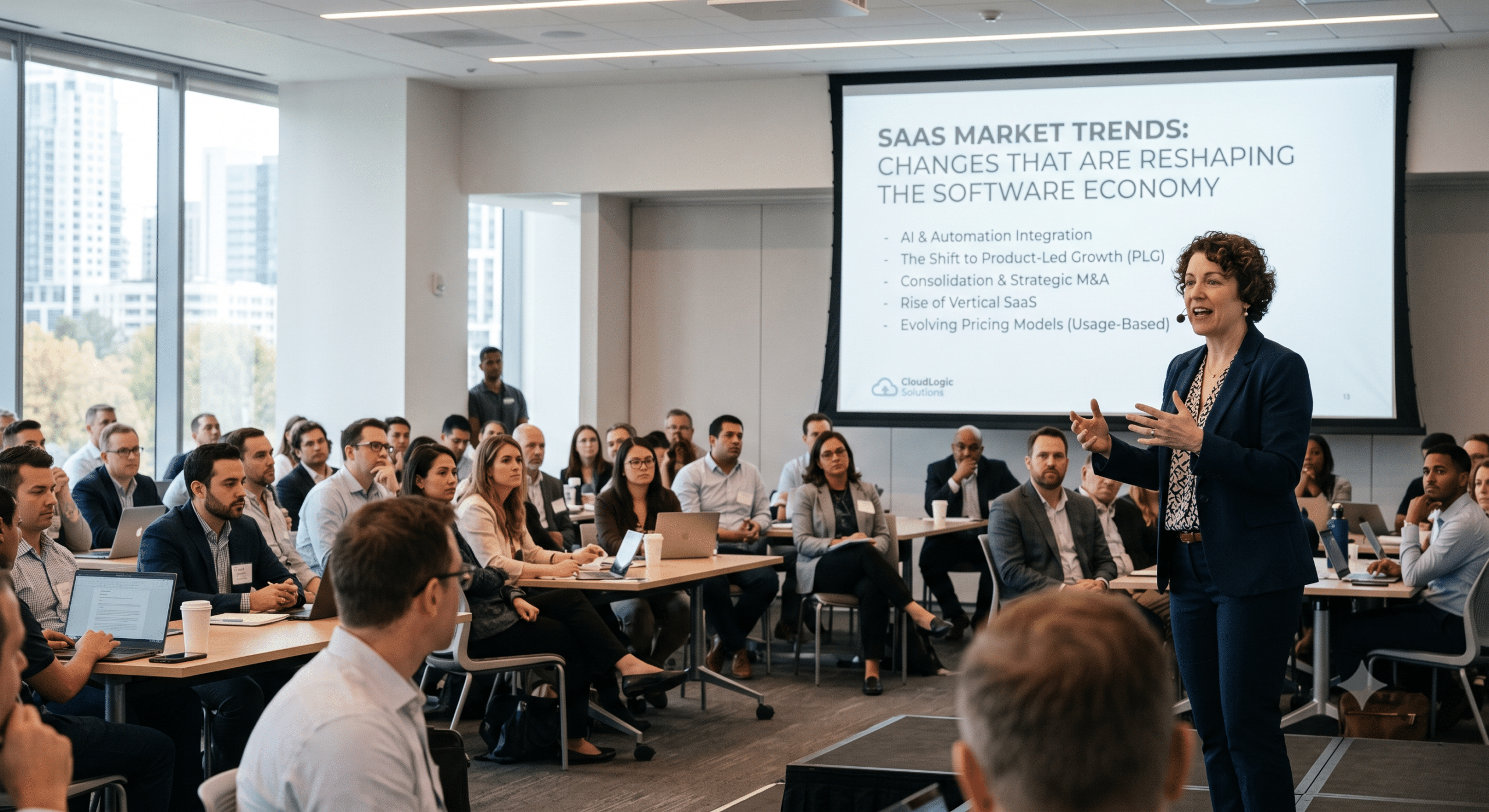
The software industry has changed more in the last five years than it did in the previous fifteen. As a result, as a Tech Economist, I spend a lot of time looking beyond product features and studying the business forces that shape technology markets. Today, SaaS Market Trends tell us much more than which software is popular; in fact, they reveal how companies invest, how customers spend, and where the digital economy is headed.
Software as a Service (SaaS) is no longer just a convenient way to buy software; instead, it has become the standard business model for thousands of technology companies. Consequently, businesses of every size—from startups to Fortune 500 enterprises—depend on cloud-based software for accounting, sales, marketing, cybersecurity, collaboration, customer service, and artificial intelligence.
Yet, the market is entering a new stage. Growth continues, however, investors are asking tougher questions. At the same time, customers are demanding greater value, and AI is fundamentally changing how software is built and sold. Therefore, instead of chasing rapid expansion at any cost, many SaaS companies are focusing on sustainable profits, customer retention, and smarter innovation. Indeed, Gartner notes that SaaS spending remains strong even as organizations become more selective about software investments, reflecting a more mature market. (Gartner)
Ultimately, understanding these SaaS Market Trends helps founders, investors, technology leaders, and buyers make better decisions. Furthermore, it provides valuable insight into where technology spending will flow over the next decade.
What Are SaaS Market Trends?
SaaS Market Trends are the long-term changes influencing how cloud software is developed, sold, purchased, and used.
Specifically, these trends include:
-
Customer buying behavior
-
Technology innovation
-
Pricing models
-
Artificial intelligence
-
Cloud infrastructure
-
Competition
-
Investor expectations
-
Economic conditions
-
Government regulations
-
Security requirements
Unlike short-lived technology fads, market trends usually develop over several years. As a result, businesses that recognize these patterns early often gain a distinct competitive advantage.
Why SaaS Continues to Lead Digital Transformation
Many people expected SaaS growth to slow dramatically after the pandemic. However, companies simply became more selective about their purchases.
In practice, organizations continue replacing traditional software because SaaS offers important economic advantages, such as:
-
Lower upfront costs
-
Faster deployment
-
Automatic updates
-
Flexible subscriptions
-
Better scalability
-
Easier remote access
-
Reduced maintenance costs
According to McKinsey, SaaS remains a core driver of digital transformation because organizations increasingly prefer cloud-based applications that reduce operational complexity while improving business agility. (McKinsey & Company)
For economists, this represents an important shift: namely, companies are spending less on owning software and more on accessing ongoing digital services. Consequently, that change affects nearly every technology market.
11 SaaS Market Trends Every Business Should Watch
1. Artificial Intelligence Is Becoming a Standard Feature
Perhaps the biggest of all SaaS Market Trends is the rapid integration of artificial intelligence. Only a few years ago, AI was considered a premium feature; today, however, customers expect AI capabilities in nearly every application.
Key examples include:
-
AI writing assistants
-
Predictive analytics
-
Customer service chatbots
-
Sales forecasting
-
Automated coding
-
Intelligent workflow automation
-
AI-powered search
Because of this shift, software companies that fail to integrate AI may struggle to remain competitive. The market has shifted from asking, “Does this software have AI?” to “How useful is its AI?” This distinction matters because customers now judge software based on measurable productivity improvements rather than marketing claims. Furthermore, Gartner expects AI capabilities to become increasingly embedded within existing cloud software offerings rather than existing as standalone products. (Gartner)
2. Profitability Is More Important Than Rapid Growth
Several years ago, investors rewarded SaaS companies primarily for adding customers quickly. Today, on the other hand, financial discipline matters much more.
As a result, investors increasingly evaluate:
-
Profit margins
-
Free cash flow
-
Customer retention
-
Operating efficiency
-
Revenue quality
This represents one of the healthiest SaaS Market Trends in recent years. Instead of spending aggressively to acquire customers at any cost, software companies are improving efficiency while building stronger businesses. Economically speaking, this creates healthier long-term markets because companies become less dependent on outside funding.
3. Customers Want Fewer Software Subscriptions
Businesses now subscribe to dozens—or even hundreds—of SaaS products, which creates new operational problems.
Specifically, organizations face:
-
Duplicate software
-
Rising subscription costs
-
License waste
-
Security risks
-
Poor integration
Instead of buying another tool, many companies first ask: “Can our existing software already do this?” Consequently, this shift encourages software vendors to build broader platforms instead of narrow point solutions. Moreover, it increases demand for software management platforms that monitor subscriptions, usage, compliance, and spending across the enterprise. Gartner highlights SaaS management as a growing priority as organizations seek greater visibility and cost control. (Gartner)
4. Usage-Based Pricing Continues to Grow
Traditional SaaS pricing looked simple (Basic, Professional, Enterprise). Now, however, pricing has become much more flexible.
For instance, many companies charge based on:
-
API requests
-
Storage usage
-
AI tokens
-
Data processed
-
Active users
-
Transactions
-
Compute time
Usage-based pricing better aligns customer costs with business value. From an economic perspective, this represents a move toward consumption-based digital markets, similar to electricity or cloud infrastructure services. Thus, customers appreciate paying only for what they actually use.
5. Vertical SaaS Is Expanding Rapidly
Generic software still dominates many industries; however, specialized SaaS continues growing much faster.
Key examples include software built specifically for:
-
Healthcare
-
Construction
-
Manufacturing
-
Insurance
-
Hospitality
-
Agriculture
-
Legal services
-
Logistics
Vertical SaaS solves industry-specific problems that general software often cannot address effectively. To achieve this, these platforms usually include industry regulations, specialized workflows, custom reporting, and compliance tools. Therefore, as industries digitize further, vertical SaaS will likely remain one of the strongest SaaS Market Trends.
6. Customer Retention Matters More Than Customer Acquisition
Finding new customers has become more expensive; meanwhile, keeping existing customers has become more valuable. Naturally, this changes how software companies invest.
Instead of focusing only on marketing, successful SaaS businesses now prioritize:
-
Customer success
-
Better onboarding
-
Product education
-
Personalized support
-
Community building
-
Continuous improvements
Ultimately, retention improves predictable recurring revenue. From an economic perspective, recurring customers reduce uncertainty while increasing lifetime value—thereby creating healthier business models and stronger company valuations.
7. Platform Ecosystems Are Winning Over Standalone Tools
One of the most important SaaS Market Trends is the rise of software ecosystems. Years ago, businesses were comfortable using separate applications for every department (e.g., marketing had one tool, sales had another, finance used something different). Today, however, companies want connected systems.
Instead of managing dozens of unrelated applications, they prefer platforms that work together through shared data and integrated workflows. Popular ecosystem categories include:
-
Customer relationship management (CRM) platforms
-
Enterprise resource planning (ERP) systems
-
Marketing automation suites
-
Human resource platforms
-
Collaboration ecosystems
This shift reduces manual work while improving reporting and decision-making. For software vendors, ecosystems create stronger customer loyalty because businesses become invested in the broader platform rather than a single application. In economic terms, ecosystems increase switching costs, which in turn leads to higher customer retention and more predictable recurring revenue.
8. Cybersecurity Is Becoming a Built-In Business Requirement
Cybersecurity is no longer treated as an optional add-on; rather, customers now expect every SaaS provider to demonstrate strong security practices before signing a contract.
As a result, enterprise buyers commonly evaluate:
-
Data encryption
-
Multi-factor authentication
-
Identity management
-
Access controls
-
Compliance certifications
-
Security monitoring
-
Disaster recovery planning
This trend is especially important as companies move more critical operations to cloud-based software. According to the IBM Cost of a Data Breach Report, organizations continue investing heavily in security because cyber incidents remain expensive and disruptive to business operations. Furthermore, strong security improves customer trust and reduces long-term financial risk. Hence, for digital economists, cybersecurity spending should be viewed as an investment rather than simply an operating expense.
9. AI Agents Are Transforming Software Workflows
Artificial intelligence has already improved software through automation, but the next phase goes much further. Specifically, AI agents are beginning to perform entire business tasks with minimal human involvement.
Instead of simply answering questions, AI systems can now:
-
Schedule meetings
-
Analyze business reports
-
Generate sales proposals
-
Draft emails
-
Review contracts
-
Process invoices
-
Build software code
-
Monitor business performance
This fundamentally changes how organizations measure software value. Rather than paying for individual features, customers increasingly evaluate how much work the software can complete on their behalf. Consequently, this evolution creates entirely new pricing opportunities for SaaS providers while significantly increasing productivity for customers. As a Tech Economist, I see AI agents shifting software from being a productivity tool to becoming a digital workforce that supports employees across multiple business functions.
10. Global Expansion Continues Despite Economic Uncertainty
The SaaS industry is no longer concentrated in a few technology hubs; instead, cloud software companies now serve customers across nearly every region of the world.
Several factors support this continued expansion:
-
Faster internet infrastructure
-
Remote work adoption
-
Digital payment systems
-
Cloud computing availability
-
Mobile-first business operations
-
International collaboration
Because of these factors, small software companies can now compete globally from their first day of operation, as cloud delivery removes many of the physical barriers that once limited international growth. However, global expansion also introduces new challenges. Software companies must address local privacy laws, data residency requirements, language localization, regional tax rules, currency support, and cultural buying preferences. Therefore, successful SaaS businesses increasingly design products with international customers in mind rather than focusing solely on a domestic market.
11. Investors Are Looking for Sustainable Value Creation
The investment community has become noticeably more selective. Several years ago, rapid revenue growth often outweighed concerns about profitability; today, however, investors pay closer attention to business fundamentals.
In particular, they evaluate:
-
Net revenue retention
-
Customer lifetime value
-
Gross margins
-
Operating efficiency
-
Cash flow generation
-
Product differentiation
-
Long-term competitive advantages
This represents one of the healthiest SaaS Market Trends because it encourages companies to build durable businesses instead of pursuing unsustainable growth. In the long run, healthy financial performance provides greater stability during economic downturns and allows companies to invest consistently in innovation. As a result, the market benefits from a stronger software ecosystem that serves customers, employees, and investors alike.
Economic Forces Driving SaaS Market Trends
Technology markets do not operate independently; instead, every software company is influenced by broader economic conditions.
Interest Rates
When interest rates rise, borrowing becomes more expensive. Consequently, investors often become more cautious, encouraging SaaS companies to prioritize profitability instead of aggressive expansion.
Inflation
Inflation increases operating costs across the technology sector. Specifically, software companies face higher expenses for salaries, cloud infrastructure, marketing, office operations, and professional services, which directly influences pricing strategies and investment decisions.
Digital Transformation
Organizations continue modernizing outdated systems. Rather than maintaining expensive on-premises software, businesses increasingly migrate to cloud platforms that offer greater flexibility and lower maintenance requirements. This long-term transition remains one of the strongest economic drivers of SaaS demand.
Artificial Intelligence Investment
AI has become a strategic priority across industries. As a result, businesses are investing not only in AI-powered software but also in the cloud infrastructure required to support advanced machine learning applications—further boosting demand for scalable SaaS solutions.
What Business Leaders Should Watch Next
Technology executives should avoid chasing every new software trend. Instead, they should monitor indicators that signal lasting market changes.
Key metrics to track include:
-
Customer retention rates
-
Net recurring revenue
-
Product adoption
-
AI feature usage
-
Infrastructure costs
-
Customer acquisition expenses
-
Subscription renewal rates
-
International expansion
-
Regulatory developments
-
Enterprise software spending
These indicators often reveal where the market is heading before broader industry reports become available. Therefore, leaders who regularly review these metrics can make more informed investment decisions and better prepare for future market shifts.
Common Mistakes Companies Make When Following SaaS Market Trends
Not every trend deserves immediate action. In fact, some organizations waste significant resources by reacting too quickly to market headlines.
Common pitfalls include:
-
Buying Software Without a Clear Strategy: Purchasing multiple applications without evaluating business needs often leads to unnecessary costs and operational complexity.
-
Ignoring Integration: Even excellent software delivers limited value if it cannot connect with existing systems. Therefore, integration planning should occur before implementation, not afterward.
-
Chasing Artificial Intelligence Without Business Goals: Adding AI simply because competitors are doing so rarely produces meaningful results. Instead, successful AI adoption begins with identifying real business problems that automation can solve.
-
Focusing Only on New Customers: Companies sometimes overlook existing customers while pursuing new sales. However, strong customer retention usually generates more predictable long-term revenue than constant acquisition.
-
Underestimating Security Investments: Security should be considered part of product quality, not an optional expense—especially as customers increasingly expect strong security standards from every SaaS provider.
Why These Trends Matter for the Future Economy
Software has become one of the world’s most valuable economic assets. Unlike physical products, cloud software can scale to millions of users without requiring equivalent increases in manufacturing costs.
This unique economic characteristic allows successful SaaS businesses to generate recurring revenue while continuously improving their products through regular updates. As AI, automation, and cloud computing continue advancing, software will influence nearly every industry—from healthcare and education to manufacturing and financial services.
Ultimately, the organizations that understand today’s SaaS Market Trends will be better positioned to compete in tomorrow’s digital economy. Rather than viewing software as a mere technology purchase, business leaders should increasingly see it as a long-term investment in productivity, innovation, and competitive advantage.
Conclusion
A Shift Toward Sustainable Enterprise Value
The software industry is entering one of the most exciting periods in its history. Looking at today’s SaaS Market Trends, it is clear that the market is moving beyond simple cloud adoption into a new era defined by artificial intelligence, platform consolidation, cybersecurity, and operational efficiency.
From a Tech Economist’s perspective, the companies that succeed over the next decade will not necessarily be those with the largest marketing budgets. Instead, they will be organizations that create measurable business value, adapt quickly to customer needs, and build sustainable recurring revenue models.
Adapting to a New Economic Reality
In summary, the economic landscape has changed:
-
Investors expect profitability alongside growth.
-
Customers expect integrated platforms instead of disconnected applications.
-
Governments continue introducing regulations around privacy and security.
-
AI is actively reshaping how software is developed, sold, and consumed.
Businesses that understand these shifts can make smarter technology investments and avoid expensive mistakes. Rather than chasing every new trend, successful organizations evaluate how each innovation contributes to productivity, customer satisfaction, and long-term financial performance.
Key Developments to Watch
Looking ahead, several key developments deserve close attention:
-
Agentic AI becoming part of everyday business software
-
Greater demand for industry-specific SaaS solutions
-
Continued platform consolidation
-
Increased investment in cybersecurity and compliance
-
Expansion of usage-based pricing models
-
More global competition among SaaS providers
-
Higher expectations for customer experience
-
Continued growth of cloud infrastructure
-
Stronger focus on recurring revenue quality
-
Greater automation across business functions
-
Data-driven decision-making becoming the competitive standard
The Future of SaaS as an Economic Engine
In short, these developments show that SaaS Market Trends are no longer only about technology; rather, they are shaping employment, investment, productivity, and the broader digital economy.
Organizations that continuously evaluate market intelligence, customer behavior, and emerging technologies will be better prepared to compete in an increasingly software-driven world. Ultimately, the future belongs to businesses that view SaaS not simply as software, but as an economic engine that drives innovation, efficiency, and sustainable growth.
Frequently Asked Questions (FAQ)
What are SaaS Market Trends?
SaaS Market Trends are long-term patterns that influence how cloud-based software is developed, sold, priced, and adopted. For example, they include changes in artificial intelligence, customer expectations, subscription pricing, cybersecurity, cloud infrastructure, and investor priorities.
Why are SaaS Market Trends important?
Understanding SaaS Market Trends helps business leaders make informed decisions about software investments, product development, budgeting, and long-term digital strategies. Ultimately, staying ahead of these trends can improve competitiveness and reduce technology risks.
Is the SaaS market still growing?
Yes. Although growth has become more balanced than in previous years, the SaaS industry continues to expand worldwide. Organizations are still investing heavily in cloud software, AI-powered applications, and digital transformation initiatives—even as they become more selective about overall software spending. (Gartner)
How is artificial intelligence changing SaaS?
Artificial intelligence is transforming SaaS by automating repetitive work, improving analytics, enhancing customer support, generating content, and enabling AI agents that can perform increasingly complex business tasks. As a result, AI has become a major competitive differentiator across nearly every software category.
What industries benefit the most from SaaS?
Many industries rely on SaaS, including:
-
Healthcare
-
Financial services
-
Manufacturing
-
Retail
-
Education
-
Logistics
-
Construction
-
Government
-
Hospitality
-
Professional services
Industry-specific SaaS solutions continue to grow because they address specialized workflows and compliance requirements.
What is Vertical SaaS?
Vertical SaaS refers to cloud software designed specifically for one industry instead of serving all businesses. For instance, examples include healthcare management systems, legal practice software, manufacturing execution platforms, and construction project management solutions.
What is usage-based pricing?
Usage-based pricing allows customers to pay according to how much they use a service instead of paying a fixed monthly subscription. Pricing may depend on API calls, storage, AI tokens, compute time, transactions, or data processed.
Why are investors focusing more on profitability?
Higher interest rates and a more mature software market have shifted investor priorities. Therefore, instead of rewarding growth at any cost, investors increasingly evaluate recurring revenue quality, customer retention, operating efficiency, and long-term profitability.
How should businesses prepare for future SaaS Market Trends?
Organizations should:
-
Review software subscriptions regularly.
-
Invest in platforms that integrate well.
-
Prioritize cybersecurity.
-
Evaluate AI features based on real business value.
-
Monitor customer adoption metrics.
-
Train employees on new technologies.
-
Focus on long-term digital transformation rather than short-term fads.
Will SaaS eventually replace traditional software?
In many industries, cloud software has already become the preferred delivery model. However, some organizations with specialized security, regulatory, or operational requirements will continue using on-premises systems. Thus, the future is likely to be a hybrid environment where SaaS and traditional software coexist.
Key Takeaways
-
SaaS Market Trends continue to reshape the global technology economy.
-
Artificial intelligence is becoming a standard feature rather than a premium add-on.
-
Platform ecosystems are actively replacing disconnected software tools.
-
Cybersecurity is now a mandatory business necessity.
-
Usage-based pricing is becoming increasingly common across software markets.
-
Vertical SaaS solutions are growing rapidly within specialized industries.
-
Investors increasingly reward sustainable profitability instead of growth alone.
-
Global SaaS adoption continues expanding despite economic uncertainty.
-
Customer retention has become just as important as customer acquisition.
-
Ultimately, market intelligence enables businesses to make smarter, future-proof technology investments.
References
The following high-authority resources provide valuable research and analysis on SaaS Market Trends and the broader software economy:
-
Gartner – Market Share: Enterprise Software, Worldwide, 2024 – Comprehensive analysis on worldwide enterprise software growth, cloud subscription revenue, and market share distribution.
-
Gartner – Market Share: Enterprise Application Software, Worldwide, 2024 – Detailed metrics on enterprise application software growth and top-performing functional categories.
-
McKinsey & Company – What Is SaaS? – Executive explainer covering SaaS fundamentals, cloud software economics, value creation, and generative AI disruption.
-
McKinsey & Company – The Next Software Disruption: How Vendors Must Adapt – Strategic roadmap on how enterprise software companies must evolve across SaaS models, PaaS competition, and margin optimization.
-
McKinsey & Company – Turning India into a SaaS Power – In-depth study on global SaaS market trajectories, emerging technology hubs, and long-term value creation.