
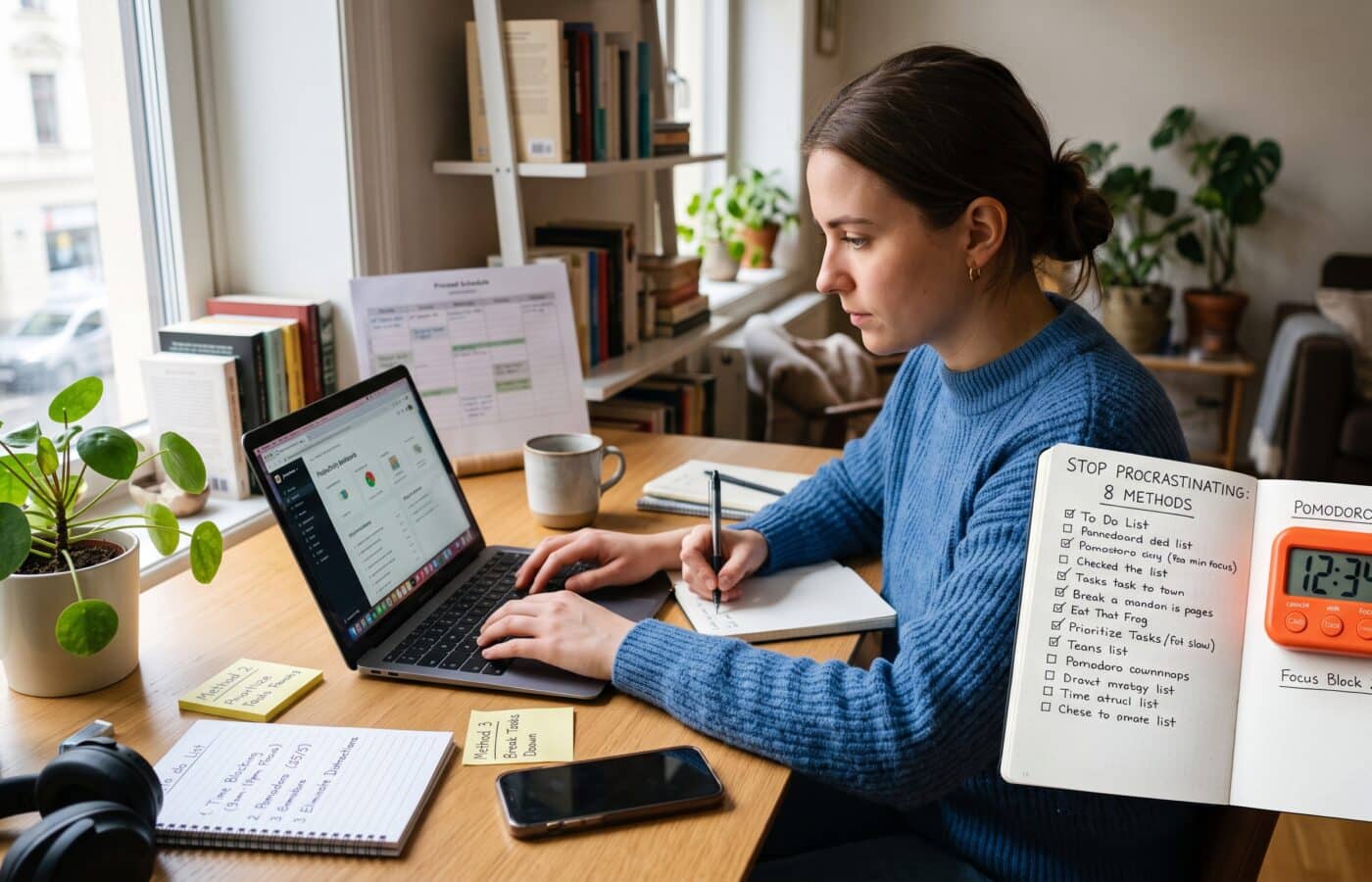
How to Stop Procrastinating: 8 Methods a CBT Therapist Teaches Clients

If you want to know how to stop procrastinating, the key is not forcing more discipline on yourself, but understanding why you put things off in the first place. Most people who ask me for help expect a lecture about willpower. They sit down on the couch in my office, apologize for being late on something like a thesis, a tax return, or an email to a family member, and wait for me to tell them to try harder.
I never do. After many years of working with chronic procrastinators, I can tell you that trying harder is almost never the missing ingredient. The people I see are usually trying very hard. They are just trying hard at the wrong thing, treating an emotional regulation problem as if it were a time management flaw.
We sat down for a long conversation about why we avoid tasks, what actually changes the pattern, and the eight practical methods I teach clients most often. What follows is that conversation, lightly edited for length and clarity.
Why Do We Procrastinate in the First Place?
Let’s start with the obvious question. Why do people procrastinate if they know it hurts them?
Because procrastination is not really a time management problem. It is a mood management problem. That is the single most important idea in this whole conversation, so I will say it plainly: we avoid tasks because of how they make us feel, not because we cannot read a calendar.
Researchers like Fuschia Sirois and Timothy Pychyl have written about this for years. Their work describes procrastination as the priority of short-term mood repair over long-term goals. In simple terms, a task shows up and brings some unpleasant feeling with it. Boredom, anxiety, confusion, resentment, fear of being judged. Putting the task off makes that feeling go away almost instantly. And anything that makes a bad feeling go away instantly is going to get repeated.
So avoidance is a kind of reward?
Exactly, and understanding it is the first step in learning how to stop procrastinating. In CBT we call it negative reinforcement. You open the document, you feel a small wave of dread, you check your phone instead, and the dread lifts. Your brain learns a very clear lesson: phone equals relief. The problem is that the relief is borrowed. The task is still there tomorrow, now with a layer of guilt on top, which makes it even more unpleasant to approach. That loop is what keeps people stuck for months.
How Common Is Procrastination?
How common is this?
Very. Joseph Ferrari’s research, which the American Psychological Association has highlighted, estimates that around 20 percent of adults are chronic procrastinators. Piers Steel’s large review of the literature, published in Psychological Bulletin in 2007, suggested that the vast majority of college students procrastinate on a regular basis. So if you are reading this and feeling like the only person who cannot get started, you are in very large company.
Is it just laziness, though? That is what a lot of people call themselves.
I hear that word almost every week, and I gently push back on it every time. Lazy people do not lie awake at 2 a.m. feeling sick about the report they have not written. The people I work with care a great deal. Often they care too much. Perfectionism, fear of failure, and a harsh inner critic show up far more often in my practice than any lack of motivation.
What Does a CBT Therapist Actually Do About It?
When someone comes to you for procrastination, what does the work look like?
CBT works on three things at once: thoughts, feelings, and behavior. We look at the thoughts that show up right before you avoid something. We look at the feelings those thoughts create. And we change the behavior in small, deliberate ways so your brain collects new evidence.
There is solid research behind this. A randomized controlled trial led by Alexander Rozental in Sweden, published in 2018, found that CBT for procrastination reduced symptoms whether it was delivered over the internet or in groups. That matters, because it means these skills can be learned. They are not personality traits you are stuck with.
So what are the methods? You mentioned eight.
Yes. These are the eight I come back to again and again. None of them is a magic trick. But used together, they are the most honest answer I can give to the question of how to stop procrastinating.
Method 1: Name the Feeling Before You Fight the Task
Where do you start with a new client?
With the feeling, not the task. When you notice yourself drifting away from something, pause for ten seconds and ask: what am I feeling right now? Then name it in one or two words. “Anxious.” “Bored.” “Embarrassed.” “Overwhelmed.”
It sounds too simple to matter, but naming an emotion tends to take some of the heat out of it. It also changes the question you are asking yourself. Instead of “Why am I so useless?” you are asking “What do I need to do with this anxiety?” That second question actually has answers.
Can you give an example?
A client I will call Maya, a graduate student, had not touched her dissertation chapter in six weeks. When we slowed down and looked at what happened each time she opened the file, the feeling was not boredom. It was shame. Her advisor had made one critical comment months earlier, and every time she saw the document, she heard that comment again. Once we named it as shame, we could work on the shame directly. The writing started moving within two weeks.
Method 2: Catch and Question the Thoughts That Keep You Stuck
You mentioned thoughts. What kind of thoughts drive procrastination?
There are a few classic ones. In CBT we call them cognitive distortions, which is just a formal way of saying thinking patterns that feel true but are not accurate. With procrastination, I see these constantly:
- All-or-nothing thinking. “If I cannot do it perfectly, there is no point starting.”
- Fortune-telling. “This is going to be awful and take forever.”
- The mood myth. “I will do it when I feel more motivated.”
- Discounting the future. “I will have more energy tomorrow.”
How do you challenge those?
Write the thought down, word for word. Then ask a few questions. Is there real evidence for this? What evidence points the other way? How would I respond to a friend who told me this? Could there be a more balanced way to see it?
Take “I will do it when I feel motivated.” The honest answer is that motivation usually shows up after we start, not before. Almost everyone has had the experience of dreading something, finally beginning, and finding it was not nearly as bad as expected. Your job is not to wait for the feeling. Your job is to start without it and let the feeling catch up.
That last point seems important.
It might be the most important sentence in the whole article. Action creates motivation far more reliably than motivation creates action.
Method 3: Shrink the First Step Until It Feels Almost Silly
Once someone understands their thoughts and feelings, what changes in behavior?
The first practical step in how to stop procrastinating is to make the starting point absurdly small. Procrastination loves vague, enormous tasks. “Write the report.” “Clean the garage.” “Sort out my finances.” Those are not tasks. Those are projects wearing a disguise.
I ask clients to define the next physical action, the thing they could do in the next five minutes with their hands. A few examples of big tasks and their tiny first steps:
- Write the report: open the file and type the title.
- Clean the garage: put three things in the recycling bin.
- Sort out my finances: list last month’s three biggest expenses, the first step toward making a budget.
- Draft a business plan: write one sentence describing your first customer.
- Back up my files: turn on cloud backup for one folder.
An AI assistant can even help you break a big project into small next actions, though you still choose which one to do first.
Why Tiny Steps Work
Why does that work so well?
Because it lowers the emotional cost of entry. Your brain is doing a quick calculation every time you consider a task: how uncomfortable is this going to be? A giant task scores very high. A tiny task scores almost nothing. And once you are moving, a lot of the dread tends to dissolve, which is exactly what Tim Pychyl describes when he talks about “just getting started.” Momentum is real.
What if the small step is all someone does?
Then that counts as a win. I mean that sincerely. Doing a little is enormously better than doing nothing, because every small start is a piece of evidence that contradicts the story “I never follow through.”
Method 4: Use If-Then Plans to Decide in Advance
You have mentioned planning a few times. Is there a particular style of planning you recommend?
Yes, and it is one of the most reliable ways to stop procrastinating. The psychologist Peter Gollwitzer spent years studying something called implementation intentions. The idea is to link a specific situation to a specific action using a simple “if, then” structure.
Instead of “I will work on my application this week,” you say: “If it is 8 a.m. on Tuesday and I have finished my coffee, then I will sit at the kitchen table and write the first paragraph of my personal statement.”
Why is that better than a regular goal?
Because it removes the decision from the moment when you are most likely to avoid it. Procrastination thrives in the gap between intending and doing. When you have already decided when, where, and how, there is much less room for negotiation with yourself. Gollwitzer’s research, and many studies built on it since, has shown that these simple plans make people noticeably more likely to follow through than goals alone.
Can you use them for the avoidance itself?
Absolutely, and this is one of my favorite uses. “If I notice myself reaching for my phone while I am working, then I will put it in the other room and take three slow breaths.” You are planning for the urge in advance, so it does not catch you off guard.
Method 5: Work in Short, Protected Blocks
What about how long people should work?
Short. Much shorter than most people think. I usually suggest starting with 15 to 25 minutes of focused effort, followed by a real break. Some people know this as the Pomodoro Technique, but the name matters less than the principle.
Why short blocks rather than a long session?
Two reasons, and both matter if you want to stop procrastinating. First, a clear end point makes the task feel tolerable. Telling yourself “I only have to do this for 20 minutes” is far less threatening than “I have to finish this today.” Second, protected time is honest time. For those 20 minutes, the phone is in another room, notifications are off, and the browser tabs you do not need are closed.
You mentioned environment. How much does that matter?
A great deal. We tend to overestimate willpower and underestimate our surroundings. If your phone is on the desk, you will look at it. That is not a character flaw. It is how attention works. This is doubly true if you are working from home, where distractions sit in every room. So I encourage people to make distraction inconvenient and focus easy. Put the thing you need in front of you. Put the thing that tempts you out of reach.
Method 6: Plan for Discomfort Instead of Waiting for It to Pass
Many people say they want to feel ready before they start. What do you tell them?
I tell them that readiness is often a feeling that never arrives. Much of CBT, and especially the approaches that grew out of it like Acceptance and Commitment Therapy, is about learning to act while uncomfortable feelings are present, rather than waiting for them to go away first.
I sometimes use a simple exercise. Before starting a dreaded task, rate your expected discomfort on a scale of 0 to 10. Then start, and after ten minutes, rate your actual discomfort. Most people find the real number is lower than the predicted one, sometimes by a lot.
So it is a kind of experiment?
Exactly. In CBT we call these behavioral experiments, and they are a practical way to stop procrastinating. You treat your fearful prediction like a hypothesis and test it. The more often you test it, the less power the prediction has. Over time your brain learns that the anticipation is usually worse than the task.
What if the discomfort is actually high?
Then you acknowledge it without letting it make the decision for you. You can say something like, “I notice I am feeling really anxious about this, and I am going to write one sentence anyway.” Feelings are allowed to come along for the ride. They just do not get to drive.
Method 7: Forgive Yourself for Past Procrastination
This one surprises people, I imagine.
It surprises almost everyone who wants to stop procrastinating. Most people assume that being hard on themselves is what keeps them in line. The research suggests the opposite.
A study by Michael Wohl, Timothy Pychyl, and Shannon Bennett, published in 2010, followed first-year university students across two sets of exams. Students who forgave themselves for procrastinating before the first exam procrastinated less before the second one. The researchers found that self-forgiveness reduced negative emotion, and that reduced negative emotion appeared to be part of why the pattern improved.
Why would forgiveness help rather than hurt?
Think back to the idea that procrastination is mood management. If every time you think about a task you also feel a wave of self-criticism, you have just made the task more unpleasant. And unpleasant tasks are exactly the ones we avoid. Self-criticism adds fuel to the loop.
Forgiveness is not the same as excusing. It means saying, “I put this off. That was not ideal. I understand why it happened, and I am going to try something different now.” It lets you close the chapter so you can move forward, instead of dragging the guilt into the next attempt.
How do you practice that in real life?
I ask clients to speak to themselves the way a kind but honest coach would. Not a cheerleader who says everything is fine, and not a drill sergeant who calls you names. Someone who sees the mistake clearly and still believes in you. Kristin Neff’s research on self-compassion supports this approach, and I see it work in session every week.
Method 8: Connect the Task to What You Actually Value
Is there a bigger-picture element to all of this?
Yes, and it is the one I save for last because it holds everything else about how to stop procrastinating together. People procrastinate far more on tasks that feel meaningless or imposed. When a task feels connected to something you care about, it becomes easier to tolerate the discomfort of starting.
So I ask: why does this matter to you? Not to your boss or your parents, but to you. Finishing the tax return might connect to financial security for your family, like finally building an emergency fund. Answering that difficult email might connect to being the kind of friend you want to be. Writing the thesis might connect to proving to yourself that you can finish hard things. Starting a small business you keep talking about might connect to the independence you want.
What if the task truly has no personal meaning?
Some tasks are just chores, and that is fine. In those cases I encourage people to connect the task to a value one level up. “I do not care about this expense report, but I care about being reliable for my team.” You can also pair a dull task with something pleasant, such as a favorite playlist or working from a café. Researchers sometimes call this temptation bundling. It is a small way of making the unpleasant a little less so.
When Procrastination Is a Sign of Something Deeper
Are there times when these methods are not enough?
Yes, and I want to be very clear about this. Sometimes chronic procrastination is connected to depression, anxiety disorders, or ADHD. If you have tried everything and you still cannot get started, if the avoidance is affecting your job, your relationships, or your health, or if you feel hopeless or stuck most of the time, please talk to a qualified mental health professional.
What should someone look for?
If you are still stuck on how to stop procrastinating, look for a licensed therapist who has specific training in cognitive behavioral therapy. Ask about their experience with procrastination, perfectionism, or anxiety. A good therapist will not simply give you a list of tips. They will help you understand your particular pattern and what keeps it going.
There is nothing shameful about needing that help. Procrastination is one of the most human things there is.
A Final Word on How to Stop Procrastinating
If a reader takes away just one thing, what should it be?
That you are not broken, and you are not lazy. You have a brain that is very good at protecting you from uncomfortable feelings in the short term, and it is doing that job a little too well.
Learning how to stop procrastinating is less about forcing yourself and more about understanding yourself. Name the feeling. Question the thought. Shrink the step. Decide in advance. Work in short blocks. Expect discomfort. Forgive yourself. And remember why it matters.
You do not need to use all eight methods at once. Pick one. Try it today, on something small. Then notice what happens. That noticing is where change begins.
Frequently Asked Questions About How to Stop Procrastinating
What is the fastest way to stop procrastinating right now?
Pick the smallest possible next action on the task you are avoiding and do only that for five minutes. Set a timer, remove your phone from reach, and start. The goal is not to finish, only to begin, because starting usually lowers the dread that keeps you stuck. The Cleveland Clinic offers similar practical strategies.
Is procrastination a mental health problem?
Procrastination on its own is not a diagnosis. It is a very common behavior. However, chronic procrastination can be linked with anxiety, depression, perfectionism, and ADHD. If it seriously affects your work, relationships, or wellbeing, speaking with a licensed therapist is a good idea. The American Psychological Association has discussed the emotional roots of procrastination with researcher Fuschia Sirois.
Can cognitive behavioral therapy help with procrastination?
Yes. CBT helps you identify the thoughts and feelings behind avoidance and change your behavior in small, manageable steps. A randomized controlled trial published in 2018 found that CBT reduced procrastination whether it was delivered online or in groups.
Why do I procrastinate even on things I care about?
Tasks that matter to us often carry more emotional weight, such as fear of failure or fear of being judged. That extra pressure can make avoidance more tempting, not less. Research on short-term mood regulation explains why we prioritize feeling better now over our future goals.
Does being hard on myself help me stop procrastinating?
Usually not. Research suggests that forgiving yourself for past procrastination is linked with less procrastination later, because it reduces the negative emotions that fuel avoidance.
How long does it take to break the habit of procrastination?
There is no fixed timeline. Many people notice small improvements within a few weeks of practicing specific strategies consistently. Deeper patterns, especially those tied to perfectionism or anxiety, can take longer and may benefit from working with a therapist.
What are implementation intentions?
They are simple “if, then” plans that link a situation to an action, such as “If it is 9 a.m. on Monday, then I will open my report and write for 20 minutes.” Research by psychologist Peter Gollwitzer shows these plans make follow-through more likely.
References
- American Psychological Association. (2010). “Psychology of Procrastination: Why People Put Off Important Tasks Until the Last Minute.” apa.org
- American Psychological Association. “Why We Procrastinate and What to Do About It, With Fuschia Sirois, PhD.” Speaking of Psychology podcast. apa.org
- Steel, P. (2007). “The Nature of Procrastination: A Meta-Analytic and Theoretical Review of Quintessential Self-Regulatory Failure.” Psychological Bulletin, 133(1), 65 to 94. pubmed.ncbi.nlm.nih.gov
- Sirois, F., & Pychyl, T. (2013). “Procrastination and the Priority of Short-Term Mood Regulation: Consequences for Future Self.” Social and Personality Psychology Compass. wiley.com
- Wohl, M. J. A., Pychyl, T. A., & Bennett, S. H. (2010). “I Forgive Myself, Now I Can Study: How Self-Forgiveness for Procrastinating Can Reduce Future Procrastination.” Personality and Individual Differences. sciencedirect.com
- Rozental, A., et al. (2018). “Treating Procrastination Using Cognitive Behavior Therapy: A Pragmatic Randomized Controlled Trial Comparing Treatment Delivered via the Internet or in Groups.” Behavior Therapy. pubmed.ncbi.nlm.nih.gov
- Gollwitzer, P. M. (1999). “Implementation Intentions: Strong Effects of Simple Plans.” American Psychologist. prospectivepsych.org
- Pychyl, T. A. (2010). “Forgive Yourself to Stop Procrastinating.” Psychology Today. psychologytoday.com
- Lieberman, C. (2019). “Why You Procrastinate (It Has Nothing to Do With Self-Control).” The New York Times, via Association for Psychological Science. psychologicalscience.org
- Cleveland Clinic. “9 Strategies to Stop Procrastinating.” Health Essentials. clevelandclinic.org
- Centre for Clinical Interventions. “Put Off Procrastinating: Practical Techniques to Stop Procrastination.” cci.health.wa.gov.au