
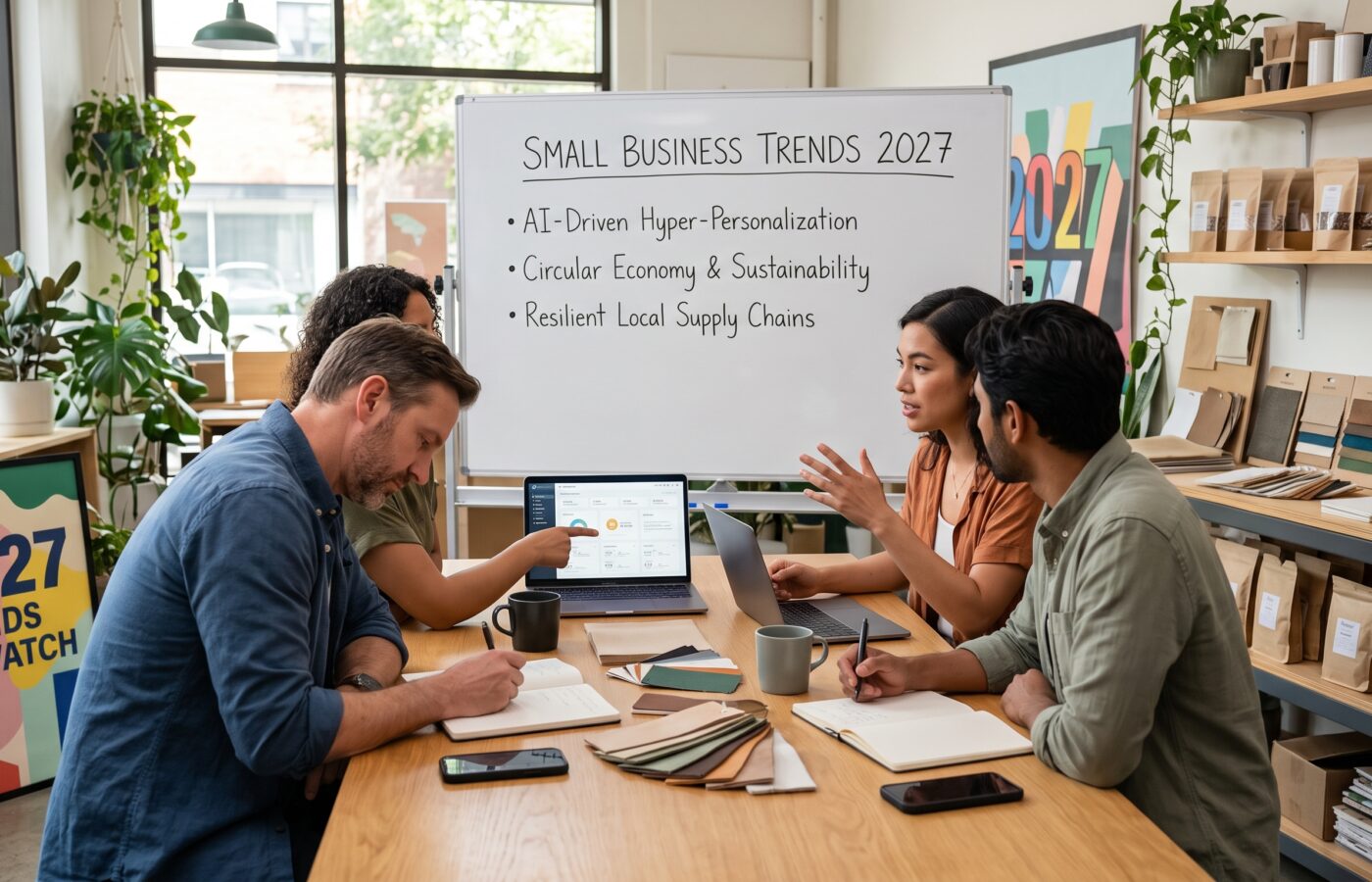
7 Small Business Trends to Watch in 2027

Every fall, around the time my clients start building next year’s budget, I get the same question in some form: “What should I be paying attention to?” These days that question is really about the small business trends 2027 will bring, and it usually comes right after a long sigh.
I understand the sigh. The last few years have asked a lot of small business owners. Costs climbed, customers changed how they buy, and every software vendor on earth started promising that artificial intelligence would fix everything. Most owners I advise don’t want another prediction list. They want to know which shifts will actually show up in their numbers and which ones they can safely ignore.
So this is not a list of buzzwords. These are the small business trends 2027 is likely to reward or punish, based on the data I trust and on what I see in the businesses I work with every week: contractors, retailers, clinics, agencies, restaurants, and a few family firms that have been around longer than I have.
The Mood Behind Small Business Trends 2027
Before we get into it, a quick read on the mood. Owners are cautious but not scared. The U.S. Chamber’s Q3 2026 Small Business Index found that seven in ten small businesses reported good business health, with the Index improving to 70.5, though owners remain cautious due to inflation and cost concerns. The NFIB data tells a similar story. Its Small Business Optimism Index dropped in August to 98.7 but stayed above the 52 year average of 98.0, while the Uncertainty Index sat at 89, well above its historical average of 68.
Translation: business is decent, but nobody feels sure about what comes next. That combination tends to separate the owners who plan from the owners who react. Here is what I would plan around.
1. AI Stops Being a Side Project
For most of 2024 and 2025, AI in small businesses looked like this: one curious person on the team used a chatbot to write emails, and everyone else quietly ignored it. That phase is over.
According to the Chamber’s fifth annual Empowering Small Business report, AI adoption among small businesses jumped from 23% in 2023 to 66% today, with owners using it for marketing, customer service, and daily workflow management. That is not early adopter territory anymore. It is the majority.
Why AI Is Adding Jobs, Not Cutting Them
Here is the part I find more interesting. Small businesses using AI were 10% more likely to have added headcount in the past year than peers that don’t use it. I hear the fear that AI replaces staff in almost every planning session. What I actually see on the ground is that AI absorbs the tedious work, and owners redeploy people toward selling, serving, and fixing things.
One of my clients runs a six person HVAC company. Last spring his office manager was spending close to two full days a week on quotes, follow up emails, and scheduling confirmations. We set up a simple AI assisted workflow that drafts quotes from technician notes and sends reminder messages automatically. She now spends that time calling past customers about maintenance plans. Maintenance plan signups went up enough that he hired another technician in August.
That is the pattern I expect to see more of in 2027. The winners won’t be the businesses with the fanciest tools. They’ll be the ones that pick two or three boring, repetitive processes and let AI handle them well.
Where to Start With AI as Small Business Trends 2027 Take Shape
Start with a time audit. Have everyone on the team write down, for one week, the tasks that feel repetitive. You will find the same four or five things on most lists. Those are your first AI projects, and our guide on how to use AI at work covers practical ways to begin.
Then set rules before you scale. Decide which tools are approved, what customer data can go into them, and who reviews the output. I will come back to why that matters in trend number four.
2. Pricing Becomes a Strategic Skill Again
For a long stretch, many small businesses treated pricing as something you revisited once a year, if that. Costs were predictable enough that a small annual bump did the job. That world is gone, and I don’t expect it back in 2027.
In the Chamber’s Q2 2026 survey, the share of owners citing inflation as their top concern jumped from 48% a year earlier to 57%. And owners are acting on it. NFIB reported that a net 36% of small business owners raised average selling prices in its May 2026 survey, the highest reading since March 2023.
Why Across the Board Price Hikes Backfire
The problem is that most small businesses raise prices the way you rip off a bandage: all at once, across the board, with an apologetic email. That approach leaves money on the table and annoys loyal customers at the same time.
NFIB’s chief economist pointed out that unpredictable fuel price hikes are harder for small firms to pass on to customers than they are for larger corporate competitors. That is exactly why pricing needs to become a skill, not an event.
Smarter Pricing for Small Business Trends 2027
Know your margin by product or service line, not just overall. I regularly find businesses where one service line is quietly losing money and the rest are covering for it. You cannot price well if you don’t know which is which.
Build in smaller, more frequent adjustments. Customers tolerate a modest change twice a year far better than one large jump.
Use packaging instead of discounting. Bundles, tiers, and service plans let you protect margin while giving customers a sense of choice. A landscaping client of mine replaced ad hoc pricing with three seasonal packages. His average ticket rose and his customer complaints dropped, because people finally understood what they were paying for.
Watch your surcharges. Fuel and material surcharges can work, but if they become permanent fixtures, customers start to resent them. Fold them into your base price when the cost stabilizes.
If I had to name one financial habit that will separate strong small businesses from struggling ones in 2027, it would be this: reviewing pricing every quarter with real cost data in front of you.
3. The Great Ownership Transfer Creates a Buyer’s Window
Of all the small business trends 2027 will bring, this is the one I think most people underestimate, and it is one I spend more and more of my time on.
A huge number of small business owners are approaching retirement, and many have no real plan for what happens next. McKinsey’s February 2026 report, “The Great Ownership Transfer,” estimates that about six million small and medium size businesses will face ownership transitions by 2035 as baby boomers retire. The same research found that one in four small business owners is 65 or older, and estimated that annual exits could reach as many as 665,000 per year by 2035, up to 42% above 2011 levels.
Why So Many Profitable Businesses Simply Close
What happens to those businesses today is sobering. Research from Washington University’s Olin Business School found that in 2022, about 92% of small business exits nationally happened through closure, with only 5% through sales and 3% through transfers to new owners.
Think about that. Profitable companies with loyal customers, trained staff, and decades of reputation are simply closing because nobody planned the handoff.
What Small Business Trends 2027 Mean for Buyers and Sellers
This trend cuts two ways.
If you are a buyer, 2027 may be one of the best windows in a generation to acquire a working business instead of starting a small business from zero. A business with existing revenue, a customer list, and equipment can be a far safer bet than a new launch. Many sellers are open to creative deal structures, including seller financing, because their alternative is closing the doors.
If you are an owner thinking about exiting in the next five to ten years, the work starts now, not the year you want to retire. Buyers pay for businesses that run without the owner in the room. That means documented processes, clean books, a team that can make decisions, and customer relationships that don’t all live in your head or your phone.
How to Make Your Business Worth Buying
I once worked with a print shop owner who wanted to sell within eighteen months. The business was profitable, but he personally handled every major account, every vendor relationship, and every pricing decision. Two potential buyers walked away after due diligence for the same reason: they were buying a job, not a business. We spent the next two years building a management layer. He sold at a much better number than he would have gotten the first time around.
If you take one action from this section, schedule a conversation with your accountant about what your business would actually be worth today, and what would make it worth more.
4. Security Turns Into a Selling Point
I used to file cybersecurity under “important but dull.” Clients nodded, then moved on to topics they found more exciting. That changed when I watched a client lose nearly three weeks of operations to a ransomware attack that started with one stolen password.
The data backs up what I’ve seen. The 2026 Verizon Data Breach Investigations Report found that small organizations made up 96% of ransomware victims. Criminals target small businesses not because they are interesting, but because they are easier.
The AI Data Leak Most Owners Miss
There is a newer wrinkle that connects directly to trend number one. The same report found that 67% of users access AI services through non corporate accounts on work devices, exposing business data, customer information, and intellectual property to public platforms. In plain terms, your employees may be pasting customer details into personal AI accounts right now, and you would never know.
Why Security Belongs Among Small Business Trends 2027
Here is why I call this a selling point and not just a risk. Larger customers increasingly ask their small vendors about security before signing contracts. Insurance carriers are asking harder questions at renewal. A small business that can show basic, documented security practices wins trust and sometimes wins the deal outright.
The Security Basics That Get You Most of the Way
Turn on multifactor authentication for email, banking, accounting software, and anything that holds customer data. This one step closes a large share of the easy doors.
Back up critical data and actually test the restore. A backup you have never restored is a hope, not a plan.
Write a one page AI and data policy. List the approved tools, what data is off limits, and who to ask when unsure.
Train your team twice a year on phishing. It takes an hour and it pays for itself the first time someone pauses before clicking. Our guide on how to spot a phishing email makes a good starting point for that session.
None of this requires a big budget. It requires an owner who decides it matters.
5. Overhead Goes Variable
The second the economy feels uncertain, I watch owners look hard at their fixed costs. In 2027, I expect more of them to design their businesses so that costs flex with revenue rather than sitting there month after month regardless of how sales go.
The clearest example is space. One 2027 forecast argues that most growing small businesses will treat traditional long term leases as a last resort rather than a status symbol. I think that is directionally right. Many of my professional services clients now run with a small core office, shared meeting rooms when needed, and staff who split time between home and site, which makes staying productive working from home a real operating skill.
Variable Costs Beyond Office Space
But space is only one piece. Variable overhead also means:
- Software you can scale down. Monthly plans over annual contracts when you aren’t sure of the fit, and a quarterly review of every subscription. I routinely find businesses paying for three tools that do the same job.
- Specialists on retainer instead of on payroll. Bookkeeping, marketing, IT support, and HR compliance often make more sense as fractional services until volume justifies a full time hire.
- Equipment leasing or sharing where ownership doesn’t create a real advantage.
Flexible Costs and Small Business Trends 2027
The goal is not to be cheap. It’s to be resilient. A business with mostly variable costs can absorb a slow quarter without panic layoffs or emergency loans. Companies locked into heavy fixed costs have very little room to breathe when sales dip.
One caution: variable overhead can drift into chaos if nobody owns it. Assign someone to track every recurring cost and review the list every quarter. Otherwise “flexible” quietly turns into “forgotten.”
6. Small Teams With Bigger Output
Labor remains one of the hardest parts of running a small business. Good people are hard to find, harder to keep, and expensive to replace. What I see in 2027 is not a hiring freeze but a hiring shift: fewer roles, better defined, with more support around each person.
Technology plays a big part. Salesforce surveyed 3,350 small business leaders worldwide for its Small and Medium Business Trends Report and found that 76% of small businesses adopting smart technology trends are growing. Other research compiled from Chamber data shows that 54% of small businesses already use AI marketing tools, with another 27% planning to adopt them within 12 months.
How Lean Teams Fit Small Business Trends 2027
But tools only matter if the people using them are well trained and clear on their roles. The small teams I see thriving share a few habits.
Every role has a written outcome. Not a list of tasks, but a clear statement of what success looks like. People perform better when they know what they’re aiming for.
Owners invest in cross training. In a team of eight, losing one person to illness or resignation can stall an entire function. Two people who can cover each critical task is the minimum.
Wellbeing is treated as an operating issue. In an Entrepreneur piece on 2027 business trends, Jason Brown argued that the most successful organizations will understand that healthy people build healthy businesses. I agree. Burnout in a small team doesn’t stay contained. It spreads to customers within weeks.
Hiring With Intent Instead of in a Panic
The worst hires I’ve seen were made in a panic after someone quit. Keep a short list of people you’d love to hire someday, even when you’re not hiring. When a role opens, you start with warm candidates rather than a blank job board.
Lean doesn’t mean overworked. The small teams that win in 2027 will be lean because they removed waste, not because they piled more onto fewer people.
7. Community Beats Reach
Advertising costs keep rising, social media reach keeps shrinking, and customers are more skeptical than ever. In that environment, the businesses I watch outperform are the ones that build genuine community around what they do.
Jason Brown expects successful businesses in 2027 to focus more heavily on creating ecosystems where customers can learn, connect, collaborate, and grow together. That sounds lofty, but in a small business it often looks simple.
What Community Looks Like in a Small Business
A hardware store I advise started hosting a free Saturday morning workshop on basic home repairs. Attendance began with a handful of regulars. Within six months it became a waiting list, and workshop attendees spend noticeably more than the average customer. The store didn’t spend a dollar more on ads. It just gave people a reason to show up and talk to each other.
Community Building Ideas That Work
Owned audiences over rented ones. An email list or text list you control is worth far more than followers on a platform that can change its rules overnight.
Customer events, even tiny ones. An open house, a client appreciation lunch, a quarterly briefing for your best accounts.
Local partnerships. Two complementary businesses cross promoting to each other’s customers. A florist and a bakery. An accountant and a financial planner. A gym and a physical therapy clinic.
Visible owners. Customers want to know who is behind the business. Short videos, a personal note in the newsletter, or simply being present on the floor builds trust that no campaign can buy.
Where Online Sales Fit Into Small Business Trends 2027
Online sales still matter, of course. Statista projects ecommerce will reach 22.6% of total retail sales worldwide by 2027. But even online, the stores that keep customers coming back are the ones that feel like a place people belong, not just a checkout page.
How I Would Prepare for Small Business Trends 2027 in the First Quarter
If you’re feeling a little overwhelmed by all seven of these, that’s normal. You don’t need to tackle everything at once. Here’s the sequence I suggest to most clients:
- January: Review pricing and margins by product or service line. Identify your two weakest margin areas.
- February: Run the time audit and pick two repetitive processes for AI support. Write your one page AI and data policy at the same time.
- March: Turn on multifactor authentication everywhere, test your backups, and review every recurring cost on your books.
- Ongoing: If you’re within ten years of retirement, start succession conversations now. If you’re a buyer, start talking to business brokers and your bank about acquisition financing.
- All year: Pick one community building activity and do it consistently. Consistency beats ambition here.
The owners who handle small business trends 2027 well won’t be the ones who predicted every shift perfectly. They’ll be the ones who made a handful of sensible moves early and kept adjusting as the year unfolded. That has been true in every uncertain year I’ve seen, and I don’t expect next year to be any different.
Frequently Asked Questions About Small Business Trends 2027
What are the biggest small business trends 2027 has in store?
Of all the small business trends 2027 will bring, the ones I would watch most closely are embedded AI in daily workflows, more disciplined pricing, the wave of retiring owners selling their businesses, cybersecurity as a trust factor, flexible overhead, lean but well supported teams, and community driven marketing. The Chamber’s latest data on AI adoption is a good starting point: U.S. Chamber Empowering Small Business Report.
Is AI going to replace jobs at small businesses in 2027?
The evidence so far points the other way. Small businesses using AI were more likely to add headcount over the past year than those that don’t. AI tends to absorb repetitive tasks so staff can focus on selling and service. Source: U.S. Chamber of Commerce.
Should small businesses keep raising prices in 2027?
That depends on your margins by product or service line. Many owners raised prices in 2026, but smaller, more frequent adjustments and smart packaging usually work better than one large increase. See the latest owner sentiment at NFIB via Trading Economics.
Is 2027 a good time to buy an existing small business?
For many buyers, yes. Millions of owners are nearing retirement and most exits currently end in closure rather than sale, which creates opportunities for prepared buyers. Read more in the Olin Business School research on ownership transitions.
How can a small business protect itself from ransomware?
Start with multifactor authentication, tested backups, regular phishing training, and a clear policy on which AI tools employees may use. Small organizations make up the vast majority of ransomware victims. Details: Cyber Readiness Institute summary of the 2026 Verizon DBIR.
How do I know if my small business is ready to be sold?
A sellable business runs without the owner making every decision. Documented processes, clean financials, a capable team, and spread out customer relationships all raise value. The McKinsey findings are summarized here: Great Ownership Transfer overview.
References
- U.S. Chamber of Commerce. The Chamber’s Free Enterprise Opportunity Tour Rolls Into Detroit With Groundbreaking New Data on How AI Is Creating Small Business Jobs. October 2, 2026.
- U.S. Chamber of Commerce. Small Business Index Q3 2026.
- U.S. Chamber of Commerce. Small Business Index Q2 2026.
- U.S. Chamber of Commerce. Small Businesses Show Resilience as Owners Look Ahead to Growth. July 15, 2026.
- JM Financial Services. US NFIB Small Business Optimism Index Drops but Remains Above Long Term Average. September 8, 2026.
- Trading Economics. US Small Business Optimism Hits Highest Level in Nearly a Year. August 11, 2026.
- Washington University Olin Business School. Silver Tsunami: Ownership Transitions. July 2026.
- Beancount. The Great Ownership Transfer: What McKinsey’s 6 Million Small Business Transitions Mean for Owners by 2035. August 13, 2026.
- MEXC News (via Forbes). $5 Trillion Worth of Baby Boomer Businesses Set to Be Transferred, Report Says. February 2026.
- Cyber Readiness Institute. 2026 Verizon Cyber Report: Small Businesses Face Escalating Cyber Threats.
- Verizon Business. 2026 Data Breach Investigations Report.
- Salesforce. Small and Medium Business Trends Report.
- Capsule CRM. Small Business AI Adoption Statistics for 2026. April 24, 2026.
- Entrepreneur. The 3 Most Exciting Business Trends Jason Brown Sees Coming in 2027.
- Davinci Meeting Rooms. Small Business Trends Forecast for 2027.
- Lovable. Top 10 Small Business Trends Shaping 2026 and Beyond.