

The Future of Remote Work in America: What the Data and the Field Say
I have spent the better part of the last six years walking through half empty office floors across the United States with executives who were trying to figure out what to do with them, and more broadly, what the future of remote work would mean for their business. Some of those walks were awkward. A managing director in Chicago once stood beside me in a beautifully renovated workspace, rows of standing desks untouched, and asked me quietly, “Did we build this for nobody?” He had not. But he had built it for a version of work that no longer existed.
That question sits at the center of every conversation I have about the future of remote work in America. Most leaders are not asking whether remote work will survive. That debate is over. They are asking something harder: what kind of organization do we want to be now that location is a choice rather than a given?
This piece is my attempt to answer that from the field. I will share what the US data says, where I think it is being misread, and what I am seeing inside American companies that are getting this right. I will also be honest about where I think things are going wrong, because there is plenty of that too.
Why the Future of Remote Work Looks Stable
For a while, every quarter brought a dramatic headline. Remote work was booming, then it was dying, then the office was back, then it was not. If you followed only the news cycle, you would think the American workplace was in constant upheaval.
What the Numbers Say About the Future of Remote Work
The actual data tells a quieter and more useful story. Gallup estimates that remote capable jobs make up roughly half of the US workforce. Among those employees, according to its Hybrid Work Indicator, 52% work hybrid, 26% work exclusively remote, and 21% work fully on site. Those numbers have barely shifted in years. Gallup has noted that since 2022, location data has shown little volatility, which signals that hybrid work has become an established fixture. Hybrid employees, by Gallup’s count, spend about 46% of their week on site, or roughly 2.3 days.
Stability Is the Real Signal for the Future of Remote Work
Stability is not exciting, so it rarely makes headlines. But for anyone doing workplace planning, stability is the most important signal we have had in a long time. It means the experimental phase is finished. We are no longer reacting to a crisis. We are designing for a permanent condition.
Nick Bloom at Stanford, who has studied this longer than almost anyone, has been saying the same thing for a while. In an Allwork.Space interview, he pointed out that despite headlines claiming remote work is dead or slowing down, his data shows it has stabilized. In my client work, I see exactly that. Companies that keep rewriting their policy every six months are not responding to a changing world. They are responding to their own anxiety.
What Workers Want From the Future of Remote Work
Here is something I tell every leadership team before we start any workplace strategy engagement: flexibility is not a perk anymore. It is part of the compensation package, whether you price it that way or not.
Flexibility as a Retention Factor
Gallup reports that six in 10 American employees with remote capable jobs want a hybrid work arrangement. More striking is what happens when you take flexibility away. Six in 10 remote capable employees who work exclusively remotely say they are extremely likely to look for a new job if that flexibility is removed.
The FlexJobs data pushes this even further. In its 2026 trends report, 85% of workers said remote work now matters more than salary when evaluating a job, and 69% said they would accept a pay cut for remote work, an 11% increase from 2024.
Flexibility Has a Price Tag
I want to be careful here. Survey responses about hypothetical pay cuts do not always match what people do when the offer letter is in front of them. But Bloom’s research gives us a more grounded figure. His work shows that people value the ability to work from home two or three days a week at about the same level as 8% more pay.
Think about what that means for a moment. If you employ 500 people at an average salary of $60,000 and you remove hybrid flexibility, you have effectively cut their compensation by millions of dollars in perceived value. Some will absorb it. Your best people, the ones with options, will not. Any honest conversation about the future of remote work has to start with that reality.
Return to Office and the Future of Remote Work
Now for the other side. There is no question that large US employers have tightened up, but the story is more complicated than the headlines suggest.
Large Employers Are Tightening Mandates
The Flex Index found that 29 of the Fortune 100 companies have full time, five day office policies, and 44 require four or five days. Across the broader Fortune 500, 24% now require full time office attendance. Savills Research, analyzing the top 200 Fortune 500 companies, found that 27% follow an office first model, up from 24% in 2025, while remote first approaches declined to 1.5%.
So the biggest names in corporate America are pulling people back. That part of the story is real.
The Gap Between Policy and Behavior
But here is what I find genuinely fascinating, and what I wish more boards understood. According to the Flex Index Q3 2025 report, the average number of days required by US company policy went up 10% in the last year, but actual office usage only went up 2 to 3%.
Read that again. Policies became stricter. Behavior barely changed.
I see this gap in nearly every organization I work with. The policy says three days. Badge data says a little under two. Managers quietly look the other way because enforcing the rule would mean losing a high performer or spending every Monday morning in confrontational conversations. What you end up with is the worst of both worlds: a rule that nobody believes in and a culture that learns to treat company policy as theater.
Brian Elliott, who publishes the Flex Index, has stressed that mandates and badge swipes are surface level metrics, and what matters is whether office time creates measurable business value. I could not agree more. In my experience, the moment a company starts measuring compliance instead of outcomes, it has already lost the plot.
The Hidden Talent Cost
There is also a talent cost that rarely shows up in the quarterly numbers. Mark Ma, an associate professor at the University of Pittsburgh, has found that highly skilled employees are significantly more likely to leave following strict return to office mandates, and senior employees are more likely to exit than junior ones. His research also suggests these mandates fall hardest on working parents, caregivers, and people with disabilities who rely on workplace accommodations. You do not lose the people who are easy to replace. You lose the ones who carry institutional knowledge in their heads.
What Productivity Evidence Says About the Future of Remote Work
Whenever I present to a leadership team, someone eventually says, “But are people actually working when they are home?” It is a fair question, and it deserves a real answer rather than a defensive one.
What the Stanford Trial Reveals About the Future of Remote Work
The strongest evidence we have comes from a randomized controlled trial led by Stanford’s Nick Bloom, which is about as rigorous as workplace research gets. As the British Psychological Society summarized, Bloom and his coauthors studied 1,612 graduate employees at Trip.com who were randomly assigned for six months to either five days on site or a hybrid schedule of three days onsite and two days at home. The hybrid group reported greater job satisfaction and better work life balance, and resigned at a rate 33% lower than the fully onsite group.
And performance? Stanford Report noted the study found that hybrid work had zero effect on productivity or career advancement while dramatically boosting retention. The company estimated that the reduced attrition saved it millions of dollars, and it now allows hybrid work companywide.
Who Benefits Most From Hybrid Work
One more detail matters here, because it is about who benefits most. The NeuroLeadership Institute highlights that the reduction in quit rates was particularly strong for non managers, women, and employees with long commutes. For any American employer competing for talent in metro areas with brutal commutes, that finding should land hard.
Where Fully Remote Falls Short
Now, I am not going to pretend that fully remote work is a perfect answer either. Microsoft’s 2025 Work Trend Index found that cross team collaboration scores drop 17% in fully remote settings compared to hybrid. Remote work is excellent for focused individual output, especially for people who have learned how to stay productive working from home. It is weaker for the messy, spontaneous collaboration that produces new ideas and teaches junior people how the business really works. Bloom has a good way of putting this: speaking with the Templeton World Charity Foundation, he likens working from home to “beer or wine: good in moderation.”
Five Shifts That Will Define the Future of Remote Work
Based on the data and on what I am seeing inside American client organizations, here is where I believe the future of remote work is actually heading.
1. Hybrid Becomes Designed, Not Defaulted
The first era of hybrid was improvised. Companies picked a number of days, usually three, and called it a strategy. That is fading. The organizations doing well now are designing hybrid around the work itself rather than around a calendar.
What does that look like? A product team might come together for two intense days at the start of each sprint, then disperse. A finance team might gather only during close. A sales team might meet monthly for pipeline reviews and otherwise work wherever their clients are. The office becomes a tool you use deliberately, not a place you report to out of habit.
Savills found that nearly 90% of the Fortune 500 companies it studied kept their existing workplace structures, which suggests hybrid work is no longer in flux but in refinement. That word, refinement, is exactly right. The next five years will be about tuning, not reinventing.
2. AI Changes What “Being Present” Means in the Future of Remote Work
This is the shift I think most leaders are underestimating. The conversation about remote work has always been about where people sit. Increasingly, it will be about how work gets done, and AI is rewriting that.
Microsoft’s 2026 Work Trend Index found that only 19% of AI users are in what it calls the Frontier zone, where organizational capability and individual readiness reinforce each other. The same report found that 58% of AI users say they produce work they could not have completed a year earlier, rising to 80% among the most advanced users.
Why does this matter for the future of remote work? Because much of the old argument for office presence was about visibility and coordination. If agents handle more of the routine execution, the human work that remains is judgment, relationships, and creative problem solving. Some of that genuinely benefits from being in a room together. Much of it does not. I expect the office to become even more specialized: a place for trust building and complex decisions, while execution increasingly happens wherever the person and their tools happen to be. If your team is still early on this curve, our guide on how to use AI at work is a practical place to start.
There is a caution here too. Microsoft found only one in four AI users believe their leadership is consistently aligned on AI strategy. In my work, I see the same misalignment around hybrid policy. Companies that cannot agree on how AI fits into work will struggle to agree on where work should happen.
3. Smaller and Younger Firms Win the Talent War
There is a growing split between large enterprises and everyone else. Giant firms are tightening mandates. Smaller and newer firms are leaning into flexibility and using it as a recruiting weapon.
New data from the Flex Index shows that US firms embracing full flexibility grew revenues 1.7 times faster than their mandate driven peers between 2019 and 2024, even after adjusting for industry and size. Bloom’s team at WFH Research has also published research showing that younger firms and CEOs allow more work from home.
I have watched this play out in hiring. A mid sized software company I advised in Austin lost three senior engineering candidates in a row to a large bank’s offer, until they started advertising their remote first policy prominently. Within a quarter, they were landing people who had turned the big firms down. Flexibility is one of the few advantages a smaller company can offer that a larger competitor cannot simply outspend, and it is one of the small business trends for 2027 worth watching closely.
4. Management Becomes the Real Bottleneck
Here is an uncomfortable truth I share with almost every client: most remote work problems are management problems in disguise.
When a manager complains that their team is not productive at home, I usually ask a few questions. Are goals written down? Does the team know what good work looks like? Are one on ones happening regularly? More often than not, the answer reveals that the manager was relying on physical proximity to compensate for unclear direction. Remove proximity, and the cracks show.
Gallup has flagged a related concern. Its strategic guide to managing hybrid and remote teams shows that remote capable employees have an eroding connection to the mission or purpose of their organization. That is not a location problem. It is a leadership and communication problem that location has exposed.
The future of remote work belongs to organizations that invest seriously in management capability: teaching people how to set clear expectations, run effective asynchronous work, and build connection on purpose rather than by accident.
5. The Future of Remote Work Splits by Sector
Remote work in the United States is no longer moving in one direction. It is splitting by sector, and the gap is getting wider.
The federal workforce is the clearest example of a pullback. After the administration that took office in 2025 curtailed remote work across government roles, Gallup found that hybrid participation among federal workers fell from 61% in late 2024 to 28% by the second quarter of 2025. That is one of the sharpest swings in any segment of the American workforce since the pandemic.
Technology is heading the other way. Gallup reports that in tech, 47% of workers are fully remote and 45% are hybrid, while only 9% work entirely on site. Between those two poles sit finance, healthcare administration, professional services, and dozens of other industries, each settling into its own norm.
What this means for employers is simple. Workers now compare flexibility across sectors the same way they compare salary and benefits. A federal analyst with technical skills can see exactly what a private tech firm offers, and many are making that move. Your remote work policy is no longer judged against your direct competitors alone. It is judged against every employer chasing the same skills.
The Hard Problems Facing the Future of Remote Work
I would be doing you a disservice if I painted the future as entirely rosy. There are real problems that the data and my own fieldwork keep surfacing.
Isolation and Wellbeing
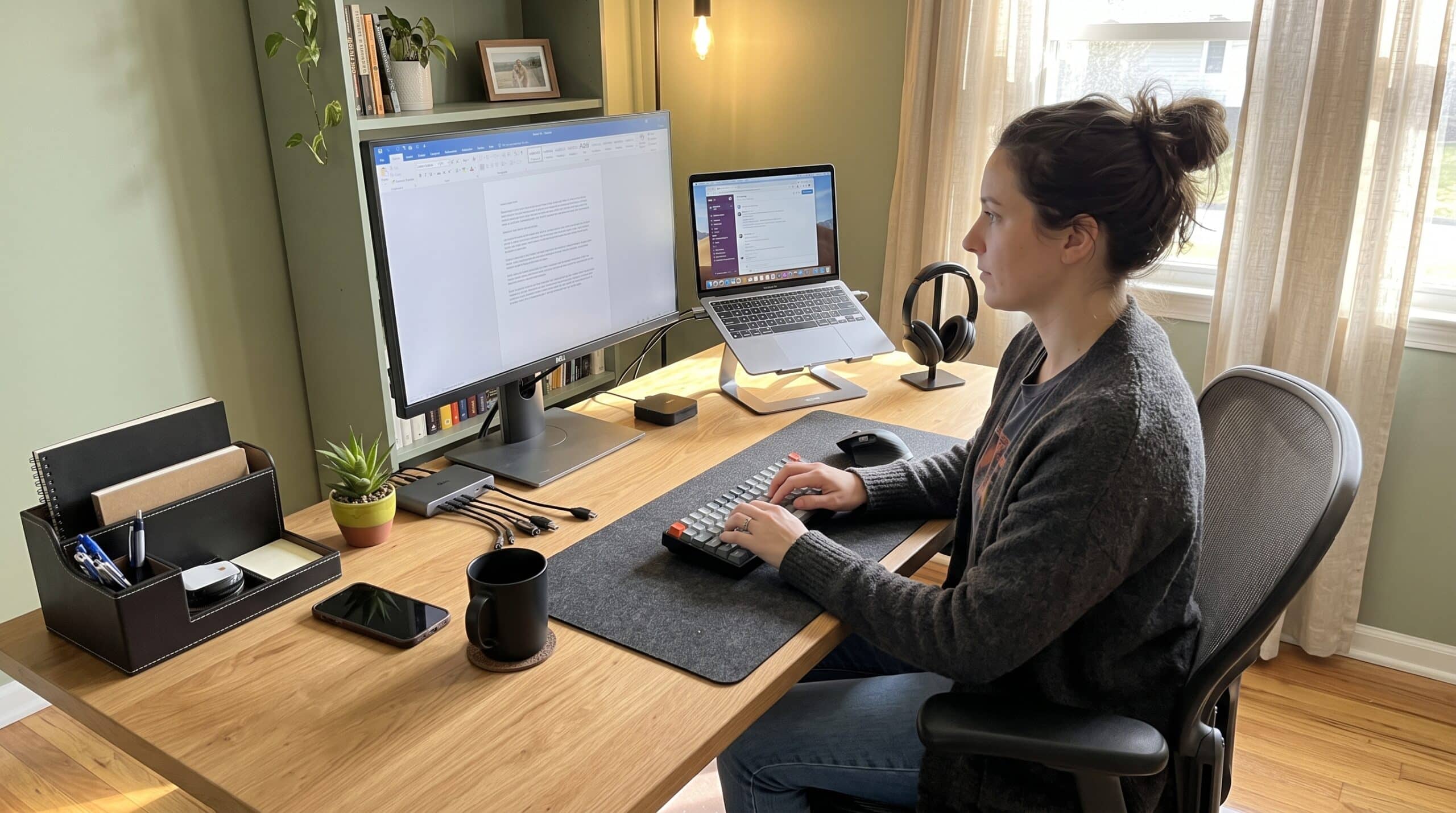
Gallup has described a “Remote Work Paradox,” in which remote workers show higher engagement but also higher distress scores than their in office peers. I see this often. People love the autonomy, but some quietly struggle with loneliness, blurred boundaries, and the feeling that their work disappears into a void. A deliberate morning routine and a proper home office setup help individuals draw those boundaries, but companies that ignore the problem will see it surface later as burnout.
Early Career Development in the Future of Remote Work
This is the one that worries me most. Junior employees learn by overhearing, by watching how senior people handle a difficult client call, by asking a quick question across a desk. Remote setups can starve them of that. The fix is not forcing everyone back. It is deliberately creating apprenticeship moments, pairing junior people with mentors, and making sure in person days are used for learning rather than for sitting on video calls in a different building.
Fairness Between Groups
When some people are in the room and others are on a screen, the people in the room tend to get more attention, more credit, and more opportunity. Hybrid can quietly recreate a two tier workforce. Good organizations set norms to prevent this, such as running meetings as if everyone is remote whenever even one person is.
Real Estate That No Longer Fits
Plenty of American companies still hold downtown leases sized for a five day world. Those spaces feel hollow, which ironically makes people less likely to come in. The answer usually involves less space, but better space: more rooms for collaboration, fewer rows of assigned desks.
How to Prepare Your Organization for the Future of Remote Work
When clients ask me where to start, I give them a short list. It is not glamorous, but it works.
Start With the Work, Not the Policy
Map what your teams actually do. Which activities need people together? Which are better done alone? Let that drive your schedule rather than picking a number of days out of the air.
Measure Outcomes, Not Attendance
If you are tracking badge swipes more carefully than you are tracking customer results, your priorities are upside down. Define what success looks like for each team and judge them on that.
Make the Office Worth the Commute
If someone sits in traffic for ninety minutes only to spend the day on video calls, you have given them a reason to resent the office. Coordinate in person days so the right people are there at the same time, and plan those days around activities that truly benefit from being together.
Invest in Managers
Your managers are the ones who will make hybrid succeed or fail. Train them in clear goal setting, feedback, and running distributed teams. This is the single highest return investment I see clients make.
Secure the Distributed Setup
Remote and hybrid teams depend on cloud tools and home networks, so make sure people understand basics like the differences between a VPN and a proxy before sensitive work leaves the building.
Be Honest and Consistent
Nothing destroys trust faster than a policy that leadership itself ignores. If executives demand three days in the office and then work from their vacation homes, employees notice. Apply the rules fairly or do not have them.
Revisit, but Do Not Thrash
Review your approach once or twice a year with real data. Avoid the temptation to change course every time a competitor announces a new mandate.
Final Thoughts on the Future of Remote Work
Back to that managing director standing in his empty Chicago office. We did not tear the space down. Instead, the plan was a redesign. Together, his team and I cut the desk count by almost half, built more rooms for project teams, and created a clear rhythm for when each department gathers. Attendance did not go to five days. It did not need to. What changed was that when people came in, they came in for something worth showing up for.
That, to me, is the real future of remote work in America. It is not a fight between the home and the office. It is a slow, deliberate shift toward choosing where work happens based on what the work requires. Organizations that understand this will hire better, keep their people longer, and get more out of every square foot they pay for. Those still fighting the last war will keep wondering why their best people keep leaving.
For years, the data has been telling us exactly this. Whether leaders are ready to listen is now the only open question.
Frequently Asked Questions About the Future of Remote Work
What is the future of remote work in the United States?
Hybrid work is settling in as the dominant long term model for American workers in remote capable jobs, with fully remote and fully on site arrangements each holding a smaller share. Gallup’s tracking shows these proportions have stayed remarkably stable since 2022. You can follow the latest figures on the Gallup Hybrid Work Indicator.
Is the future of remote work at risk from return to office mandates?
No. Large US companies have tightened policies, but actual office attendance has risen only slightly compared to how much mandates increased. The Flex Index Fortune 100 report shows hybrid remains the most common model even among the biggest employers.
Does hybrid work hurt productivity?
The best available evidence says no. A Stanford led randomized controlled trial of more than 1,600 employees found hybrid work had no effect on productivity or promotions and reduced quit rates by about a third. Read the summary from Stanford Report.
How will AI affect the future of remote work?
AI is shifting human work toward judgment and decision making while agents take on more routine execution, which reduces some of the old arguments for constant office presence. Microsoft’s research on this shift is available in the Work Trend Index.
How much do employees value remote flexibility?
A great deal. Research from Stanford economist Nick Bloom suggests workers value two or three days of working from home roughly as much as an 8% pay raise. Hear more in this Allwork.Space interview with Nick Bloom.
Are US federal employees still working remotely?
Far fewer than before. Gallup found that hybrid participation among federal workers dropped from 61% in late 2024 to 28% by the second quarter of 2025 after the government curtailed remote work. See the breakdown from HR Grapevine on Gallup’s hybrid data.
References
- Gallup. Hybrid Work Indicator
- Gallup. How to Manage Hybrid and Remote Teams: A Gallup Strategic Guide
- Gallup. Hybrid Work in Retreat? Barely
- HR Grapevine. Gallup Data Shows Return to Office Mandates Stalling
- Stanford Report. Hybrid Work Is a Win for Companies and Workers
- British Psychological Society. Hybrid Workers Are More Satisfied, Quit Less Than Onsite Workers
- NeuroLeadership Institute. Hybrid Work Improves Employee Retention Without Affecting Performance
- WFH Research. Research and Policy
- Templeton World Charity Foundation. The Work From Home Revolution with Nicholas Bloom
- Allwork.Space. Remote Work in 2030 with Nick Bloom
- Flex Index. 67 of the Fortune 100 Are Hybrid
- Flex Index. Q3 2025 Flex Report
- Savills Research. Mandates, Flexibility and the Future of Work: A Fortune 500 Perspective
- Allwork.Space. 55% of Fortune 500 Companies Now Require Fixed Hybrid Schedules
- FlexJobs. The Future of Remote Work: 2026 Trends Report
- Microsoft WorkLab. Work Trend Index, including the 2026 Annual Report

Daniel Arkwright
Daniel Arkwright is a Certified Business Coach and Advisor who helps founders build smarter plans and stronger businesses.

You May Also Like

How to Write a Business Plan: A Coach’s Step-by-Step Guide (With Free Template)

How to Improve Your Credit Score: 7 Steps That Work